Optical vs Digital Zoom on Drone Cameras: What the Numbers Really Mean
Optical zoom vs digital zoom is the first question to ask about any zoom camera drone. Optical zoom changes the lens. Digital zoom only crops the picture. Hybrid zoom mixes the two, which is why a headline such as 56x does not tell you how much real detail you get. This guide explains how each one works, how focal length and field of view connect, and how to shoot sharp inspection photos from a safe distance.
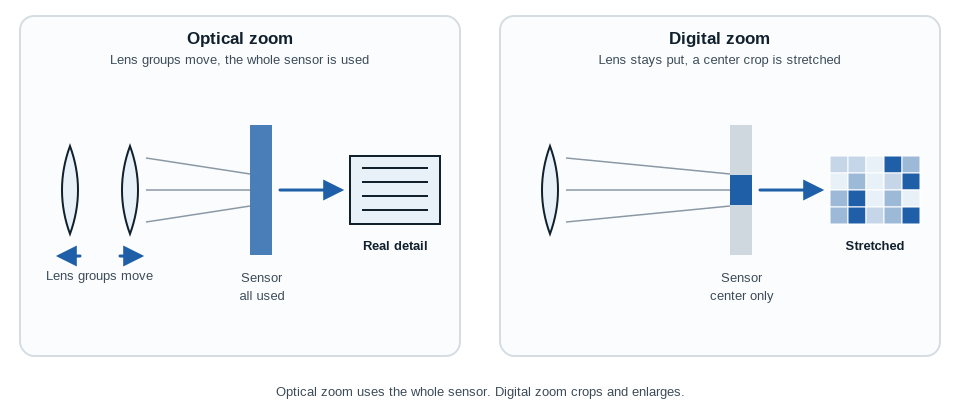
How optical zoom works
Optical zoom moves groups of glass elements inside the lens. This changes the focal length before the light reaches the image sensor. The view narrows and a distant object looks bigger.
The zoomed scene still covers the whole sensor. Every pixel records real detail, and nothing is stretched by software. That is why optical zoom is called lossless.
Telephoto zoom also seems to compress distance, so the background looks closer to the subject. The perspective itself depends on where the camera is. A long lens just cuts out a narrow part of the same view.
Drone hardware comes in two forms.
- Continuous optical zoom. Lens groups move smoothly through a range, as on a dedicated zoom camera payload.
- Dual cameras. Some drones pair a wide main camera with a fixed telephoto camera. The drone switches between them and then adds digital enlargement. That is not continuous optical zoom.
How digital zoom works
With digital zoom the lens does not move. The camera software takes the center of the picture, throws away the edges and stretches what is left back to the full output size. This is called cropping and interpolation, or upscaling.
It is the same as cropping a photo on a computer afterwards. No new detail is captured. Effective resolution falls, and you see blocky pixels, jagged edges and smeared texture. Take 4x digital zoom on a normal sensor. It uses only a small patch at the center and stretches it.
In-sensor crop
Some advice says all digital zoom loses quality. High-pixel sensors are a partial exception. A 48 MP sensor that records 4K video (3840 × 2160) can read the center pixels natively at a low crop, such as 2x, without stretching them. The output is not interpolated.
It still has limits. The light comes through the same main lens, and optical diffraction caps the detail. A separate telephoto lens still resolves more.
How hybrid zoom works
Hybrid zoom chains three steps together. First, the lens zooms optically, or the drone switches between cameras. Second, it crops on the sensor. Third, it applies digital zoom with sharpening, noise reduction, super-resolution or multi-frame fusion.
Within the optical range, the image stays sharp. Past it, quality softens steadily as the magnification rises.
Looking for zoom camera payloads for your inspection or survey work? Ask our team.
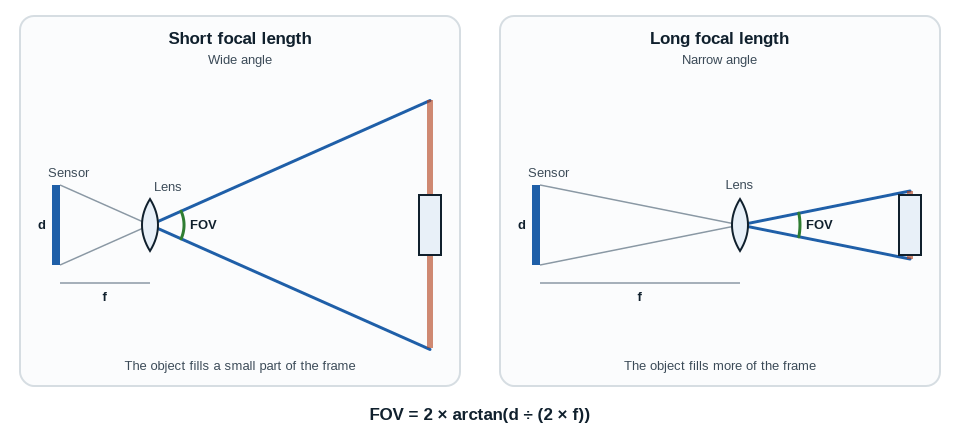
Focal length and field of view
Focal length is measured in millimeters. It sets the field of view (FOV), the angle the camera sees, in degrees.
- A short focal length gives a wide angle.
- A long focal length gives a narrow, telephoto angle.
The angle also depends on sensor size. The formula is:
FOV = 2 × arctan(d ÷ (2 × f))
Here d is the sensor width (for horizontal FOV), height or diagonal, and f is the focal length. Use the same unit for both.
At a set distance D, the width of ground the frame covers is:
FOV width = sensor width × D ÷ f
Drone sensors are small, such as 1/2 inch, 1/1.8 inch or 1/1.7 inch types. They are far smaller than a 35 mm full-frame sensor, which is 36 mm wide. So spec sheets often list both the real focal length and the 35 mm equivalent. The equivalent tells you the view you would get from a full-frame camera. Use it to compare cameras with different sensors.
Optical, digital and hybrid zoom compared
| Feature | Optical zoom | Digital zoom | Hybrid zoom |
|---|---|---|---|
| What changes | Lens elements move, or a telephoto lens is selected | Software crops the sensor center | Optical zoom, then crop and enhancement |
| Sensor pixels used | Whole sensor | Small center area | Whole sensor at first, then less |
| Detail | Real detail, no stretching | Pixelation and blur | Sharp to the optical limit, softer after |
| Added detail | Yes | None | Only inside the optical range |
| Best use | Inspection, identifying defects | Not for judging defects | Wide framing, with details confirmed inside the optical range |
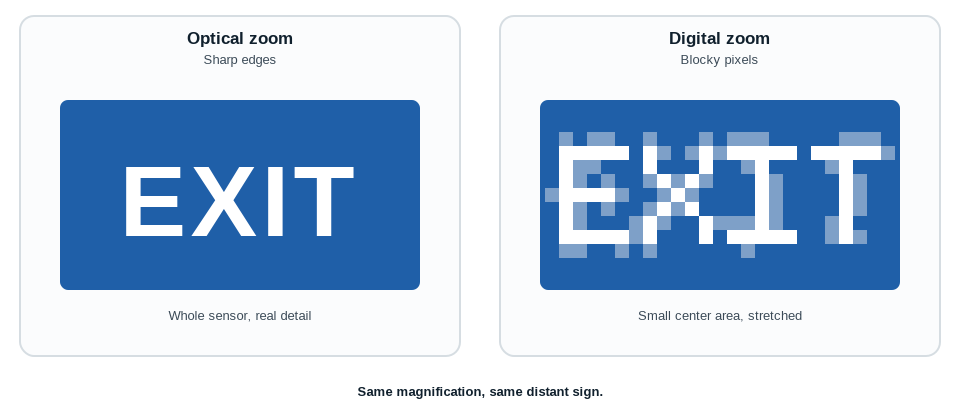
A label such as 56x hybrid zoom, or 200x zoom, multiplies optical magnification by digital crop. Often only the first few steps, or a fixed telephoto lens, are truly optical. Always ask for the true optical zoom figure on its own.
Why zoom matters for inspection
Inspection work depends on ground sample distance (GSD). GSD is the real size on the target that one pixel covers, in mm per pixel. Our ground sample distance guide covers the basics. The formula is:
GSD = distance × sensor width ÷ (focal length × image width)
A longer focal length makes the denominator larger, so GSD gets smaller. The drone can stay farther away and still reach a fine GSD. For structure checks, a target of about 1 to 3 mm per pixel is common for general defects such as corrosion, loose bolts or wider cracks. Hairline cracks are often only 0.1 to 0.5 mm wide, so they need about 0.2 to 0.5 mm per pixel, and no more than 1 mm per pixel.
For example, take a small sensor 6.4 mm wide with an image 4000 pixels wide, and a target 20 m away. A 10 mm focal length gives a GSD of 3.2 mm per pixel. A 30 mm focal length gives about 1.1 mm per pixel. This is an illustrative calculation, not a specification.
Distance matters for safety too. On bridges, power lines, wind turbines, towers and flare stacks, optical zoom lets the drone stay back instead of flying 2 to 5 m from the structure. It can work from 10 to 30 m or more, away from collision risk, rotor wash bouncing off walls and compass interference near large metal structures.
Digital zoom does not make the real GSD smaller. It cuts existing pixels into larger blocks. Inspection guides do not accept pure digital zoom as proof of small cracks or spalling.
Many professional zoom gimbals also carry a laser rangefinder. It measures the distance to the spot you see. With an RTK module and gimbal angles it can turn that spot into map coordinates.
Key specifications
| Parameter | What it means | Typical range | Unit |
|---|---|---|---|
| Optical zoom | Magnification from moving lens groups, or as the maker states it. Dual-camera payloads switch between fixed lenses, and some 23x and 34x gimbal ratings are hybrid optical zoom or are measured from the wide camera | 2–10 (or 5–16) on small or dual-camera payloads; 12, 23, 30, 34–35 on dedicated zoom gimbals | x |
| Hybrid zoom | Optical magnification multiplied by digital crop and enhancement | 20–56 on light inspection drones; 160–200 on larger multi-sensor payloads; up to 560 on long-range gimbals | x |
| Actual focal length | Real lens focal length | About 4.7–56.4 on 12x modules; 4.3–180 on 23x to 34x gimbals | mm |
| 35 mm equivalent | Focal length with the same view on a full-frame camera | About 24 wide; 162 on a fixed telephoto; 24–288 up to 33.4–809.3 on continuous zoom | mm |
| Field of view | Angle covered by the frame | About 60–85.7 at wide end; 15 for fixed telephoto; 2.2–4 at full zoom | degrees |
| Sensor size | Size of the image sensor | 1/3, 1/2.8, 1/2, 1/1.8, 1/1.7 and 1/1.2 | inch |
| Aperture | Lens opening | f/1.6–f/5.2 or f/2.8–f/4.8; adjustable lenses f/2.8–f/11 | f-number |
| Minimum focus distance | Closest sharp distance, longer at the telephoto end | About 0.6–1 at wide; about 1.2–10 at full telephoto | m |
| Shutter speed | Exposure time | Hardware 1/8000–2 (to 30); inspection use 1/500–1/1000 or faster | s |
| ISO | Sensor gain | Hardware 100–25600; inspection use 100–400 | none |
| Gimbal angular vibration | Leftover shake after stabilization | About ±0.002 hovering, ±0.004 flying on high-precision gimbals | degrees |
| Inspection GSD | Pixel size on target | 1–3 for general structural defects; 0.2–0.5 (1 at most) for hairline cracks | mm per pixel |
Optical zoom also affects light. Many zoom lenses let in less light at the long end, so the maximum aperture shrinks as the focal length grows.
How to choose and use zoom for inspection
1. Plan the target GSD and safe distance. Decide the smallest defect you must see, for example 1 to 3 mm per pixel for general defects, or 0.2 to 0.5 mm per pixel for hairline cracks. Decide how far the drone can safely stay. Then work backward to the focal length and optical zoom you need.
2. Prepare the camera. Wipe the lens with a microfiber cloth, because zoom magnifies dust and fingerprints. Calibrate the gimbal on flat ground. Read our guide on how a gimbal works and check the IMU and compass before flying near large metal structures.
3. Slow the gimbal down. Set the pitch and yaw speed low, for example 5 to 10 degrees per second, and soften the stick response. A narrow view makes any wobble hard to settle.
4. Go wide first, then zoom. Frame the whole structure with the wide lens to record context and locate the target. Then zoom in on welds, bolts or cracks. Stay within the pure optical limit, or the native lossless crop range. Do not use high digital zoom to decide whether something is a defect.
5. Hover, then shoot. Stop at the waypoint and wait for gimbal and frame vibration to fade before you trigger the shutter. Shooting while moving sideways or forward causes motion blur.
6. Set a fast shutter and a low ISO. For still inspection photos, use 1/500 to 1/1000 s or faster instead of the video 180-degree shutter rule. Another guide suggests 1 ÷ (2 to 3 × the 35 mm equivalent focal length) for drone vibration. That is 2 to 3 times faster than the plain reciprocal rule. Keep ISO at 100 to 400. If the aperture is adjustable, f/4 to f/8 is a common range. Use manual exposure, fixed white balance and RAW.
7. Check focus. At full zoom the minimum focus distance gets longer, about 1.2 m up to 10 m on some lenses, so stay beyond it. Focus on a high-contrast edge, then switch to manual focus or lock the focus. This stops focus hunting on trusses, mesh or plain walls.
For related payloads, browse aerial photo drones, drone cameras, EO/IR cameras, 3-axis gimbals or the inspection drone and survey drone categories.
Common mistakes
- Treating hybrid or digital zoom as real resolution. At 30x, 56x or more, the screen looks fine, but the saved image looks pixelated. Cracks and bolt numbers blur out. Find the true optical limit and stay within it. If the drone has no optical zoom, fly closer where it is safe.
- Using wide-angle shutter settings at the long end. A narrow view magnifies small vibration, side wind and forward motion. The photo shows streaks or jello. Raise the shutter to 1/500 to 1/1000 s, or to 1 ÷ (2 to 3 × the equivalent focal length), and shoot from a still hover.
- Judging detail from the live feed. At 50 m the small, compressed screen can look good enough. On a computer at 100 percent, 1 mm cracks are not visible. Calculate the GSD from sensor width, focal length and distance, and check the first photos at full size before the main job.
- Trusting autofocus on trusses and plain walls. The narrow view has shallow depth of field, and contrast autofocus can lock onto branches or railings in front. Focus on a bolt or edge at the target distance, then lock or switch to manual.
- Letting ISO rise on its own in poor light. Long lenses are often darker, and auto exposure may push ISO high. The color noise can hide fine defects or look like pitting. Keep ISO at 100 to 400, pick better light, and loosen the exposure a little only while holding a steady hover.
- Flying wide-angle stick speeds at full zoom. A tiny stick movement throws the target out of frame, with a field of view as small as 2 to 4 degrees. Slow the gimbal, find the target at wide angle, and keep beyond the minimum focus distance.
- Skipping the lens check. Fingerprints, dust or condensation show up as haze, flare or dark spots at long focal length. Wipe the lens every flight, and let it adjust to temperature changes in damp or hot-cold conditions.
Frequently asked questions
Does digital zoom reduce image quality on a drone?
In most cases, yes. Traditional digital zoom crops the center of the sensor and stretches it, which lowers effective resolution and causes pixelation and blur. A high-pixel sensor, such as 48 MP shooting 4K, can crop a little without stretching, but its detail is still below a separate telephoto lens.
What is the difference between optical zoom, digital zoom and hybrid zoom?
Optical zoom moves lens elements and keeps the full sensor resolution. Digital zoom crops and enlarges pixels, which loses quality. Hybrid zoom combines optical zoom, camera switching or sensor crop, and digital enlargement with sharpening, so it stays sharp inside the optical range and softens beyond it.
What does 56x hybrid zoom or 200x zoom actually mean on a drone?
The number is usually optical magnification multiplied by digital crop and algorithm enlargement. Often only the first few steps, or a fixed telephoto lens, are truly optical. Look for the true optical zoom figure on its own.
Why is optical zoom better than digital zoom for drone inspections?
Inspections need a small ground sample distance, such as 1 to 3 mm per pixel for general defects like corrosion or loose bolts, and about 0.2 to 0.5 mm per pixel for hairline cracks. Optical zoom gives real pixel detail from a safe 10 to 30 m or more, while digital zoom cannot add resolution.
Is digital zoom the same as cropping a photo later?
In effect, yes. Digital zoom enlarges the center of the frame inside the camera. Cropping the wide original afterward gives similar detail, and it keeps your options open for framing.
Does zooming in make drone footage shakier?
Yes. Zooming narrows the field of view, so the same wind, motor vibration and gimbal shake move the image much more. A precise 3-axis gimbal, slower gimbal speed, hovering before you shoot and a faster shutter all help.
Should I fly closer or zoom in when inspecting with a drone?
If the camera has only digital zoom and the area is safe, fly closer for real pixel detail. If it has optical zoom and the target is near power lines, hot equipment or strong airflow, stay back and use optical zoom.
How does focal length affect the field of view?
A shorter focal length gives a wider field of view, and a longer focal length gives a narrower one that makes distant objects larger. The angle also depends on the sensor size, which is why spec sheets often show a 35 mm equivalent.