Drone Thrust-to-Weight Ratio and Payload Capacity Explained
Thrust to weight ratio is the number that tells you whether a drone can lift itself, and how much extra it can carry. If you have ever asked how much weight a drone can carry, the answer starts here. This guide explains the ratio, shows how it links to hover throttle and drone payload capacity, and walks through a simple sizing method with worked numbers.
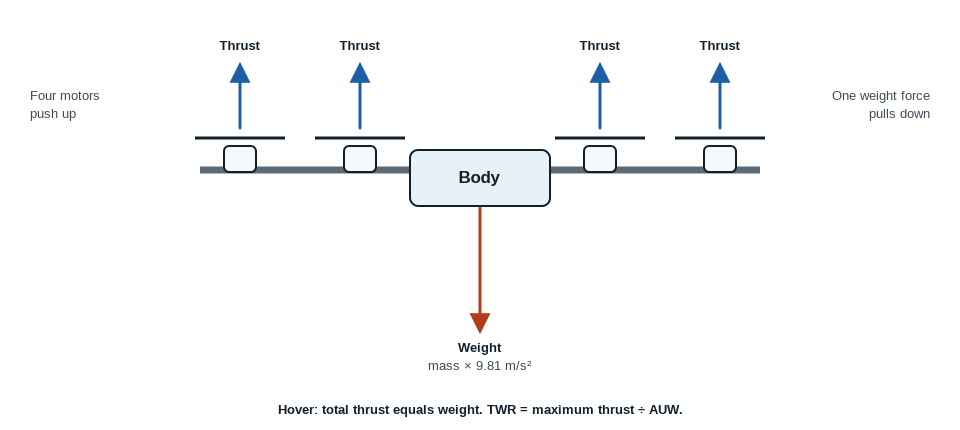
Weight terms you need first
Four terms come up again and again.
- All-up weight (AUW) is the total mass when the drone is ready to take off. It adds up the frame, motors and ESCs, battery, electronics, propellers and payload.
- Maximum takeoff weight (MTOW) is the highest total weight the airframe and power system are designed, or approved, to lift off with safely.
- Payload capacity is the weight you can add after the empty drone and its battery. The formula is payload capacity = MTOW − (empty weight + battery weight).
- Thrust is the upward pull the propellers make. Test tables show it in grams-force (gf), kilograms-force (kgf) or newtons (N). One kgf is about 9.81 N.
In a steady, windless hover, total thrust must equal weight exactly. Weight is mass times gravity, about 9.81 m/s². That is the force balance in the picture above.
What thrust-to-weight ratio means
Thrust-to-weight ratio (TWR) is the total maximum static thrust of all motors at 100 percent throttle divided by the all-up weight.
TWR = total maximum thrust ÷ AUW
It has no unit. People write it as 2:1 or just 2. A ratio of 1:1 means the motors can only just cancel gravity at full throttle. There is nothing left to climb, fight wind or correct tilt, so the drone is unsafe. The spare thrust above hover is called headroom, or control authority. The more headroom, the better the drone resists gusts, climbs and reacts.
TWR, hover throttle and payload
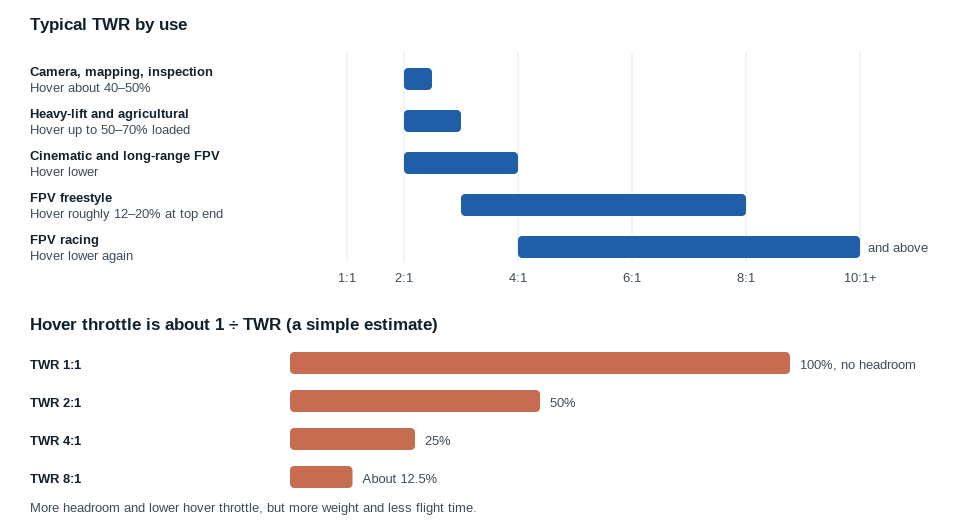
Hover throttle is the throttle setting that holds the drone steady in the air. A first guess comes from a simple rule. If thrust rises in a straight line with throttle, hover throttle is about 1 divided by TWR.
- A TWR of 2:1 hovers at about 50 percent throttle.
- A TWR of 4:1 hovers at about 25 percent throttle.
Real motors, ESCs and propellers are not linear. Thrust does not rise in a straight line with throttle, so the simple rule is only an estimate. Flight controllers deal with this. Some flight controller software uses a thrust expo setting, with a common default of 0.65, to straighten the curve and learns the hover value. Others estimate hover thrust in flight and remap it as battery voltage and load change.
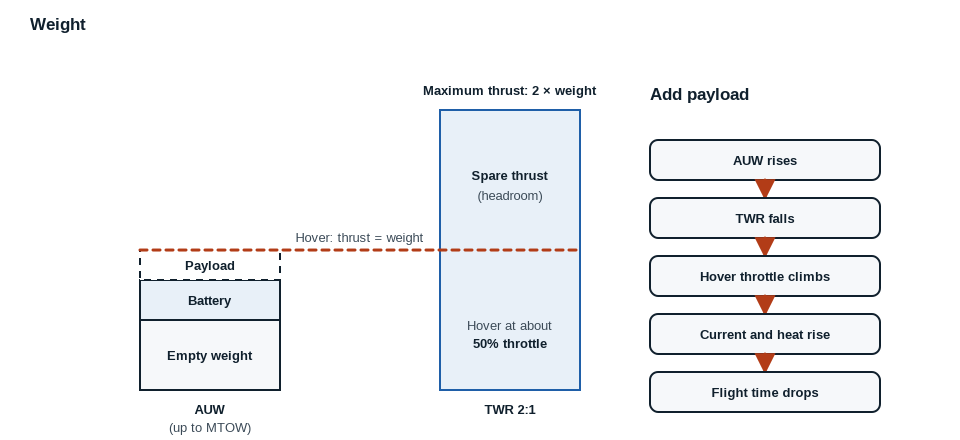
Payload ties it all together. Adding payload raises AUW. TWR then falls, hover throttle climbs, and motor current and heat rise. Flight time drops as well. Near full load, flight time is commonly 30 to 50 percent shorter than with no load. A bigger battery makes up for some of it, but it adds weight and uses up part of the payload budget.
Looking for motors, propellers or batteries sized for a payload? Ask our team.
How to read a motor thrust table
A thrust table comes from a test stand that measures one motor with one propeller at one voltage. Read these columns.
- Throttle (%). Steps from 0 to 100 percent (1000 to 2000 microseconds), with tables often starting around 25 to 50 percent (1250 to 1500 microseconds). Look at the hover zone, usually 40 to 70 percent, and at the 100 percent peak.
- Voltage (V). Test supply voltage, for example about 11.1 V for 3S, 14.8 V for 4S or 22.2 V for 6S. A bench supply holds its voltage. A real battery sags under heavy current, so thrust at high throttle is a little lower in flight.
- Propeller size. A code such as 5045 or 1045. The same motor gives different thrust and current with another propeller.
- Current (A) and power (W). Watts are roughly volts times amps. Use the 100 percent current to choose an ESC with safe margin.
- Thrust. Static thrust, measured with zero airspeed. In forward flight the effective thrust can differ from the bench value.
- Efficiency (g/W). Grams of thrust per watt. It is usually higher at low and middle throttle and drops near full throttle. Check it near your hover point.
- RPM. Propeller speed at that load.
Target ratios by use
Different jobs need different ratios, and sources disagree on exact numbers. These ranges put the common views side by side.
| Use | Typical TWR | Hover throttle guide |
|---|---|---|
| Aerial photography, mapping, inspection | 2:1 to 2.5:1; efficiency-focused designs sometimes 1.5:1 to 1.8:1 | About 40–50% |
| Heavy-lift and agricultural platforms | 2:1 to 3:1 (some studies use 1.6:1 to 2.0:1) | Up to 50–70% when fully loaded |
| Cinematic and long-range FPV | 2:1 to 4:1 | Lower, depending on ratio |
| FPV freestyle | 4:1 to 8:1 | Roughly 12–20% at the top end |
| FPV racing | 4:1 to 10:1 and above | Lower again |
For a camera or survey drone, 2:1 is a safe baseline. At that ratio the drone hovers near half throttle with half its thrust spare. Freestyle FPV drones and racing drones use much higher ratios. They respond faster, but flight time usually falls.
More is not always better. For a camera, mapping or heavy-lift aircraft, a very high TWR means heavy motors and ESCs that add dead weight. Hover throttle that falls below roughly 20 to 30 percent also makes the sticks too sensitive and the hover drifty. Some flight controller software also sets a lower limit of 0.125 for the learned hover value.
Key specifications
| Parameter | What it means | Typical range | Unit |
|---|---|---|---|
| Thrust-to-weight ratio, camera and survey | Maximum static thrust divided by AUW | 2:1 to 2.5:1 | ratio |
| Thrust-to-weight ratio, heavy lift | Platforms that carry or spray | 2:1 to 3:1 | ratio |
| Thrust-to-weight ratio, FPV freestyle | Agile aircraft | 4:1 to 8:1 | ratio |
| Hover throttle, design target | Throttle that holds a steady hover | 40–50 | % |
| Hover throttle, typical flight controller logs | Seen on tuned aircraft | 20–60 | % |
| Specific thrust | Thrust per watt of power | Varies with propeller size and throttle: 4–6 is good for 5-inch FPV in hover or cruise; industrial 15–30-inch propellers typically reach 10–15 or more in hover | g/W |
| Thrust expo | Flight controller setting that straightens the throttle-thrust curve | 0 (linear) to 1.0; default 0.65 | none |
| Coaxial thrust loss | Loss from stacked rotors, as in X8 and Y6 layouts | About 16–23 | % |
| Small sensor platform payload | Light survey and sensor drones | 0.5–5 | kg |
| Heavy and agricultural payload | Carrying and spraying aircraft | 5–50 | kg |
In the United States, the small drone rules (Part 107) cap total takeoff weight, payload included, below 55 lb (about 25 kg).
How to size motors for a payload
1. Set the mission and the frame. Pick the frame and the largest propeller it can take. Then pick a target TWR, for example 2:1 for camera and cargo work.
2. Add up the AUW. Include the frame, flight electronics, motors, battery, and the heaviest payload with its mount or gimbal. Weigh it on a scale. Do not leave out the battery.
3. Work out thrust per motor. Hover thrust per motor = AUW ÷ number of motors. Maximum thrust per motor = AUW × target TWR ÷ number of motors. For coaxial X8 or Y6 layouts, remove about 16 to 23 percent from the total first.
4. Match the thrust table. Find a motor, propeller and battery voltage that reaches the maximum thrust at 100 percent throttle. Then check that the hover thrust sits near 40 to 55 percent throttle, and that efficiency in grams per watt is good at that point.
5. Check current and heat. Read the peak current at 100 percent throttle. Choose an ESC rated above it. If you change to heavier motors or a bigger battery, add that weight back into AUW and repeat.
Worked example: thrust per motor
A quadcopter weighs 1.5 kg with its battery. It will carry a 0.5 kg camera. The target TWR is 2.0.
- AUW = 1.5 + 0.5 = 2.0 kg, or 2000 g.
- Hover thrust per motor = 2000 g ÷ 4 = 500 g, about 4.9 N.
- Maximum thrust per motor = 2000 g × 2.0 ÷ 4 = 1000 g.
So the table needs at least 1000 gf at 100 percent throttle, and 500 gf should fall near 40 to 55 percent throttle.
Worked example: payload from motor thrust
Turn the question around. Suppose a bench test shows four motors reach 1000 gf each, so 4000 gf in total. The empty drone with its battery weighs 1.5 kg. At 2:1, the largest safe AUW is 4000 ÷ 2 = 2000 g. The payload limit is 2000 − 1500 = 500 g.
A larger example uses a 35 kg multirotor, with its battery, whose motors give 70 kgf in total. At 2:1, the largest AUW is 70 ÷ 2 = 35 kg, so the aircraft is already at the limit. To add a 5 kg load and keep 2:1, the AUW becomes 40 kg and the total thrust must reach 80 kgf.
Do not take total thrust minus empty weight as the safe payload. That would use up all of the headroom. For more on how the parts fit together, see how drones work and how a brushless motor works. Browse heavy-lift drones, delivery drones, agricultural drones or motors, ESCs and propellers.
Common mistakes
- Designing for 1:1. Maximum thrust equal to weight leaves no headroom for wind or corrections. For camera, mapping and cargo work, design for at least 2:1, with hover at about 50 percent throttle or less. For FPV freestyle, plan for 4:1 to 8:1.
- Using empty weight instead of AUW. The drone flies fine empty. Then the battery, gimbal and cargo box arrive, hover throttle jumps past 70 percent, and the motors run hot. Weigh the full aircraft and recheck after every change. Do not fall into the loop of adding a bigger battery, adding weight and using more power.
- Ignoring the center of gravity. The total can be under MTOW and the drone still leans or yaws. Motors on the heavy side run at higher throttle and can hit 100 percent first. Mount the battery and payload symmetrically near the center, and fix them so they cannot slide.
- Confusing peak thrust with sustained thrust. The 100 percent row in a thrust table is a short peak with high current, heat and poor efficiency. Plan the hover at 40 to 55 percent, and run a 60-second hover check for temperature and current first.
- Fitting large or high-pitch props to small high-KV motors. Current and voltage drop spike, and the motor and ESC can burn out. Heavy loads need low-KV motors with large stators and large, low-pitch propellers. If you increase propeller size, lower the KV or battery voltage, and keep the ESC rating above peak current.
- Forgetting density altitude. A load that lifts at a cool sea-level site can struggle at a high or hot site. Thin air gives less lift per turn. Cut the payload and keep extra thrust margin for hot, high or humid work.
- Trusting the thrust table under load. Tables are often measured with a steady supply or a full cell. Under heavy current, battery voltage sags, and real maximum thrust can be 10 to 20 percent lower. Leave margin and plan the return from the voltage under load, not the resting voltage.
- Overlooking maneuver loads and coaxial loss. A hard turn or sudden pull-up raises the load factor, which acts like extra weight. Coaxial layouts lose about 16 to 23 percent of thrust compared with two separate rotors. Fly cargo gently, and count the loss when you rate an X8 or Y6.
Frequently asked questions
What is a good thrust-to-weight ratio for a drone?
It depends on the job. Camera, mapping and inspection drones typically use 2:1 to 2.5:1. At 2:1, hover is near half throttle if thrust rises linearly with throttle. Efficiency-focused designs sometimes go as low as 1.5:1 to 1.8:1. FPV freestyle usually needs 4:1 to 8:1, and racing can reach 10:1 or more.
How do you calculate how much weight a drone can carry?
Divide the total maximum static thrust of all motors by the target thrust-to-weight ratio, such as 2.0, to get the largest safe all-up weight. Then subtract the empty weight and the battery weight. The result is the payload.
What is the difference between payload capacity and maximum takeoff weight?
Payload capacity is the extra weight you can carry beyond the drone itself and its battery. Maximum takeoff weight is the upper limit for the whole aircraft: airframe, battery and payload together.
How does carrying extra weight affect drone battery life?
It shortens flight time. More weight raises hover throttle, pulls the motors out of their efficient range and increases current. Near full load, flight time is commonly 30 to 50 percent shorter than with no load.
What happens if you overload a drone?
The thrust-to-weight ratio drops and the control margin disappears, so wind and attitude corrections get much harder. Motors and ESCs overheat, battery voltage sags, and the drone can land hard or lose control. It may also break aviation rules, such as the 55 lb limit for small drones under US Part 107 rules.
How do weather and altitude affect drone payload capacity?
High altitude, heat and humidity make the air thinner. The propellers then produce less lift, the motors need more rpm and power, and the usable payload and climb rate fall. Strong wind also uses thrust just to hold position.
Can a drone have too much thrust?
Yes. A very high ratio on a camera, mapping or heavy-lift drone means heavy motors and ESCs that add dead weight. A hover throttle below about 20 to 30 percent also makes the sticks overly sensitive and the hover drifty.
What does hover throttle tell you about a drone?
It shows how much thrust is spare. A simple estimate is 1 divided by the thrust-to-weight ratio, so 2:1 hovers near 50 percent. Real thrust is not linear, so the flight controller learns the actual value.