What Is an ESC? Electronic Speed Controllers Explained
What is an ESC, and why does a drone need one? On a drone parts list, the meaning of ESC is electronic speed controller, a device that regulates the power supplied to a motor. Here is how an ESC works, how the different types compare and what to know about their settings.
What an ESC does
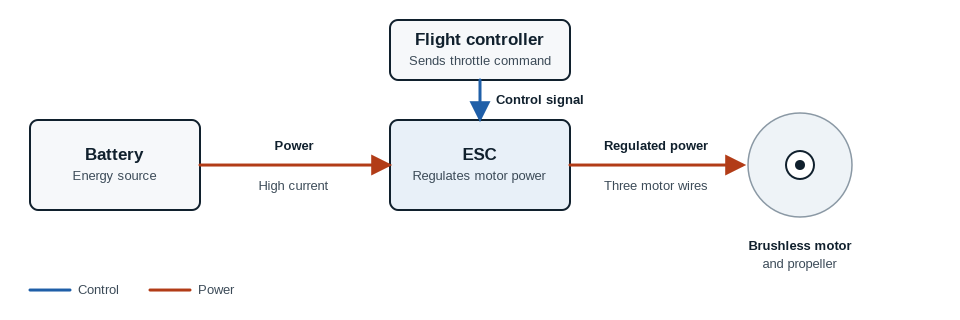
A drone's electronic speed controller sits between the battery, the flight controller (FC) and the motor. It receives a throttle command from the FC and regulates the electrical power delivered to the motor.
The battery is the energy source. The flight controller sends instructions but does not drive the motor itself. The ESC handles the high-current power needed to turn the motor and its propeller.
An ESC can control speed, rotation direction and electronic braking. Throttle is a command for motor output, not a measurement of the motor's actual speed.
The same basic principle applies to FPV drones, radio-controlled aircraft and many types of robots. In simpler radio-controlled equipment, an ESC may receive its throttle signal directly from an RC receiver.
Why brushless motors need an ESC
A traditional brushed motor uses mechanical brushes and a commutator to switch the direction of current inside the motor. An external controller can adjust its speed by changing the average voltage supplied to it.
A brushless DC motor, or BLDC motor, has no brushes or mechanical commutator. Its rotor (the part that spins) contains permanent magnets. Its stator (the stationary part) contains coils, usually arranged in three phases.
The battery supplies direct current, or DC. A brushless motor needs a changing magnetic field to keep spinning. The ESC switches the current in its windings in sequence to create this rotating field.
Connecting a brushless motor directly to a battery does not produce continuous rotation. It can also overheat the windings and damage the motor.
A brushed ESC typically has two motor output wires, while a brushless ESC typically has three phase wires. They perform different electrical tasks. The guide to how a brushless motor works explains the motor itself.
How an ESC works
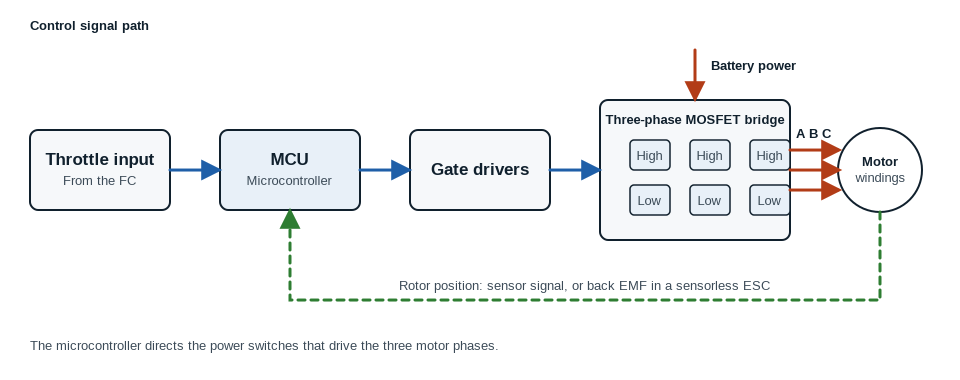
Inside a brushless ESC, a small processor controls a set of electronic power switches.
Step 1. Receive the throttle signal. The signal from the flight controller or receiver encodes the requested motor output. A protocol is the set of rules used to represent that command.
Step 2. Interpret the command. The microcontroller, or MCU, runs the ESC's internal software (firmware). It interprets the throttle signal and controls the timing of the power switches through circuits called gate drivers.
Step 3. Switch the three motor phases. MOSFETs are transistors used as fast power switches. A basic brushless ESC has a three-phase bridge made up of six power MOSFETs. Switching the current through the motor windings in sequence creates the rotating magnetic field. This electronic switching of the phases is called commutation.
Step 4. Track the rotor. A sensored ESC receives rotor position information from sensors in the motor. A sensorless ESC uses the voltage generated by the moving rotor, called back electromotive force (back EMF), to estimate its position.
A sensorless system has no back EMF signal at a standstill. This is one reason that some sensorless motors are less smooth at very low speeds than sensored motors.
ESC protocols
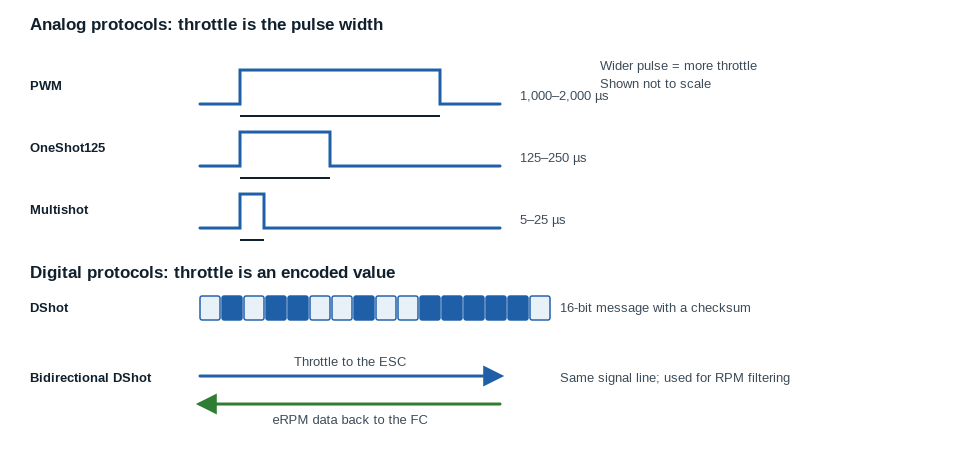
ESC protocols determine how the control command is sent. The older pulse-width protocols encode throttle by varying the length of a pulse. DShot transmits a digital message instead.
| Protocol | Signal type | Typical signal | Used for |
|---|---|---|---|
| PWM | Analog pulse width | 1,000–2,000 µs | Traditional RC models and older control systems |
| OneShot | Analog pulse width | 125–250 µs for OneShot125 | Older multirotor systems with shorter control pulses |
| Multishot | Analog pulse width | 5–25 µs | Older systems using very short pulses |
| DShot | Digital | 16-bit message | Compatible modern ESCs with digital throttle commands |
| Bidirectional DShot | Digital with feedback | Throttle and return speed data | Systems that use motor speed telemetry |
PWM stands for pulse width modulation. OneShot and Multishot shorten the pulse used to convey the throttle command. These analog protocols need throttle range calibration.
DShot (Digital Shot) uses an encoded throttle value and includes a checksum to help detect transmission errors. No traditional throttle range calibration is needed.
Bidirectional DShot lets the ESC return electrical RPM (eRPM) data to the flight controller over the same signal line. RPM stands for revolutions per minute. The controller can use this feedback for RPM filtering, which helps it identify and filter out motor vibration signals in its sensor data.
The protocol must be supported by both the flight controller and the ESC firmware. A protocol name alone does not tell you whether a particular combination of hardware supports it.
ESC firmware
Firmware is the software running on the ESC's microcontroller. It determines which protocols, telemetry functions and motor control settings the ESC supports.
- BLHeli_S. Open-source firmware for compatible 8-bit ESC hardware. It supports ordinary DShot but does not natively support bidirectional DShot.
- BLHeli_32. Closed-source firmware for compatible 32-bit ESC hardware. Later versions supported bidirectional DShot and additional telemetry. Development of this firmware has been discontinued.
- AM32. Open-source firmware for compatible 32-bit ESC hardware. AM32 ESCs can support bidirectional DShot and telemetry.
- Bluejay. An open-source alternative for compatible BLHeli_S hardware. It adds bidirectional DShot support to that hardware.
Firmware and hardware are not the same thing. An ESC built for an 8-bit processor cannot simply run firmware written for a 32-bit processor.
Features also depend on the firmware version and the hardware on the board. An ESC may have a current sensor, for example, but the ability to report its readings is a separate feature.
Sourcing electronic speed controllers for your business or school? Ask our team.
4-in-1 ESC vs individual ESCs
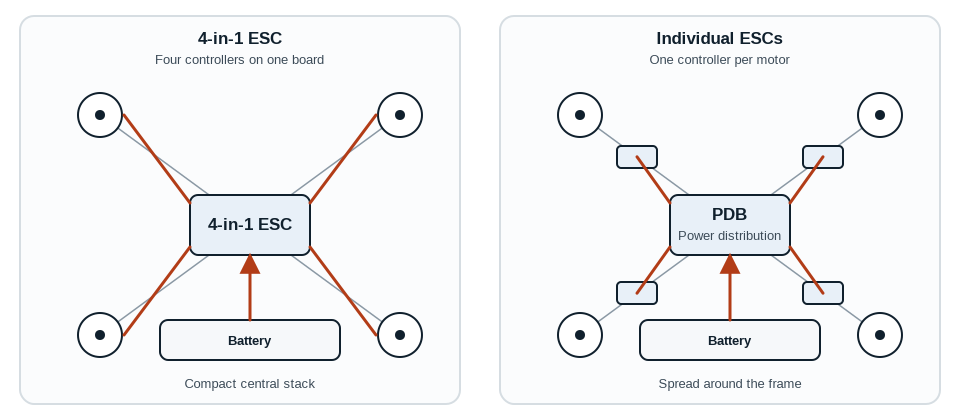
A 4-in-1 ESC contains four separate motor control channels and power distribution on a single circuit board. It often sits under the flight controller in a stack in the center of the drone frame.
Individual ESCs are separate boards, often placed on the arms near their respective motors. A power distribution board (PDB) can distribute battery power to them.
| Item | 4-in-1 ESC | Individual ESCs |
|---|---|---|
| Layout | Four controllers on a shared board | Separate controller for each motor |
| Power wiring | Shared battery connection | Separate power feeds |
| Control connection | Often a shared cable to the FC | Separate control connections |
| Space | Compact central stack | Distributed around the frame |
| Cooling | Heat concentrated in one area | Heat spread across the frame |
| Repairs | A failed channel may require board replacement | Individual controller can be replaced |
| Common uses | Compact FPV drones | Larger multirotor frames |
A 4-in-1 ESC still controls each motor separately. The combined board changes the packaging and wiring, not the basic method of driving a brushless motor.
Cable connectors on an ESC and flight controller may look identical but have different pin assignments. A matching connector shape does not guarantee electrical compatibility.
ESC specifications explained
ESC ratings describe different aspects of the hardware. Current is measured in amperes (A), voltage in volts (V) and frequency in hertz (Hz).
| Specification | Meaning | Common range or values | Unit |
|---|---|---|---|
| Continuous current | Current the ESC can sustain with adequate cooling | 5–25 for micro models; 30–65 or more for common 3- to 5-inch models | A |
| Burst current | Current tolerated for a short period (typically 5–10 s) | Often 2–5 above the continuous rating for 5–15 A micro ESCs; 10–20 above for common 30–65 A ESCs in 3- to 5-inch models | A |
| Battery cell count | Supported number of LiPo cells in series | 1–2 for micro models; 2–6 for many multirotors | S |
| PWM switching frequency | Frequency of the internal power switching | 24–128 | kHz |
| DShot bitrate | Speed of the digital control signal | 150, 300, 600 | kbps |
| MOSFET count | Number of power switches | Typically 6 for a single ESC; 24 for a basic 4-in-1 | switches |
| Weight | Mass of the ESC board and cooling hardware | About 1–3 for micro single ESCs; 10–22 for common 30.5 × 30.5 mm 4-in-1 boards | g |
| Mounting hole pattern | Distance between mounting hole centers | 16 × 16, 20 × 20, 25.5 × 25.5, 30.5 × 30.5 | mm |
The current rating is the ESC's capacity, not the current it forces into the motor. Motor current depends on the load. The burst rating is not a continuous operating rating.
The PWM switching frequency in the table describes the switching inside the ESC. It is not the same as the PWM throttle protocol. DShot bitrate also describes the input signal, not the switching frequency of the motor power stage.
Some ESCs contain a BEC (battery eliminator circuit). This is a voltage regulator that supplies lower-voltage power, commonly 5 V or 6 V, to devices such as a receiver or RC servo. Many multirotor ESCs have no BEC. A separate UBEC or other voltage regulator can provide this supply.
How to wire and calibrate an ESC
The power connection, throttle signal and motor output serve different purposes. For a beginner, it helps to identify them before starting a bench check.
Step 1. Prepare the equipment. Disconnect the battery and remove all propellers before working on the ESC. Check that the battery voltage is within the ESC's rated range.
Step 2. Identify the connections. Locate the power input, motor phase outputs and control signal connections. On a combined ESC board, identify the individual motor channels and the control cable. Do not assume that connectors with the same shape have the same pin assignments.
Step 3. Check the wiring before power-up. Look for solder bridges, damaged wires and incorrect battery polarity. A multimeter can help detect short circuits. A current limiter, often called a smoke stopper, is useful for the first power-up after assembly or repair.
Step 4. Confirm the protocol. Check the protocol and firmware compatibility of the ESC and control system. PWM and OneShot use throttle endpoints; DShot uses digital values.
Step 5. Understand ESC calibration. With analog ESCs, throttle range calibration teaches the controller which input pulse represents minimum throttle and which represents maximum throttle. Use the control system's ESC calibration routine to record these endpoints. Confirmation tones indicate when the ESC has accepted its settings. DShot does not need this endpoint calibration.
Step 6. Review the result. With the propellers still removed, look for abnormal sounds, stuttering or excessive heat during a bench check. Stop and disconnect the battery if the motor or ESC behaves abnormally.
Common mistakes
- Confusing burst and continuous ratings. A burst rating describes short-term current capacity, not what the ESC can sustain.
- Using an incompatible battery voltage. Excess voltage can damage the ESC as soon as power is connected.
- Choosing incompatible protocols. An ESC may not respond if the controller uses a protocol the ESC firmware does not support.
- Skipping analog throttle calibration. Uncalibrated endpoints can cause motors to start at different command levels.
- Assuming every ESC includes a BEC. An ESC may control a motor without providing a regulated supply for other electronics.
- Assuming matching cable plugs have matching pins. An incorrect pin assignment can damage connected boards.
- Missing solder bridges during assembly. Check for shorts before connecting a battery.
- Ignoring abnormal motor sounds. Stuttering, scraping sounds or unusual heat are reasons to stop a test and check for damage.
Frequently asked questions
What does ESC mean on a drone?
ESC stands for electronic speed controller. It receives commands from the flight controller and regulates the electrical power supplied to the motor.
Why does a brushless motor need an ESC?
A brushless motor has no mechanical commutator to switch current through its windings. An ESC creates the changing magnetic field that keeps the motor rotating.
What is the difference between a brushed and a brushless ESC?
A brushed ESC typically controls a motor through two motor wires. A brushless ESC typically uses three phase wires and switches current through the motor windings in sequence.
Do I need to calibrate an ESC when using DShot?
No. DShot sends digital throttle values rather than analog pulse widths, so traditional throttle range calibration is unnecessary.
What is bidirectional DShot on an ESC?
Bidirectional DShot lets an ESC send electrical motor speed data back to the flight controller over the same signal line. The flight controller can use that data for RPM filtering.
What does a 4-in-1 ESC do?
A 4-in-1 ESC combines four independent motor control channels and power distribution into a single circuit board. Each channel still controls its own motor.
What does BEC mean on an ESC?
BEC stands for battery eliminator circuit. It provides regulated low-voltage power for electronics such as a receiver or servo, but not all ESCs have one.
Why does my ESC beep when I connect the battery?
An ESC typically uses the motor windings to produce audible tones. These tones may indicate that the ESC has powered on, detected the battery or received a valid throttle signal.