How Do Drones Work? Lift, Parts, Controls and Sensors Explained
How do drones work? A multirotor can take off vertically and hover in place, but how does a drone work without the fixed wings of an airplane? Here is how its parts work together to produce lift, control movement and keep the aircraft stable.
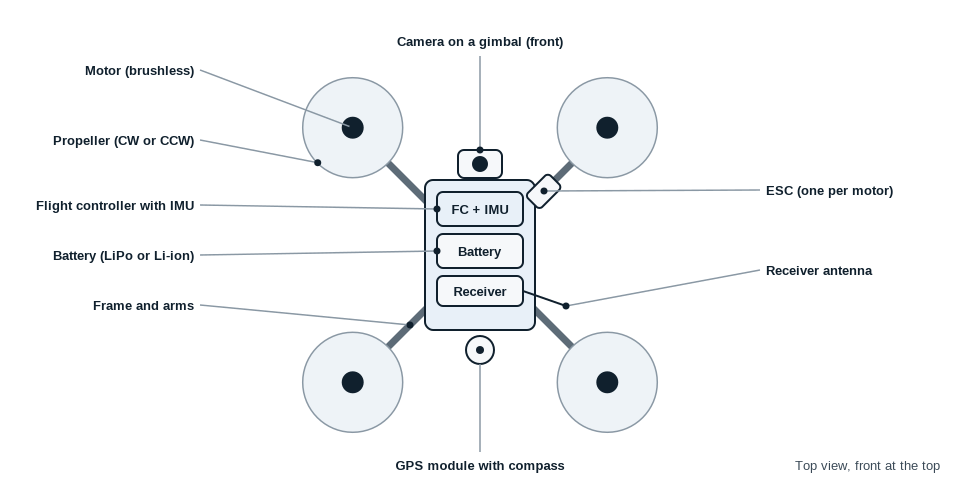
How a drone produces lift
A quadcopter is a type of multirotor drone with four rotors. Each rotor has a motor that spins a propeller. Together, the rotors generate lift. The RadioLink F450 DIY Quadcopter ARF Kit is an example of a classic 450 mm quadcopter platform.
A propeller blade works like a rotating wing. Its shape and angle allow it to move air as it spins. Air flowing around the blade creates a difference in pressure between its surfaces. At the same time, the propeller accelerates air downward. The air pushes back on the propeller in the opposite direction. Both descriptions explain the same upward force.
The relationship between thrust and weight determines whether a level drone begins to rise or fall.
- Hover. The combined upward thrust of the propellers equals the weight of the drone.
- Climb. The combined upward thrust exceeds the weight.
- Descend. The combined upward thrust falls below the weight.
A spinning propeller can produce thrust even when the aircraft is stationary. This is why a multirotor can hover.
When the drone tilts, its thrust is no longer directed straight up. Part of that thrust acts horizontally and moves the drone sideways, forward or backward.
Why the propellers spin in opposite directions
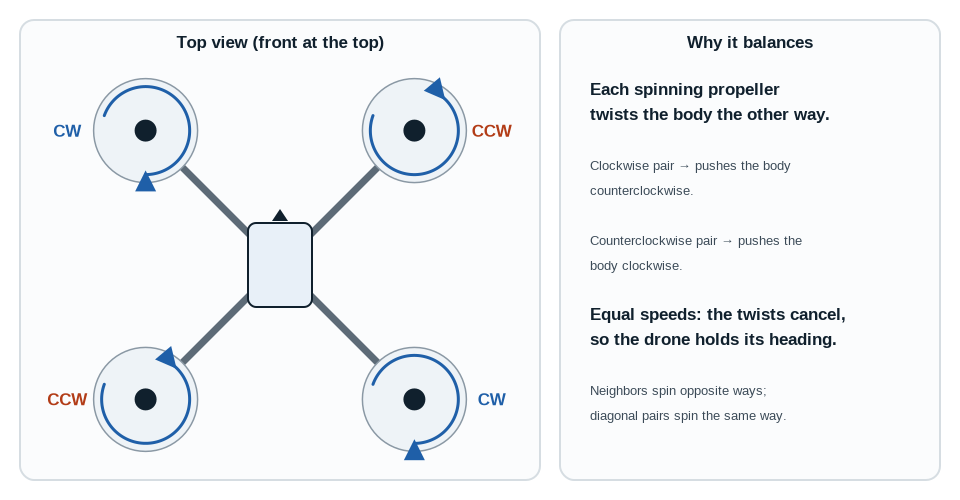
When a motor turns a propeller, the aircraft experiences a twisting force in the opposite direction. This effect is called reaction torque. If all the propellers turned the same way, the body of the drone would tend to spin the other way.
A quadcopter balances torque by using two opposing pairs of propellers. Viewed from above, two spin clockwise (CW) and two spin counterclockwise (CCW). Adjacent propellers spin in opposite directions, and propellers on opposite corners spin in the same direction.
The two pairs cancel each other's reaction torque during balanced hovering. A quadcopter does not need a separate tail rotor to counter this twisting force.
The exact clockwise and counterclockwise positions vary by aircraft design. The important principle is that the rotation directions and propeller types match the intended layout.
How a drone moves: throttle, pitch, roll and yaw
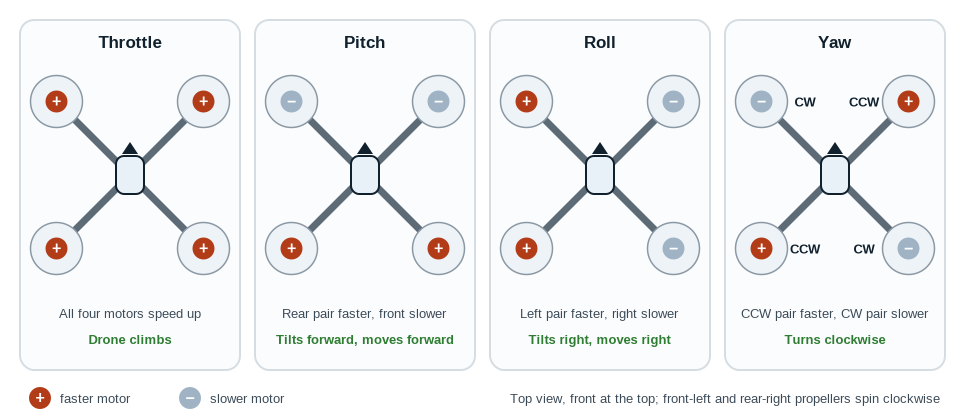
How does a drone fly in the direction you want? Instead of steering with movable surfaces on wings, a quadcopter uses changes in motor speed to produce lift, tilt and rotation. Each electronic speed controller, or ESC, controls power to a motor. The flight controller coordinates the changes across the motors.
There are four basic control inputs.
- Throttle. This changes the combined thrust. To begin climbing from a level hover, all four motors speed up together. To begin descending, all four slow down together.
- Pitch. This tilts the nose up or down around the axis that runs from left to right. To tilt forward, the two rear motors speed up and the two front motors slow down. To tilt backward, the front pair speeds up and the rear pair slows down.
- Roll. This tilts the drone around the axis that runs from nose to tail. To tilt to the right, the left pair of motors speeds up and the right pair slows down. To tilt to the left, the right pair speeds up and the left pair slows down.
- Yaw. This turns the nose around the vertical axis. For a clockwise turn viewed from above, the counterclockwise pair speeds up and the clockwise pair slows down. For a counterclockwise turn, the clockwise pair speeds up and the counterclockwise pair slows down.
Pitch and roll create horizontal movement by tilting the direction of thrust. A drone moving forward is pushing air backward as well as downward. During yaw, the flight controller creates a difference in reaction torque between the two diagonal pairs while aiming to maintain the total thrust. The aircraft can change its heading without tilting.
These are simplified changes from balanced flight. The flight controller continually adjusts motor output as the aircraft responds. The pilot does not control each motor separately.
The parts of a drone and what each does
Drone components include propulsion equipment, control electronics and optional camera equipment. Here are the main parts of a drone and the specifications you may see on a parts list.
| Component | What it does | Common specifications |
|---|---|---|
| Frame | Supports the motors and electronics and holds them in position | Carbon fiber or engineering plastic construction |
| Motor | Converts electrical energy into rotation | Brushless type; KV (RPM per volt with no load); stator size, such as 2207 |
| Propeller | Converts rotation into thrust | Diameter and pitch (inches); two or three blades; CW or CCW |
| ESC | Controls electrical power to the motor | Brushless motor control; PWM or digital command input |
| Battery | Supplies energy to propulsion and electronics | LiPo (3.7 V nominal per cell) or Li-ion; capacity (mAh or Ah) |
| Flight controller | Processes commands and sensor readings and controls the motors | Processor, onboard IMU, PWM or digital motor outputs |
| Radio transmitter and receiver | Sends the pilot's commands from the ground to the aircraft | Radio frequency, such as 2.4 GHz; control protocol |
| GPS module | Provides position and speed data for navigation | GNSS support; optional integrated compass |
| Camera | Captures images or live video | Analog or digital video link |
| Gimbal | Stabilizes the camera independently of the frame | Two-axis or three-axis stabilization |
Motor and propeller labels. A stator size code of 2207 indicates a stator 22 mm in diameter and 7 mm high. Propeller pitch describes how far the propeller would theoretically move in one revolution. It is not the same thing as the drone's actual speed. The drone and FPV parts glossary explains more of these labels.
Battery labels. LiPo stands for lithium polymer. The S number on a battery indicates the number of cells connected in series. Capacity measures the charge the battery can store. A larger battery also adds weight, so a higher capacity does not automatically mean a longer flight.
Camera equipment. A camera can send a live view to the pilot or capture images for later use. A two-axis gimbal stabilizes pitch and roll; a three-axis gimbal also stabilizes yaw. This helps keep the image steady when the aircraft tilts or turns; see how a drone gimbal works.
Sourcing drones or components for your business? Ask our team.
From stick to motor: the signal path
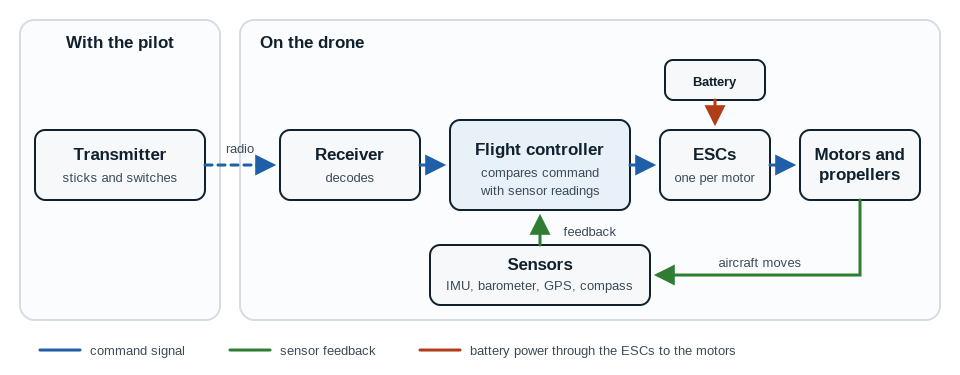
A stick command passes through several components before the propellers respond.
Step 1. The transmitter sends a command. The hand-held transmitter converts the movement of the sticks and switches into data. It sends that information over a wireless radio link.
Step 2. The receiver passes on the command. The receiver on the aircraft receives the radio signal and decodes it. It passes the control data to the flight controller over a wired connection.
Step 3. The flight controller interprets the command. It compares what the pilot requested with the movement measured by its sensors. It works out the motor outputs needed to create the desired movement.
Step 4. The ESCs control the motors. Each ESC receives its own command from the flight controller. It draws energy from the battery and controls the electrical power delivered to its motor.
Step 5. The motors and propellers respond. The motors change speed, which changes the thrust and torque generated by the propellers. The aircraft moves, the sensors detect that movement, and the flight controller uses the new readings to make further corrections.
The control signal carries instructions; the battery supplies the energy used to carry them out. The receiver relays the pilot's commands, but it is the flight controller that decides how the motors should respond. The CUAV 7-Nano Autopilot is an example of a flight controller. An FPV drone adds a second radio link that sends live video from the aircraft to the pilot.
Sensors and stabilization
A multirotor needs constant corrections to stay balanced. Think of trying to balance an upright broom on your hand. You have to keep adjusting for small movements, even if the broom looks still.
Several sensors provide this feedback.
- Gyroscope. Measures how quickly the aircraft is rotating in pitch, roll and yaw. It helps the flight controller detect unwanted rotation.
- Accelerometer. Measures acceleration along different axes. It helps estimate tilt using gravity and correct drift in the attitude estimate from the gyroscope.
- Barometer. Measures air pressure. Changes in pressure help the flight controller estimate relative altitude and maintain height.
- GPS. GPS is one of the global navigation satellite systems (GNSS). A GNSS receiver provides position and ground speed, which can support position hold and return-to-home.
- Magnetometer (compass). Measures the Earth's magnetic field and provides a heading reference. Nearby metal and electrical currents can interfere with its readings.
The gyroscope and accelerometer are commonly packaged together as an inertial measurement unit, or IMU. Sensor fusion combines information from different sensors to estimate the aircraft's attitude, speed and position.
How PID control works. PID stands for proportional, integral and derivative. Imagine that a gust of wind tilts a hovering drone. P responds to how far the drone is from its target attitude now. I accounts for small errors that persist over time. D responds to how quickly the error changes and helps reduce overshoot. The controller uses this feedback to make repeated corrections rather than relying on a single instruction from the pilot.
Keeping a drone level is not the same as holding it at a fixed point in the air. The IMU helps with attitude stabilization. Position hold also needs a position reference, such as GPS, to detect and correct drift.
Quadcopter vs hexacopter vs fixed-wing
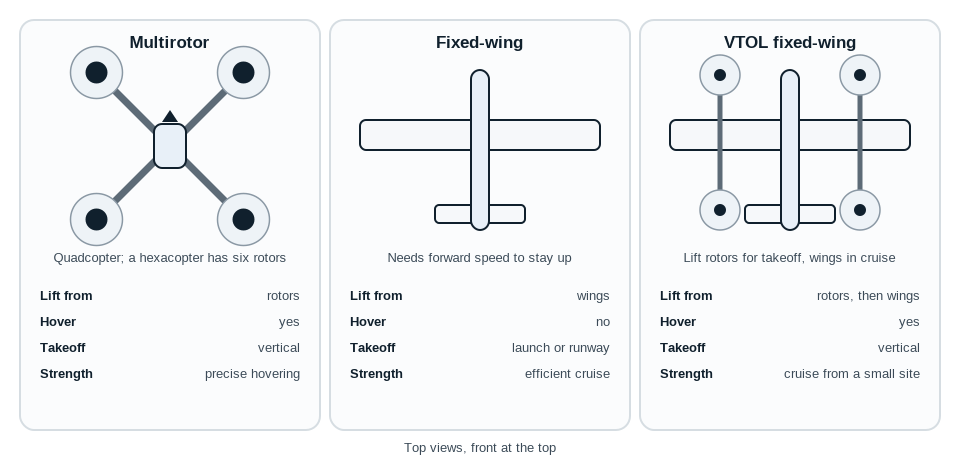
A hexacopter is also a multirotor. It uses six rotors instead of four. The additional rotors can support greater payloads, but they add motors and complexity.
A fixed-wing drone behaves more like an airplane, while a VTOL drone with fixed wings combines vertical takeoff and landing with wing-borne forward flight.
| Type | How it produces lift | Takeoff and hover | Main trade-off |
|---|---|---|---|
| Quadcopter | Four rotors | Vertical takeoff; can hover | Simple multirotor layout |
| Hexacopter | Six rotors | Vertical takeoff; can hover | Greater payload potential; more components |
| Fixed-wing | Wings in forward flight | Usually needs launch and recovery space; cannot hover | Efficient cruising |
| VTOL fixed-wing | Rotor thrust in hover; wings in cruise | Vertical takeoff and landing; can hover | Efficient forward flight with additional hardware |
Multirotors are useful when the job requires hovering, such as taking steady aerial photos. Fixed wings make efficient forward flight possible. VTOL fixed-wing designs are useful when the job calls for wing-borne flight but there is limited space for takeoff and landing.
Common misconceptions
- All propellers are interchangeable. Clockwise and counterclockwise propellers are shaped for different rotation directions. Both the direction of rotation and the type of propeller matter.
- A hovering drone is doing nothing. The motors are producing thrust to balance the aircraft's weight, and the flight controller is making repeated corrections.
- GPS keeps the drone level. The gyroscope and accelerometer provide the main feedback for attitude stabilization. GPS helps the aircraft estimate its position and movement over the ground.
- The position of the battery does not matter. An off-center battery or camera shifts the center of gravity. The motors then need unequal thrust to keep the drone level.
- A bigger battery always means more flight time. Extra capacity can increase flight time, but the extra weight requires more thrust.
- A small chip in a propeller is only cosmetic. Damage can lead to vibrations and a propeller may fail while spinning. Vibrations also affect the readings used for stabilization.
- The camera and aircraft always point in the same direction. A stabilized gimbal moves the camera to compensate for changes in aircraft attitude.
Frequently asked questions
How does a drone work?
A multirotor uses motors and propellers to produce thrust. A flight controller reads sensor data and responds to the pilot by adjusting motor outputs.
How do drones stay in the air?
The propellers push air downward, producing an upward force on the aircraft. In a level hover, total upward thrust equals the weight of the drone.
Why do quadcopters have four propellers?
Two propellers spin clockwise and two spin counterclockwise to balance reaction torque. The four-rotor layout lets the flight controller adjust lift and control pitch, roll and yaw.
Can a drone hover without GPS?
Yes, a drone can produce enough thrust to hover without GPS. However, holding a fixed position automatically requires a position reference, such as GPS or downward-facing vision sensors.
What is the most important part of a drone?
The flight controller is central to controlling the drone. It processes the pilot's commands and sensor data and sends instructions to the electronic speed controllers.
How long does a drone battery last on one charge?
Many consumer camera multirotors fly for around 20–45 minutes in ideal conditions. Flight time depends on the aircraft, wind and flying style.
What is the difference between a quadcopter and a hexacopter?
A quadcopter has four rotors and a hexacopter has six. The extra rotors on a hexacopter can support heavier payloads, but they add components.
Can a fixed-wing drone hover in place?
A conventional fixed-wing drone needs forward airflow over its wings to generate lift and cannot hover. A VTOL fixed-wing drone can hover using rotor thrust.