What Is an FPV Drone? How FPV Works, Types and How to Start
An FPV drone is a drone that lets you fly using a live view from its onboard camera; FPV stands for first-person view. You see the scene ahead through FPV goggles or a monitor, almost as if you were sitting inside the aircraft. Here is how FPV works, how the types of drones compare and what to know before your first flight.
What FPV means
Browse FPV drones and FPV goggles in our catalogue. First-person view describes the pilot's perspective, not the size or shape of the drone. As the aircraft turns or tilts, the view in the goggles moves with it.
In line-of-sight flying, you watch the aircraft from the ground. FPV goggles show the live camera feed instead, but block your direct view of your surroundings.
The pilot's camera is not necessarily the camera used to record a finished video. Some FPV drones carry a separate action camera. Popular uses include recreation, racing and creative filming.
How an FPV drone works
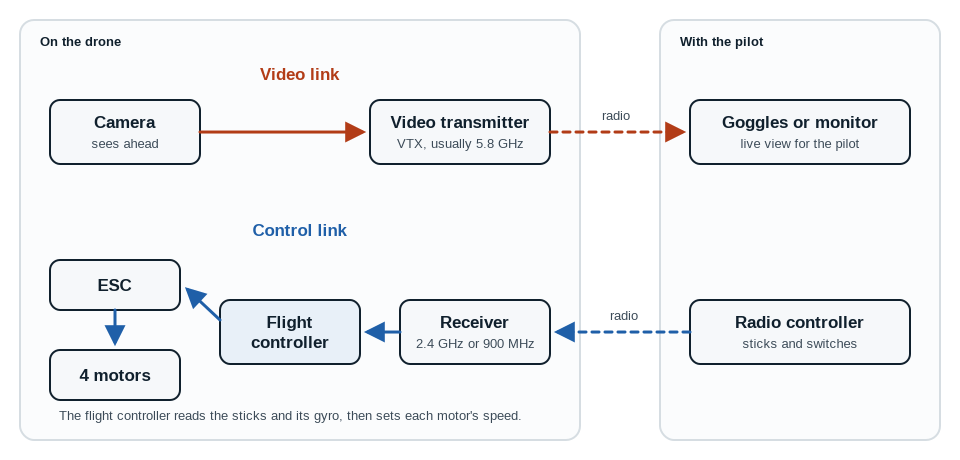
An FPV drone uses a video link to send pictures to the pilot and a control link to receive commands.
The video link. An FPV camera captures the scene in front of the drone. A video transmitter, often called a VTX, sends the image wirelessly through its antenna. The goggles or monitor receive the signal and display the picture in real time.
An on-screen display, or OSD, can overlay battery voltage and flight mode on the live image.
The control link. The hand-held radio sends stick and switch commands to a receiver aboard the drone. They need to use compatible control protocols. An ELRS receiver is an example of a receiver using the ExpressLRS control system. The receiver passes the pilot's commands to the onboard controller.
The flight controller and motors. The flight controller, or FC, is the drone's electronic brain. Sensors tell it how the aircraft is moving. It compares this movement with the pilot's commands and sends instructions to the electronic speed controllers, or ESCs. The ESCs control the power supplied to the motors, and the propellers produce lift.
The frame, motors, propellers, battery and circuit boards are all FPV drone parts. The FPV parts glossary explains unfamiliar abbreviations. A wiring diagram shows how the parts relate.
FPV drone vs a regular camera drone
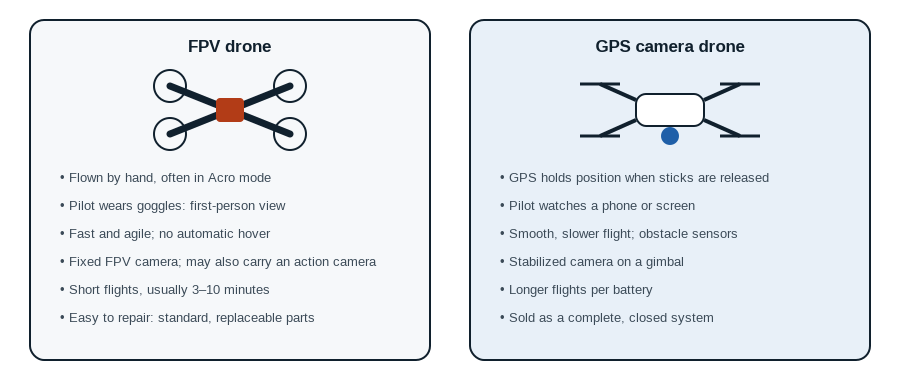
A GPS camera drone prioritizes steady aerial photography. A traditional FPV drone focuses on manual control.
| Item | FPV drone | GPS camera drone |
|---|---|---|
| Pilot's view | Goggles or a monitor | Direct view and a phone or tablet display |
| Flight control | Usually manual, with optional self-leveling modes | Automatic stabilization with GPS and sensors |
| When sticks are released | In Acro, does not level itself | Usually holds position and altitude |
| Camera mount | Usually fixed to the frame | Usually a stabilized gimbal |
| Common uses | Recreation, racing and dynamic filming | Steady aerial photography and surveying |
| Repairs | Modular parts can often be replaced | Repairs may require manufacturer service |
| Learning curve | Requires practice, especially in a simulator | Assisted flight makes basic control easier |
Some consumer FPV drones add GPS hovering and return-to-home; traditional freestyle drones do not.
A stabilized camera can hold a steady view while the drone moves. A fixed FPV camera follows the angle of the aircraft itself.
Types of FPV drones
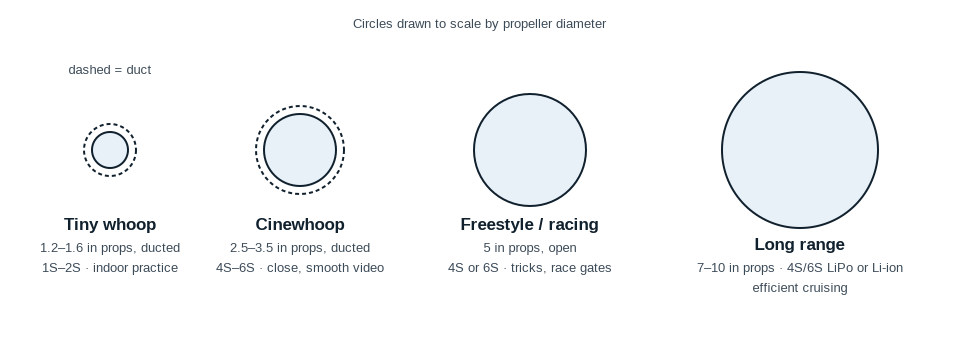
Size often refers to propeller diameter, not the total width of the drone. In the battery column, S indicates the number of cells connected in series.
| Type | Typical prop size | Battery | Used for |
|---|---|---|---|
| Tiny whoop | 1.2–1.6 inches | 1S–2S | Indoor recreation and beginner practice |
| Cinewhoop | Around 3 inches | 3S–6S | Smooth video and indoor filming |
| Freestyle FPV drone | 5 inches | 4S or 6S | Recreational aerobatics in open areas |
| Racing drone | 5 inches | 4S or 6S | Flying through gates on dedicated courses |
| Long-range drone | 7–10 inches | LiPo or Li-ion | Scenic outdoor flights |
A tiny whoop is small, light and has propeller guards. A cinewhoop also has guards but is generally larger and intended for filming.
Freestyle and racing drones commonly have exposed propellers and are unsuitable for indoor beginner practice. Larger long-range models are designed for cruising.
Two examples: the BETAFPV Meteor75 Pro O4 is a tiny whoop with digital video, and the iFlight Nazgul Evoque F5 V3 O4 6S HD is a 5-inch freestyle drone.
Analog vs digital FPV video
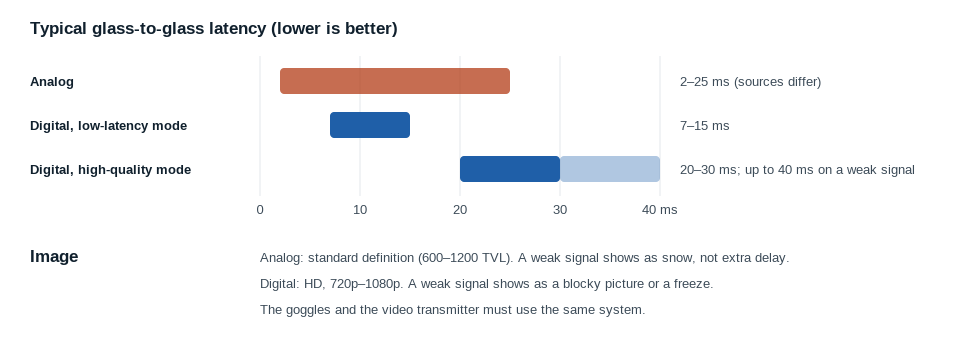
Analog and digital are two ways to transmit live video. Latency is the delay between an event in front of the camera and its appearance in the goggles.
| Item | Analog FPV | Digital FPV |
|---|---|---|
| Picture quality | Standard-definition appearance | Usually clearer HD images |
| Latency | Generally low and consistent | Varies with the system and video processing |
| Weak signal | Increasing static and noise | May show pixelation, stutter or frozen frames |
| Compatibility | Broad compatibility with matching bands and channels | Depends on the specific digital system |
Typical analog latency runs from a few milliseconds to about 25 ms, depending on how it is measured. Digital systems run about 7–15 ms in low-latency modes and 20–30 ms in high-quality modes, and can reach about 40 ms on a weak signal.
Digital goggles are not automatically compatible with every digital drone. Check that both devices support the same system.
Flight modes: Angle, Horizon and Acro
Flight modes change how the drone responds to stick movements.
- Angle mode. The controller limits the tilt angle and helps the aircraft return to level when the roll and pitch sticks are centered. This can make early practice easier. Self-leveling is not the same as holding position.
- Horizon mode. This mode behaves like Angle near the center of the sticks, but permits more freedom of rotation at larger stick movements. It combines self-leveling behavior with aspects of manual flying.
- Acro mode. The sticks command rotation rates rather than a target tilt angle. Centering the rotation sticks stops the commanded rotation but does not automatically level the aircraft. The pilot must manage its attitude. This is common in traditional FPV flying.
Explore these differences in a simulator before trying them with a real drone.
How to start flying FPV
Step 1. Begin with a simulator. Use a real radio controller connected to a computer. Practice basic turns and landings in the simulator until the controls feel familiar.
Step 2. Choose compatible systems. The goggles must work with the onboard video system, and the radio must work with the receiver. A beginner FPV drone kit guide explains the equipment categories.
Step 3. Decide how much assembly you want. An FPV drone kit may include the aircraft and accessories, but package contents vary. Understand the common labels before choosing:
- RTF (Ready-to-Fly). Usually a package with the drone, radio, goggles, battery and charger. The equipment is normally prepared to work together. The EMAX Tinyhawk Lite RTF is an example of an RTF listing.
- BNF (Bind-and-Fly). An assembled drone with an onboard receiver and video system. You usually supply a compatible radio, goggles, battery and charger.
- PNP (Plug-and-Play). An assembled aircraft that normally lacks a receiver. Some versions may also lack video equipment. Additional installation and configuration are required.
The guide to building a 5-inch FPV drone explains what assembly involves. Beginners do not need to build their own aircraft.
Step 4. Complete the preflight checks. Follow the manufacturer's checklist. Confirm the propellers and their guards, if fitted, are in good condition. Check that the controls, video feed, battery display, arming switch and failsafe (the behavior when control is lost) work as expected before flying.
Check your local aviation and radio-frequency rules before flying.
Step 5. Practice in a suitable space. Start with a small, guarded model or use an open, empty area with someone watching the aircraft while you wear goggles. Focus on gentle, controlled flight and safe landings. Revisit the simulator when needed.
Sourcing FPV drones or parts for your shop or school? Ask our team.
Common beginner mistakes
- Skipping the simulator. Manual flight takes practice. Learn basic control in a simulator instead of learning through crashes.
- Buying incompatible goggles. Check video-system compatibility rather than assuming that every set of goggles receives every video signal.
- Confusing the radio and video links. Confirm that the radio is compatible with the receiver as well as checking the video equipment.
- Assuming Angle mode will hold position. Self-leveling can correct the tilt, but a traditional FPV drone does not automatically hover in place.
- Leaving LiPo batteries fully charged or deeply discharged in storage. Use the storage function of a compatible charger. Storing batteries improperly can damage them and create a safety hazard.
- Expecting every kit to include everything. Read the package contents carefully, especially for BNF and PNP drones.
- Starting with exposed propellers indoors. Choose a small aircraft with propeller guards for indoor practice. Keep it away from people and obstacles.
Frequently asked questions
What does FPV mean on a drone?
FPV stands for first-person view. A camera on the drone sends live video to the pilot's goggles or a monitor, giving the pilot a view from the aircraft.
Are FPV drones harder to fly than regular camera drones?
Traditional FPV drones require more practice because they usually rely on manual control rather than automatic position and altitude hold. A simulator lets you learn the controls before flying a real drone.
Can an FPV drone hover or return home automatically?
Most traditional freestyle and racing drones do not hold position or return home automatically by default. Some consumer FPV models do offer GPS-assisted hovering and return functions.
How long does an FPV drone battery last per flight?
Many everyday FPV flights last around 3–10 minutes. Actual flight time depends on the aircraft design, battery and flying style.
Can you fly an FPV drone indoors?
Yes, small tiny whoops with propeller guards are designed for indoor flying and practice. Keep the flight area clear of people and obstacles.
Can you wear glasses with FPV goggles?
Some larger box-style goggles can fit over prescription glasses. Other models offer focus adjustments or support corrective lenses, so check the fit and features of the specific goggles.
What is the difference between RTF and BNF FPV drones?
Ready-to-Fly (RTF) packages usually include a drone and compatible flying equipment. Bind-and-Fly (BNF) drones are assembled but normally require you to supply a compatible radio, goggles, battery and charger.