LiPo vs Li-ion Drone Batteries: What's the Difference?
When comparing LiPo vs Li-ion batteries for drones, you will see differences in cell shape, electrical characteristics and charging requirements. LiHV is another common label, and it looks almost identical to ordinary LiPo. Here is what these names mean, how to read the specifications and how to look after your drone's battery.
How LiPo, Li-ion and LiHV batteries work
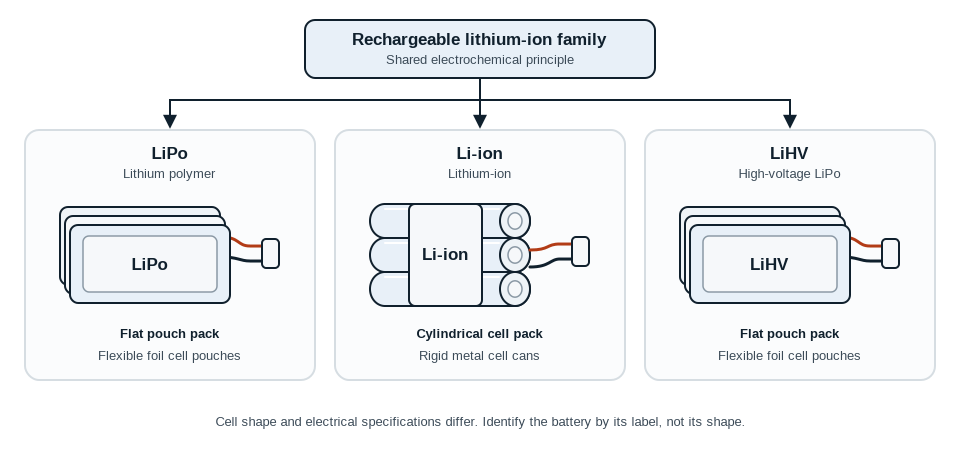
Browse drone batteries by battery type. LiPo stands for lithium polymer. Along with Li-ion, it belongs to the rechargeable lithium-ion battery family. In both types, lithium ions move between the positive and negative electrodes as the battery charges and discharges.
Inside a cell, a separator keeps the electrodes apart. The electrolyte allows lithium ions to move between them. The cell's shape and the form of its electrolyte can differ, even though the basic electrochemical principle is the same.
LiPo. A typical LiPo battery uses flat cells enclosed in a flexible foil pouch. Inside the pouch are layers of electrode material and a separator. The electrolyte in modern commercial LiPo cells is typically held in a gel or a microporous polymer structure.
A pouch does not need a rigid metal can around each cell. This allows battery packs to come in different flat shapes. However, the soft outer material offers less mechanical protection against crushing and punctures. Gas buildup inside a pouch can also cause it to swell.
Li-ion. A typical Li-ion drone battery contains cylindrical cells enclosed in metal cans. The electrodes and separator are usually rolled into a spiral, sometimes called a jelly roll. These cells use a liquid organic electrolyte.
A rigid can protects the cell against some forms of mechanical damage, but it does not make the cell immune to damage. Cylindrical cells can also contain pressure vents and other protective features.
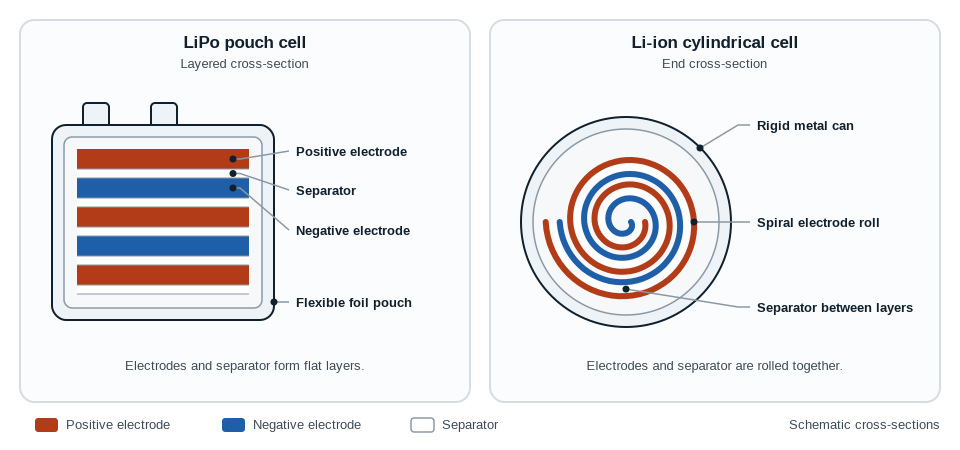
LiHV. A LiHV battery is a high-voltage type of lithium polymer battery. It has a similar pouch construction to ordinary LiPo, with changes to the cell chemistry that allow a higher charging voltage. You cannot reliably tell LiHV and LiPo apart by shape alone.
What the battery specifications mean
On a battery label you will often see voltage, capacity and a cell count. These describe different things.
- Nominal voltage (V). This is a reference voltage for a cell or pack during discharge. It is not the same as its fully charged voltage.
- Capacity (mAh). This measures the amount of electrical charge the battery is rated to store. It is not a measure of voltage or a direct measure of flight time.
- Energy (Wh). Watt-hours measure electrical energy. Packs with the same capacity in milliamp-hours can have different amounts of stored energy if their voltages differ.
- Specific energy (gravimetric energy density, Wh/kg). This describes how much energy a battery stores for a given mass. It is different from the rate at which a battery can release that energy.
- Cell count (S). The S on a battery label refers to the number of cells connected in series.
- C-rating. This expresses the rate of charge or discharge relative to the rated capacity. A discharge rating is not a charging rating. Some labels also distinguish a continuous rating from a short-term rating.
- Internal resistance (IR). This is the resistance within the battery itself. It contributes to heat generation and a drop in voltage when current flows.
A temporary drop in battery voltage while current is being drawn is called voltage sag. The voltage at rest can be higher than the voltage while the battery is in use. A low-voltage warning during use should not be ignored simply because the voltage rises again afterward.
Another common term is cycle life. Batteries lose capacity as they age and go through repeated charging and discharging. High temperatures, high voltage during storage and demanding discharge conditions can contribute to that deterioration. Cycle life depends on the cell and the conditions in which it is used.
LiPo vs Li-ion vs LiHV: how they compare
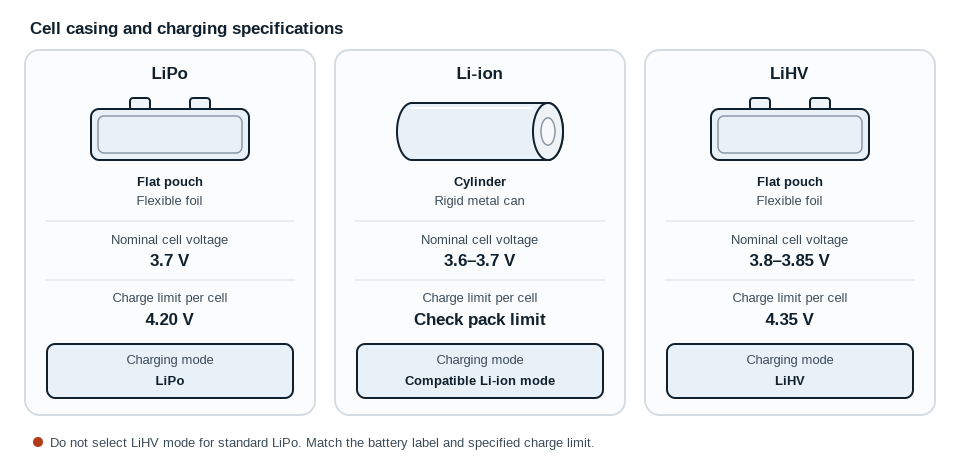
There is no single battery type that is better for every application. A battery designed for one aircraft is not necessarily compatible with another, even if both are rechargeable lithium batteries.
Many drone LiPo cells are designed for high discharge rates, while many cylindrical Li-ion cells emphasize energy storage. These are general design tendencies, not specifications for an individual pack. Specific energy and discharge capability are different characteristics.
| Item | LiPo | Li-ion | LiHV |
|---|---|---|---|
| Usual cell shape in drone packs | Flat pouch | Cylinder | Flat pouch |
| External cell casing | Flexible foil | Rigid metal can | Flexible foil |
| Typical electrode arrangement | Stacked layers | Rolled layers | Stacked layers |
| Nominal cell voltage | 3.7 V | 3.6–3.7 V | 3.8–3.85 V |
| Charging mode | LiPo | Compatible Li-ion mode | LiHV |
| Mechanical concerns | Punctures, crushing and swelling | Damage to the can or pack | Punctures, crushing and swelling |
| Storage | Partial charge | Partial charge | Partial charge |
The LiHV vs LiPo difference is particularly important at the charger. Ordinary LiPo cells generally have a full-charge voltage of 4.20 V per cell. A typical LiHV cell has a full-charge voltage of 4.35 V per cell. Using the LiHV setting with a standard LiPo pack can overcharge the cells.
The battery supplied with a recreational FPV drone may look quite different from the battery supplied with a commercial survey drone. Small aircraft such as a tiny whoop may use miniature pouch cells. Some agricultural drones use smart battery packs with built-in battery management systems. These differences in packaging and electronics matter when replacing or charging a battery.
Sourcing replacement drone batteries for your business? Ask our team.
Common drone battery parameters
Distinguish cell voltage from pack voltage when reading a label or a charger's display. The following values are common cell specifications, not interchangeable charging settings for every battery.
| Parameter | Meaning | Typical range or value | Unit |
|---|---|---|---|
| LiPo nominal cell voltage | Reference operating voltage | 3.7 | V/cell |
| Li-ion nominal cell voltage | Reference operating voltage | 3.6–3.7 | V/cell |
| LiHV nominal cell voltage | Reference operating voltage | 3.8–3.85 | V/cell |
| Standard LiPo charge limit | Upper charging voltage | 4.20 | V/cell |
| Typical LiHV charge limit | Upper charging voltage | 4.35 | V/cell |
| LiPo storage voltage | Voltage for storage at partial charge | 3.80–3.85 | V/cell |
| Charging temperature lower limit | Temperature below which standard graphite-based lithium cells should not be charged | 0 | °C |
For Li-ion, check the specific pack's stated charge limit. Do not use its nominal voltage to infer that limit. If the information on the pack and the available charging modes do not match, do not start charging it.
How to use and care for a drone battery
Step 1. Identify the battery. Read its chemistry label and compare it with the specifications of the original battery. Look for the voltage, cell count and charging requirements. Use a compatible replacement pack for your aircraft. The voltage must be compatible with its motors and electronic speed controllers, or ESCs.
Check that the pack fits its normal installation space and has the correct battery connector. A matching plug does not by itself establish electrical compatibility.
Step 2. Inspect the pack before charging. Look for a swollen pouch, damaged outer wrap, leaking electrolyte, deformed casing or burned connectors. Set aside a battery with visible damage rather than putting it back into service.
After flying, let a warm battery cool to room temperature. A battery that is too cold to charge should also return to a suitable temperature before being connected.
Step 3. Use the correct charger. Choose a compatible drone battery charger with the appropriate battery mode. Confirm the chemistry and cell count before starting. If a pack uses a separate balance lead, use its compatible balance charging function. Built-in battery management systems control individual cells in some smart packs.
A lithium battery charger normally starts with a constant-current stage, then switches to a constant-voltage stage as the battery reaches its specified upper voltage. The charging current gradually decreases until charging ends.
Charge on a noncombustible surface and keep the battery in view throughout the session. Disconnect it when charging is complete.
Step 4. Store the battery at partial charge. If you do not plan to fly soon, use the storage function of a compatible charger. This brings the battery toward its appropriate storage voltage rather than leaving it completely full or empty. A smart battery may have an automatic storage function; check its status before putting it away.
Keep packs in a cool, dry place away from direct sunlight, combustible material and heavy objects that could crush them. Avoid leaving them inside a hot car.
Step 5. Retire damaged batteries. Do not continue using or charging a battery that has become visibly swollen or damaged. Do not open the casing or puncture the cells. Keep retired batteries out of ordinary household trash and arrange appropriate battery waste recycling.
Common mistakes
- Leaving a battery fully charged for long periods. High voltage during storage can accelerate degradation. Use the appropriate storage mode when you do not expect to fly soon.
- Using all the available charge. Deep discharge can permanently damage cells. Respond to low-battery warnings instead of continuing to fly until the battery cuts out.
- Confusing LiPo and LiHV charging modes. A high-voltage charging program can overcharge a standard LiPo cell. Check the chemistry and cell count every time you start a charging session.
- Ignoring the balance lead. The total voltage of a multicell pack may look normal even when individual cell voltages are unequal. Use the appropriate balancing function for the pack.
- Charging a hot or frozen battery. Charging a pack before it has cooled after use puts extra stress on the cells. Charging a conventional lithium cell below freezing can cause internal damage known as lithium plating.
- Charging different battery types together. Packs with different cell counts, chemistries or states of charge can create hazardous conditions when connected in parallel. Charge packs separately.
- Treating the C-rating as proof of compatibility. A printed discharge rating does not establish that a battery is suitable for an aircraft. Keep charging and discharge specifications separate and use a compatible pack.
- Keeping a swollen battery in service. Swelling indicates gas buildup inside a cell and may accompany internal damage. Stop using the battery, do not puncture it and take it out of service for recycling.
Frequently asked questions
Are Li-ion batteries better than LiPo for drones?
Neither type is better in every situation. They differ in packaging and electrical characteristics, so use a battery compatible with your particular drone.
What is the difference between LiHV and LiPo batteries?
LiHV is a higher-voltage version of a lithium polymer battery. A typical LiHV cell charges to 4.35 V instead of the standard LiPo limit of 4.20 V.
Can you charge a Li-ion battery on a LiPo charger?
Only if the charger supports the charge voltage, cell count and charging requirements of that Li-ion pack. Select its compatible charging mode rather than assuming that all lithium battery modes are interchangeable.
Can I use LiHV mode to charge a regular LiPo battery?
No. LiHV mode can exceed the voltage limit of a regular LiPo cell, causing dangerous overcharging.
How should I store a LiPo drone battery?
Store it at partial charge, commonly 3.80–3.85 V per cell, using the storage mode of a compatible charger. Keep it in a cool, dry place away from combustible materials.
Why do LiPo batteries puff up?
Gas can build up inside a pouch cell as the electrolyte degrades. Stop using and charging a visibly swollen battery and arrange for battery recycling without puncturing the cell.
Can you charge LiPo and LiHV batteries together?
Do not charge them together in parallel. Their different upper charging voltages can lead to a standard LiPo cell being overcharged.
What does the S mean on a drone battery label?
S refers to the number of cells connected in series. The cell count and chemistry are important when checking whether a charger is compatible with the pack.