How Do Drone Light Shows Work?
How do drone light shows work when so many lights appear to move across the sky as a single image? Each aircraft acts as a flying pixel in a carefully designed animation, with its own light and a role in the performance. Here is how the pictures are created, what the equipment does and what to consider when planning a show for an event.
How are drone shows programmed?
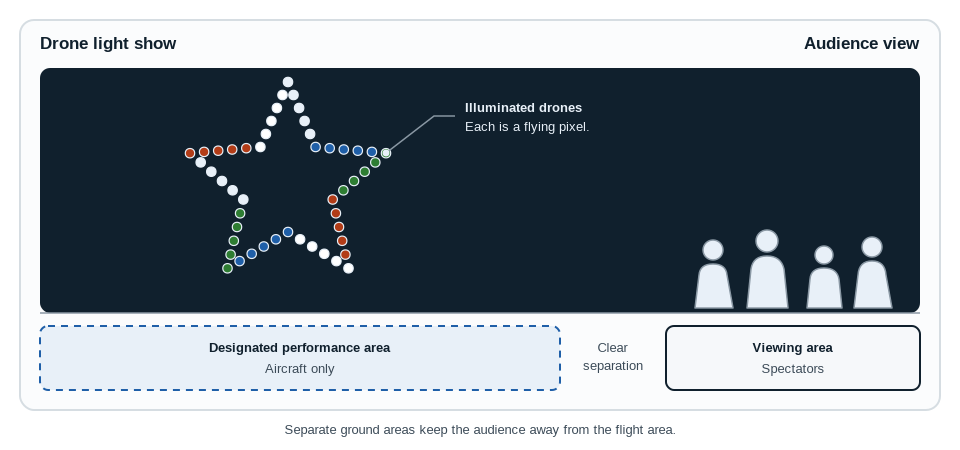
A drone light show starts with a piece of digital art rather than a group of pilots with remote controls. Specially designed light show drones form the pixels of that artwork. Unlike the pixels on a television screen, these points of light can appear to move in three-dimensional (3D) space.
Designing the images. An animator creates a storyboard, which is a sequence of scenes for the show. A simple scene might be the outline of a star. The next could be a company logo, followed by an animated figure. The images can be flat, like lettering on a screen, or have depth, like a light sculpture.
The colors form another part of the artwork. An outline can change from blue to green without changing its shape. A moving picture can also change its colors as it transforms into the next scene.
Turning animation into a show. The pictures in a storyboard describe what the audience should see. Show software turns the artistic design into a planned performance. The aircraft follow preprogrammed choreography rather than relying on each drone to decide what shape to make in the sky.
An animation that looks good on a computer is not necessarily suitable for a live event. Show software includes simulation and safety validation to account for the limitations of real aircraft. This is a separate task from drawing the pictures.
Matching the music. A soundtrack and the animation can share a common timeline. Timecode is a way to keep the picture and the sound in sync. It helps a change of color or the appearance of a new scene feel like part of the music rather than a separate event.
More flying pixels generally allow for more visual detail. Think of the difference between a picture made of a few dots and the same picture made of many dots. A simple outline needs less detail than lettering or a complex illustration. The size of the audience and its viewing distance also affect how those details appear.
How a drone light show works in the air
A show drone needs to know where it is, and the show crew needs to know how the aircraft are doing. Those are related but different jobs.
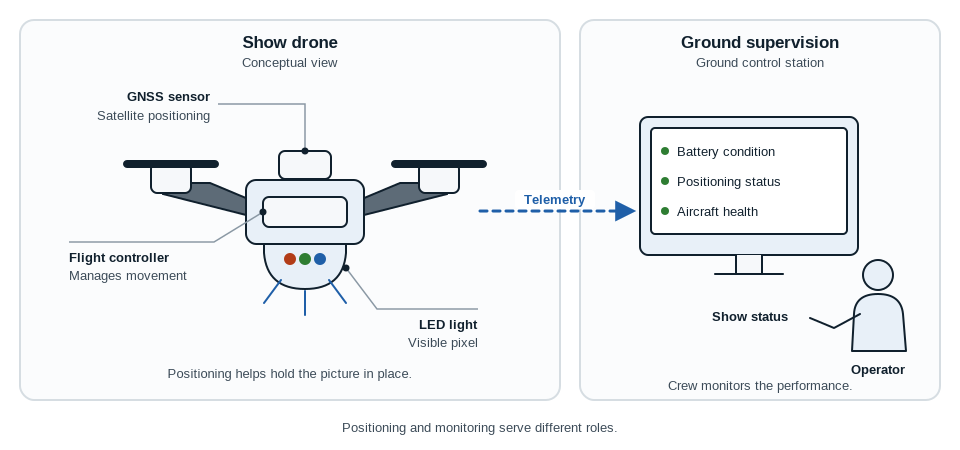
Satellite positioning. A drone GPS receiver estimates the location of the aircraft from satellite navigation signals. GNSS stands for Global Navigation Satellite System; GPS is a member of this broader family of satellite systems.
Ordinary GPS can show a position that is somewhat different from the aircraft's actual position. That uncertainty matters when many lights need to form a recognizable picture. An uneven line of lights, for example, can spoil the appearance of a letter.
An RTK module supports real-time kinematic positioning. RTK uses corrections from a reference station to improve the accuracy of satellite-based position estimates. The difference is important for a show: the artwork depends not just on knowing a general location, but on how precisely each light appears in relation to the others.
Onboard electronics. A drone flight controller manages the aircraft's movement. Some show drones also have backup sensors, such as additional inertial measurement units (IMUs) and compasses. Extra sensors provide redundancy if a sensor develops a problem.
The general principles of flight are similar to those described in how drones work. A show aircraft, however, is designed around the particular job of carrying an illuminated pixel through a performance.
Ground supervision. A ground control station (GCS) gives the crew a view of the show system. Information about battery condition, positioning status and aircraft health is called telemetry. It is different from the colored images the crowd sees. The crew monitors conditions during the show and can intervene when safety requires it.
A geofence is a digital boundary used as part of flight safety. A failsafe is a protective response to a problem such as low battery power or loss of positioning. Neither replaces a clear separation between the flight area and the audience.
How the lights make color and brightness
The visible part of a show drone is its light. Although much of the electronics is hidden inside a lightweight drone frame, the appearance of the light is easy to see.
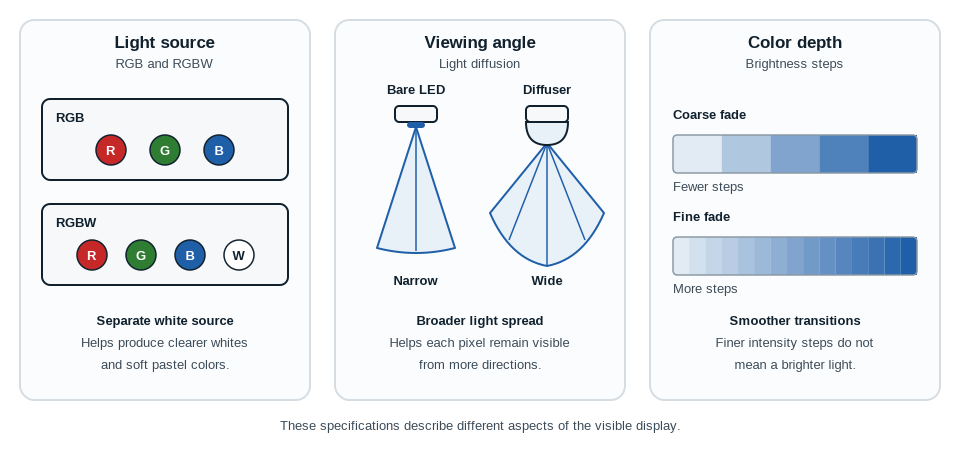
RGB and RGBW LEDs. The drone lighting system often uses RGB LEDs, which combine red, green and blue light to make different colors. RGBW adds a separate white light source. This helps produce clearer whites and soft pastel colors.
The RGB or RGBW designation describes the light source, not the number of shades that the audience will see.
Light diffusion. Many show drones have a translucent dome over the LED. This is called a diffuser. It spreads the light over a wider viewing angle than a bare light source. A broad spread helps make each dot visible to spectators who are not directly in front of the show.
A wide light viewing angle does not mean the image looks the same from everywhere. A bright letter can still be difficult to read from the side. The orientation of the entire picture and the direction from which the light is visible are different things.
Brightness control. Pulse width modulation, or PWM, is a way of changing the apparent brightness of an LED. The light switches on and off rapidly. Adjusting how much of the cycle it spends on changes the apparent brightness.
Color depth describes how finely those brightness levels can be divided. Greater color depth allows more levels for gradual color transitions. It is not another name for light output.
Power use. The drone battery supplies energy for both the lights and flight. Bright white output can draw substantial power and create heat. The flight motors also need power, especially in wind. The advertised maximum flight time of a drone is therefore different from the time available for illuminated scenes.
How to choose a drone light show for an event
If you are organizing a festival or a corporate event, begin with the artwork and the audience experience. The show provider's responsibilities include the preparation, flight safety and supervision that turn that artwork into a live performance.
Step 1. Describe the scenes you want. Decide whether the main feature will be a logo, short text, a series of shapes or a story told through moving images. Give the design team a preferred color palette and any soundtrack. A short storyboard makes those ideas easier to discuss than a general request for a spectacular show.
Step 2. Review the design preview. Ask to see how your logo or other artwork looks when it is made up of separate points of light. The original graphic may contain fine details that are hard to distinguish in a dot-based picture. Review the simpler and more complex scenes as parts of the same story.
Step 3. Consider the audience's view. Discuss where spectators will watch the event and review the artwork from their perspective. The front view of a logo in an animation may look quite different from the side view. Agree on which scenes need to remain legible and which are more abstract or decorative.
Sourcing light show drones or lighting components for your business? Ask our team.
Step 4. Discuss the production requirements. Ask the show provider about simulation, aviation permissions, the separate audience area and arrangements for unfavorable weather. Make sure the event plan accounts for these requirements rather than focusing only on the pictures and soundtrack.
Step 5. Review the equipment and light quality. Ask what kind of LEDs are included and look at examples of whites, saturated colors and gradual color changes. The appearance of pastels may be particularly important when the design uses a company's own colors.
Step 6. Agree on the event schedule. Include time for preparation and safety checks, the public performance and the recovery of the aircraft afterward. A drone show's time in the air is not the same as its time displaying artwork. The show also needs energy for takeoff and landing, with power kept in reserve.
Common drone light show parameters
The specifications of a show drone describe different aspects of its design. For example, watts measure power, not the amount of visible light produced. The following are common equipment specifications for show drones, rather than operating targets for a particular event.
| Parameter | Meaning | Common range | Unit |
|---|---|---|---|
| LED viewing angle | Angular coverage of the diffused light (about 120–180° for single-sided diffusers; 360° can refer to horizontal omnidirectional coverage or near-omnidirectional spherical or double-sided designs) | 120–360 | Degrees |
| Color depth | Resolution of the light intensity settings | 8 or 16 | Bits per channel |
| LED peak power | Maximum electrical power drawn by the light assembly on outdoor show drones | 9–30+ | W |
| Takeoff weight | Weight of the complete outdoor show aircraft with its light and battery | 250–1,000+ | g |
The number of bits relates to the available levels of light intensity. A higher bit depth is useful for describing finer steps in a fade. It does not necessarily mean a brighter light.
LED output can also be described in lumens (lm), which measure luminous flux. Compare that separately from the electrical power in watts. A large viewing angle describes the spread of the light, rather than its total output.
These equipment values say relatively little about the length of the public show on their own. Battery energy, lighting demands and weather all affect the usable performance time. A show should be evaluated as a complete production, not on a single figure in a specification sheet.
Common mistakes
- Treating a computer animation as a finished show. Virtual points of light do not have the physical limitations of aircraft. Ask about simulation and safety validation as well as the artwork.
- Paying attention only to the ground-level weather. Conditions in the air can differ from those at the viewing area. Wind increases the demand for battery power, while cold weather can shorten the available flight time.
- Assuming a crowded venue is an easy venue. Local radio interference and busy wireless networks can affect the communication equipment. Include the site's suitability in discussions with the show provider.
- Expecting a logo to read the same from every angle. Even if the individual lights are visible, the complete image can look distorted or reversed from another direction. Review the audience's perspective.
- Leaving music synchronization until the last moment. Picture and sound are parts of the same performance. Review them together rather than judging the artwork with no soundtrack.
- Assuming a connected drone is ready for a show. Individual aircraft still need health checks. A faulty light or a missing drone can leave a gap in the finished picture.
- Confusing permission to use the venue with permission to fly. Aviation permissions and a suitable audience separation plan are distinct from simply having access to the event space.
Frequently asked questions
Are drone light shows controlled by individual pilots?
Commercial shows typically use preprogrammed choreography. A crew supervises the performance from a ground control station rather than steering each aircraft by hand.
How are drone light shows programmed?
Designers create a digital animation made of points of light, with planned shapes, colors and timing. Show software turns the artwork into a performance and helps validate it before flight.
Why do drone light shows use RTK instead of regular GPS?
RTK improves the accuracy of satellite-based position estimates using reference corrections. Accurate positioning matters when separate points of light need to form a clear picture.
How long does a drone light show last?
The length of the performance depends on battery energy, lighting demands and weather. The usable show time is shorter than the maximum flight time because the aircraft also need energy for takeoff and landing.
How many drones do you need to make a picture in the sky?
The number depends on the complexity of the picture and the audience's viewing distance. Simple outlines need fewer flying pixels than detailed figures or lettering.
Can drone light shows take place in windy or rainy weather?
Strong winds can increase energy use and make it harder for drones to maintain their positions. Many show drones are not fully waterproof, so unsuitable weather can mean postponing the event.
How do drone show lights change colors?
RGB LEDs mix red, green and blue light, while RGBW LEDs add a dedicated white light source. Controlled changes in the brightness of the light channels create different colors and fades.