What Is a VTOL Drone? How VTOL Fixed-Wing Drones Work
A VTOL drone can take off and land vertically, while a fixed-wing VTOL can also fly like an airplane. The VTOL meaning is simple: vertical takeoff and landing. So what is VTOL flight like, and how does a drone change from hovering to flying on its wings?
What VTOL means
VTOL stands for vertical takeoff and landing. The term describes the way an aircraft leaves the ground and comes back down, rather than a particular aircraft shape.
A quadcopter is technically a VTOL aircraft because it can rise vertically, hover and land vertically. In commercial drone catalogs, however, VTOL drones generally refer to aircraft that combine vertical flight with the wing-supported flight of fixed-wing drones. You may also see them called fixed-wing VTOL or hybrid VTOL drones.
In hover, the aircraft stays in the air through thrust from its motors and propellers. In forward flight, air flowing around the wings produces lift. The propulsion system provides forward thrust rather than supplying all the lift directly.
This distinction explains the appeal of a fixed-wing VTOL. It can use a small landing area without needing a runway, while spending much of its time flying in an efficient fixed-wing mode.
Hybrid VTOL describes the combination of flight modes. It does not necessarily mean that the drone has a hybrid fuel and electric power system. A hybrid VTOL can be fully electric.
Common VTOL designs: quadplane, tiltrotor and tailsitter
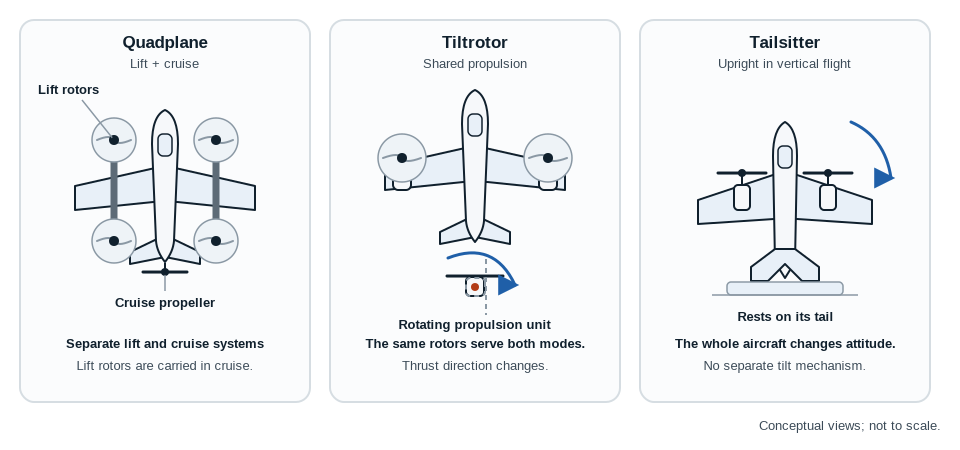
The difference between these designs is how they arrange their propulsion systems. Some use separate systems for vertical and forward flight. Others change the direction of thrust from the same system.
| Design | Vertical flight | Forward flight | Main trade-off |
|---|---|---|---|
| Quadplane (lift plus cruise) | Dedicated lift rotors | Separate cruise propeller | Extra weight and drag from the lift system |
| Tiltrotor | Rotors face upward | The same rotors tilt forward | More complex moving mechanisms |
| Tailsitter | Aircraft stands upright on its tail | The whole aircraft changes orientation | Greater exposure to wind in hover |
Quadplane. Also called standard VTOL or lift plus cruise, it resembles a regular airplane with extra lift rotors. A separate propeller provides forward thrust. The vertical propulsion hardware remains aboard during cruise, even when it is no longer producing lift. This is the compromise behind the relatively simple division of propulsion duties.
Tiltrotor. The propulsion units are mounted on mechanisms that allow them to change direction. A tilt-wing version moves the wing itself. These designs share propulsion hardware between the flight modes, but the tilting hardware adds mechanical complexity.
Tailsitter. Instead of tilting the propulsion units, the aircraft changes its entire orientation. It rests upright for takeoff and landing and assumes a horizontal attitude for cruise. There is no separate tilt mechanism, but the wings have a large exposed area when the aircraft is upright in the wind.
All these designs have wings. What differs is whether the lifting and forward-thrust systems are separate, shared through a moving mount or shared by changing the orientation of the aircraft.
How the transition from hover to cruise works
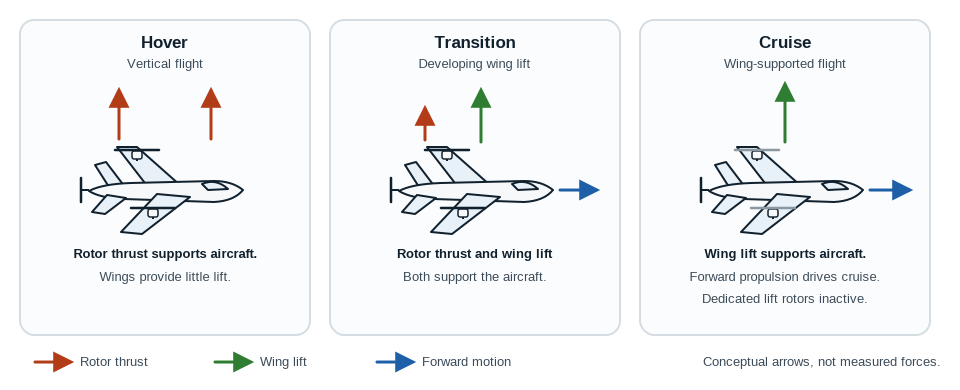
How does VTOL work when the aircraft changes flight modes? The change is called a forward transition. The flight controller manages the change between vertical and wing-supported flight.
Step 1. Hover. The aircraft is in its vertical flight mode. Its propulsion system produces the upward thrust that supports its weight. The wings are not yet supplying the lift associated with normal cruise.
Step 2. Begin forward flight. The aircraft starts to move forward. The way it does this depends on its design: separate forward propulsion in a quadplane, rotating propulsion units in a tiltrotor or a change in the aircraft's orientation in a tailsitter.
Step 3. Transfer lift to the wings. Air moving around the wings begins to produce aerodynamic lift. There is a period when rotor thrust and wing lift both contribute to supporting the aircraft. The transition is a change in the way the aircraft is supported, not simply a change in its direction.
Step 4. Enter cruise. The wings support the aircraft, and the propulsion system provides forward thrust. A quadplane's dedicated lift rotors are typically inactive in this mode. The other designs use their shared propulsion systems for cruise.
Airspeed means the speed of the aircraft relative to the surrounding air. It is different from speed relative to the ground. An airspeed sensor measures airspeed, and that information is relevant to wing-supported flight.
The reverse change, from cruise to hover, is called a back-transition. It is part of the return to vertical flight before landing.
VTOL vs multirotor vs fixed-wing
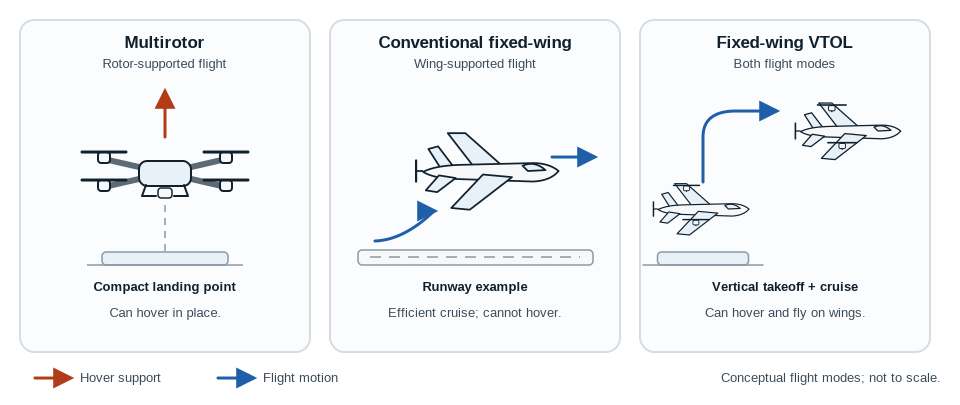
When comparing VTOL vs fixed-wing drones, the distinction is in the takeoff and landing design. A fixed-wing VTOL has wings just like a conventional airplane. The following comparison uses fixed-wing to mean a conventional drone without vertical takeoff capability.
| Item | Multirotor | Conventional fixed-wing | Fixed-wing VTOL |
|---|---|---|---|
| Endurance | Generally shorter | Generally longest in a comparable electric class | Usually between the other two |
| Payload | Flexible payload arrangements | Sensitive to payload balance | Sensitive to balance, with some weight allocated to vertical flight hardware |
| Takeoff and landing area | Compact, no runway | May need a runway or separate launch and recovery arrangements | Compact landing area, no runway |
| Hovering | Yes | No | Yes, in vertical flight mode |
| Main advantage | Stationary aerial work | Efficient wing-supported cruise | Wing-supported cruise with vertical takeoff and landing |
These are differences in aircraft type, not guarantees about individual models. The extra hardware in a fixed-wing VTOL can reduce its endurance compared with a similar conventional fixed-wing drone. The two aircraft may also differ in how much of their total weight budget is available for the task equipment.
A multirotor is a natural fit when the work depends on holding a position. If the work mostly takes place during forward flight, the fixed wings have an advantage. A fixed-wing VTOL is useful when a job calls for both wing-supported flight and a runway-free landing.
Sourcing fixed-wing VTOL drones for your business? Ask our team.
Flight phases of a VTOL mission
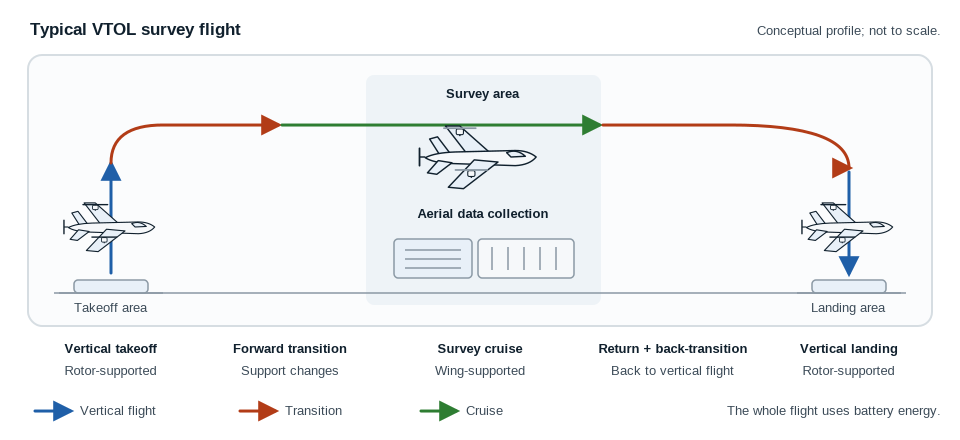
Consider a commercial aerial survey. The journey includes more than just the time spent collecting images. The diagram shows the basic phases of the flight.
Step 1. Vertical takeoff. The aircraft rises from its takeoff area in vertical flight mode, much like a multirotor.
Step 2. Forward transition. The drone changes from vertical flight to wing-supported flight. This is the part of the journey in which the flight modes overlap.
Step 3. Cruise. The aircraft flies over the survey area using its wings. This is where a mapping drone spends a large part of its working flight and collects aerial data.
Step 4. Return and back-transition. The aircraft returns from the survey area and changes from fixed-wing flight to its vertical flight mode. During conventional fixed-wing flight it cannot simply stop in midair.
Step 5. Vertical landing. The aircraft descends and touches down while in vertical flight mode. It does not need the rolling or sliding landing of a conventional fixed-wing aircraft.
The cruise phase is efficient, but it is not the entire flight. Hovering and the changes between flight modes also draw energy from the drone battery. This is why an estimate of cruise time is not the same thing as the total time needed for a survey.
VTOL specifications explained
A specification sheet describes more than the dimensions of a drone. It also describes the weight it is designed to carry and the way it performs in flight. Here are common terms you will find when comparing electric VTOL aircraft for surveying.
| Specification | Meaning | Example range or description |
|---|---|---|
| Wingspan | Distance from wingtip to wingtip | 1.2–4.0 m on many electric survey models below 25 kg |
| Maximum takeoff weight (MTOW) | Maximum permitted total weight at takeoff, including the aircraft, battery and payload | Around 4.5–25 kg for lighter electric survey aircraft |
| Endurance | How long the aircraft can remain airborne | About 45–120 minutes for many electric VTOL models below 25 kg |
| Cruise speed | Typical speed in fixed-wing flight, rather than the maximum speed | Depends on the aircraft and surveying task |
| Payload capacity | Weight of equipment the aircraft can carry for its task | 0.8–2.5 kg on many survey models below 25 kg |
Takeoff weight vs payload. MTOW includes everything carried into the air. Payload refers to task equipment, such as a mapping camera, not the entire weight of the aircraft. Two aircraft of similar size can allocate their weight differently between the airframe, propulsion system, battery and payload.
Endurance vs working time. Endurance describes a flight as a whole. It is not the amount of time a drone can spend taking survey images. A heavier load can reduce endurance, even when the total aircraft weight remains within its stated limit.
Cruise speed vs ground speed. Wind can change the speed at which an aircraft travels over the ground. Its airspeed and ground speed are not necessarily the same. Cruise speed is a useful description of the forward-flight mode; it says little about how the drone behaves while hovering.
Where VTOL drones are used
Fixed-wing VTOL drones are used for a variety of civil jobs, particularly those that involve collecting information over an area without a suitable runway nearby.
- Surveying and mapping. Survey drones combine aerial image collection with wing-supported flight. A commercial land survey is an example of a job where much of the data is collected as the aircraft moves.
- Infrastructure inspection. Inspection drones can be used to collect information along infrastructure corridors, such as utility lines. This differs from a close-up inspection that requires the aircraft to hover at a particular point.
- Logistics. Delivery drones can use vertical landing at sites without a runway. A delivery load is included in the drone's payload weight.
- Agriculture and forestry. Agricultural drones and aerial mapping platforms can survey cropland and woodland. Mapping with VTOL is a different task from hovering over a particular part of a field.
The task also determines what kind of sensor belongs aboard the aircraft. A visible-light camera, a multispectral camera or a LiDAR scanner are examples of equipment used in aerial surveys. The guide to drone mapping outputs explains the types of data products a survey can produce.
Common mistakes
- Thinking VTOL means a fixed-wing shape. VTOL describes takeoff and landing capability. A multirotor can take off vertically too, but it does not have a wing-supported cruise mode.
- Equating a small landing area with an obstacle-free flight area. A vertical touchdown still takes place in a wider environment that may contain trees, buildings and wires.
- Assuming wind affects all modes equally. Large wings exposed to wind during hover can behave differently from wings in cruise. Gusts and crosswinds are especially relevant to vertical flight.
- Treating payload weight as the only loading consideration. The center of gravity is the point at which the aircraft's mass is balanced. Where the load sits matters as well as how much it weighs.
- Confusing maximum endurance with working time. Takeoff, transition, return and landing are part of a flight even when the sensor is not collecting useful survey data.
- Confusing airspeed with ground speed. Motion over the ground does not tell you the speed of the airflow around the wings, particularly in windy conditions.
- Overlooking basic sensor condition. Moisture or other blockages in an airspeed sensor can affect its readings. Sound sensor condition matters in both flight modes.
Frequently asked questions
What does VTOL stand for in drones?
VTOL stands for vertical takeoff and landing. A fixed-wing VTOL drone combines vertical flight with wing-supported cruise.
Can a VTOL drone hover?
Yes, a fixed-wing VTOL drone can hover in vertical flight mode. Hovering usually consumes more power than wing-supported cruise.
What is the difference between a VTOL drone and a fixed-wing drone?
A conventional fixed-wing drone relies on forward flight and may need separate launch or recovery arrangements. A fixed-wing VTOL can also take off and land vertically.
How does a VTOL drone switch to forward flight?
The aircraft changes from rotor-supported hover to wing-supported flight during a transition. Depending on the design, it uses separate propulsion systems, tilting rotors or a change in the orientation of the whole aircraft.
Is a hybrid VTOL drone always fuel powered?
No. Hybrid VTOL can describe an aircraft that combines vertical and fixed-wing flight modes, even if its propulsion is entirely electric.
What are fixed-wing VTOL drones used for?
Common commercial applications include aerial surveying, mapping, infrastructure inspection and delivery. They are useful for jobs that combine wing-supported cruise with vertical takeoff and landing.
Do VTOL drones need a runway?
No, fixed-wing VTOL drones can take off and land vertically. They still need a landing area with adequate clearance from surrounding obstacles.