How Does a Brushless Motor Work? Brushed vs Brushless and KV Explained
A brushless motor spins without brushes. An electronic controller switches the current instead. If you are comparing brushed vs brushless motors, or wondering what motor KV means, this guide explains how a brushless motor works in plain language and how to read the numbers on a drone motor.
How a brushless motor works
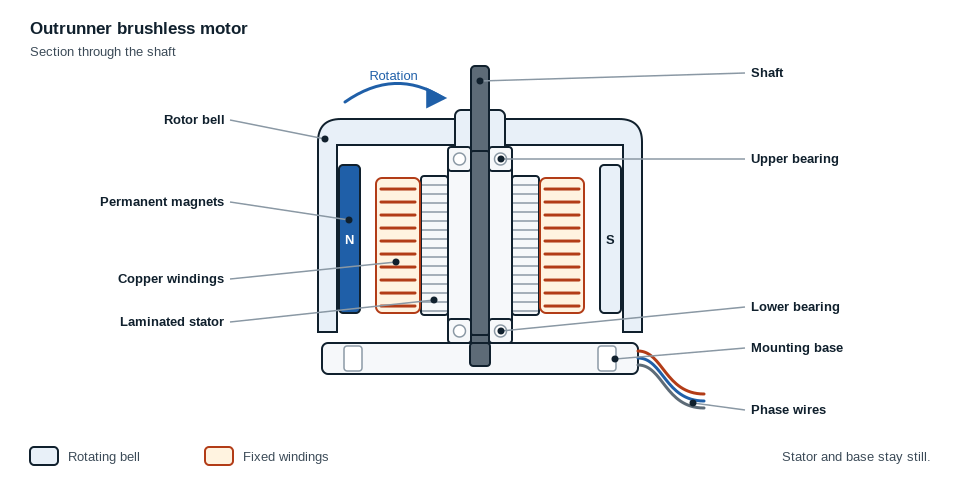
Most drone motors have the same few parts. Knowing them makes the rest of this guide easy.
- Stator. The fixed core in the center. It is a stack of thin insulated steel sheets, called laminations. The stack reduces energy lost to eddy currents.
- Windings. Insulated copper wire wrapped around the stator teeth. Most drone motors use three phases, often called A, B and C, or U, V and W. When current flows, each winding becomes an electromagnet.
- Rotor and magnets. The rotating part. It carries permanent magnets, usually neodymium, with north and south poles alternating. The rotor has no coils, no brushes and no electrical contacts.
- Shaft and bearings. The shaft carries the propeller. Ball bearings at the top and bottom let it spin smoothly.
- Base and wires. The base has the mounting holes. Three wires run to the electronic speed controller.
A brushless motor cannot run from a battery alone. It needs an electronic speed controller, or ESC. A good drone ESC contains a three-phase bridge, usually built from six power transistors called MOSFETs. These switch current between the windings in a fixed order.
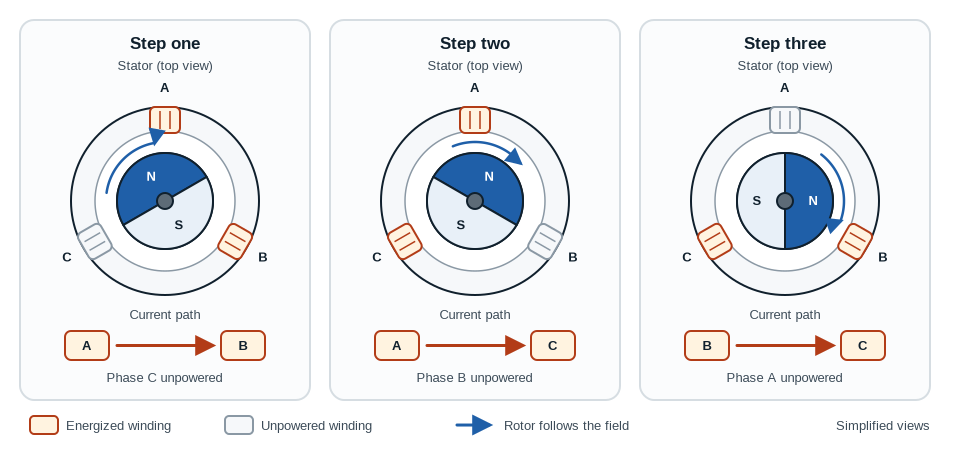
Here is the basic cycle, often called six-step or trapezoidal commutation:
1. The ESC sends current through two of the three windings.
2. Those windings become electromagnets and pull on the nearest rotor magnets. Opposite poles attract and like poles repel.
3. The rotor turns toward the new magnetic position.
4. The ESC works out where the rotor is and switches to the next pair of windings.
5. The magnetic field now sits a little further around the stator, so the rotor keeps following it.
6. The sequence repeats many thousands of times per minute. A faster switching rate means a faster motor.
This rotating magnetic field is the heart of the design. The ESC creates it, and the rotor chases it.
How the ESC knows where the rotor is
The ESC needs to know the rotor position to switch at the right moment. There are two common methods.
- Sensored. Hall-effect sensors inside the motor detect the magnets passing by. This gives smooth starts at low speed, but adds wires, cost and bulk.
- Sensorless. Most drone systems use this method. The ESC watches the unpowered winding, where the passing magnets induce a small voltage called back-EMF. It times the next switch from the moment that voltage crosses zero. At a standstill there is almost no back-EMF, so the ESC first pushes the rotor around in open loop, then switches to closed loop.
Brushed vs brushless motors
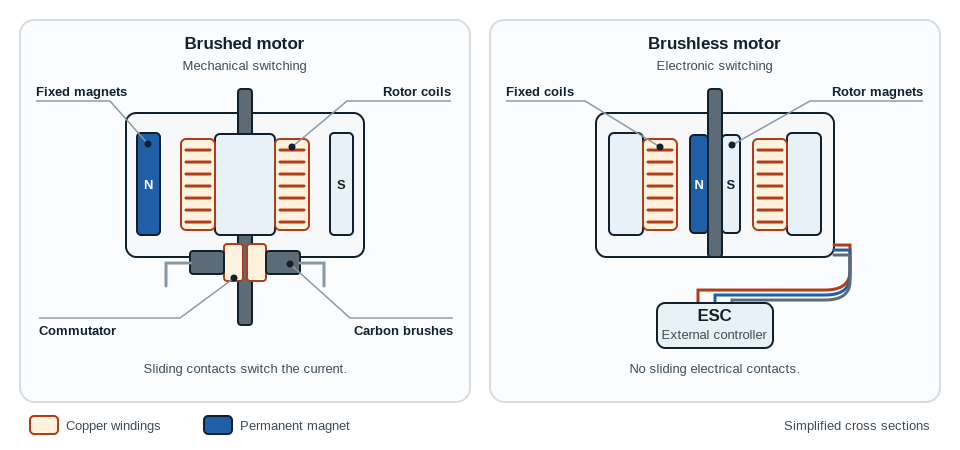
A brushed DC motor puts its coils on the rotating part and its magnets on the fixed part. Carbon brushes press against a copper commutator on the shaft. As the shaft turns, the contact points change and the current flips direction. A brushless motor moves the magnets to the rotor and the coils to the stator, so there is no sliding electrical contact inside.
| Item | Brushed motor | Brushless motor |
|---|---|---|
| Switching method | Carbon brushes and commutator | ESC with electronic switching |
| Where the coils are | On the rotor | On the stator |
| Typical life | About 1,000–3,000 hours, limited by brush wear | 10,000 hours or more, limited mainly by bearings |
| Maintenance | Brushes need cleaning or replacing | Very little |
| Sparking and noise | Brush sparking and friction noise | No sparks, quieter |
| Efficiency and power for the weight | Lower | Generally higher |
| Drive electronics | Runs directly from a DC supply | Needs an ESC |
| Starting cost and wiring | Lower | Higher |
Some guides say brushed motors have more torque. That mostly describes starting torque at zero speed with simple voltage control.
Almost all modern drone motors are brushless. Small toy drones are the main exception.
Outrunner vs inrunner
Brushless motors come in two layouts.
Outrunner. The stator sits in the center. The magnets are glued to the inside wall of a rotating outer shell, called the rotor bell. Because the magnets work at a larger radius, an outrunner of a given size produces more torque and usually has a lower KV. The spinning shell also helps cooling. The open shell lets in dust and sand more easily, and heat or a hard impact can loosen the glue that holds the magnets.
Inrunner. The stator windings are fixed to the inside of a closed case. The magnet rotor spins inside. An inrunner has very high speed and lower torque at the shaft. The closed case keeps out dirt, but cooling often needs airflow or heat sinks. Inrunners appear in ducted fans, high-speed spindles and geared systems.
Multirotor drones use outrunners almost everywhere. A typical FPV motor is an outrunner, and so is a heavy-lift drone motor. Both turn large propellers directly, without a gearbox.
Sourcing motors for a drone project? Ask our team.
What KV means
KV is the velocity constant of a motor. It tells you how many revolutions per minute the motor turns for each volt applied, with no propeller fitted. The unit is RPM per volt.
The letters do not mean kilovolts. The K stands for constant and the V stands for velocity.
The formula is:
No-load RPM = KV × voltage
Here is a worked example for a 5-inch propeller setup on a 4S battery. A fully charged 4S battery is 16.8 V, and the nominal voltage is 14.8 V. Take a motor of 2,300 KV, which is inside the usual 4S range for this size:
- 2,300 KV × 14.8 V = 34,040 RPM with no propeller.
With a propeller fitted, the real speed is lower. Air resistance loads the motor, and the battery voltage sags under current.
KV limits speed because a spinning motor generates its own voltage, called back-EMF. When it approaches the battery voltage, little is left to push current through the windings, so the motor cannot go faster.
KV and winding
For the same stator size, a high-KV motor typically uses fewer turns of thicker copper wire. A low-KV motor typically uses more turns of thinner wire.
Many beginner guides say low KV means more torque. That is a handy rule for choosing propellers, but KV does not set the maximum torque or power. What changes is torque per amp. A low-KV motor needs less current for the same torque, but more voltage for the same speed. Stator size and heat limits decide how much torque a motor can sustain.
Stator size and motor naming
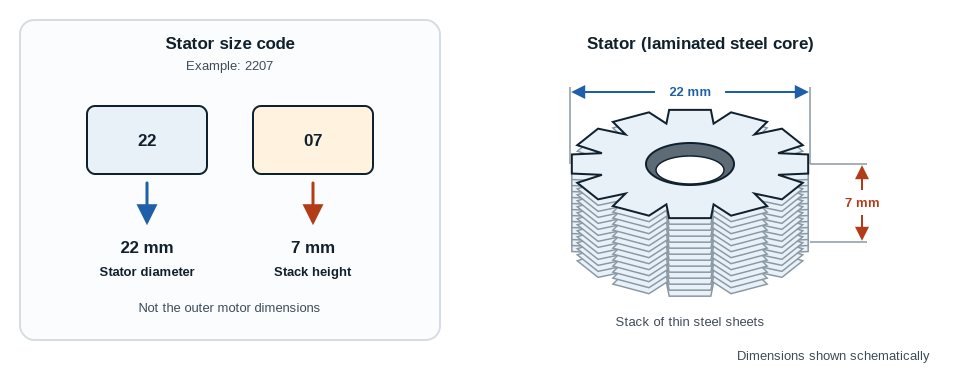
A four-digit number such as 2207 describes the stator, not the outside of the motor.
- First two digits: stator diameter in millimeters. In 2207 this is 22 mm.
- Last two digits: stator height, or stack height, in millimeters. In 2207 this is 7 mm. A decimal such as 2806.5 means 6.5 mm.
A larger stator volume handles more heat and sustains more torque, so bigger stators suit larger or higher-pitch propellers.
People often compare 2207 motors with 2306 motors. Many tutorials say the wider 2306 feels smoother at low throttle, while the taller 2207 has more top-end punch. The two have similar stator volume, and air gap, magnet grade and winding design also change the feel.
You may also see a code like 12N14P. The 12N is the number of stator slots, or teeth. The 14P is the number of rotor magnet poles. Two poles make a pole pair, so 14P means 7 pole pairs. Electrical RPM equals mechanical RPM times the number of pole pairs. Multirotor motors often use 12N14P because it reduces cogging, the notchy feel when you turn the bell by hand, giving smoother running and less vibration for the flight controller.
Motor specifications explained
These ranges are typical for civilian multirotors and FPV drones. Actual values depend on the winding, magnets and design.
| Parameter | What it means | 1S micro | 3 in. | 5 in. | 7 in. |
|---|---|---|---|---|---|
| KV (RPM per volt) | No-load speed per volt | 20,000–30,000+ | 3S–4S: 3,300–5,500 | 4S: 2,300–2,700; 6S: 1,700–1,950 | 6S: 1,250–1,500 (2806.5); 900–1,250 (3110) |
| Stator size | Diameter × height in mm | 0702, 0802 | 1204, 1404 | 2207, 2306 | 2806.5, 3110 |
| Max current (A) | Peak draw at full throttle; sets ESC size | 5–8 | 6–20 | 35–55 | 45–65 |
| Max power (W) | Volts × amps at full load | 20–35 | 60–250 | 700–950 | 1,100–1,500 |
| Resistance (mΩ) | Winding resistance; more resistance means more heat | 100–300 | 140–330 | 40–70 | 43–76 |
| Weight (g) | One motor | 1.5–2.5 | 5.5–9.0 | 30–35 | 45–90 |
A motor thrust table adds two more details. Total thrust should be at least twice the weight of the aircraft. Freestyle builds often reach five to eight times the aircraft’s weight, while racing builds often reach eight to twelve times or more. Thrust efficiency, measured in grams of thrust per watt, is usually highest at low throttle (around 10–30 percent) and falls as throttle increases. The 30–50 percent range is typical of hover and cruise, while the motor’s electromechanical efficiency usually peaks at 60–80 percent throttle.
How to read a thrust table
1. Check the test conditions first: propeller diameter, pitch, blade count and battery voltage. Change either one and the table no longer applies.
2. Look at current at 100 percent throttle. Your ESC rating must be higher, with margin. A peak of 26 A, for example, is often paired with a 35–40 A ESC.
3. Check thrust near 50 percent throttle. All motors together should lift the aircraft easily, with hover between 30 and 50 percent.
4. Compare grams per watt across the 30–60 percent range. A higher number gives longer flight time.
Matching motor, propeller and battery
Start with the propeller. The frame decides the largest one that fits, and it sets the load on the motor. Then pick the battery voltage: a 4S pack is 14.8 V nominal and a 6S pack is 22.2 V. Higher voltage delivers the same power with less current, so there is less sag and heat.
Then choose KV. A larger propeller or a higher voltage calls for a lower KV. For a 5-inch three-blade propeller, the usual range is 2,300–2,700 KV on 4S and 1,700–1,950 KV on 6S. Pick a stator size that suits the propeller, such as a 2207 or 2306 for 5-inch, or a 2806.5 for 7-inch.
Finally, fine-tune with blade count and pitch. Two-blade propellers are efficient for long flights, three-blade propellers balance grip and response, and four or more add drag. A higher pitch gives more top speed but draws more current.
Browse drone propellers, 4S LiPo batteries and 6S LiPo batteries to see what pairs with each motor size. Our FPV wiring diagram shows how the motors connect to the rest of the drone.
Common mistakes
- Mismatching KV, voltage and propeller. A high-KV motor made for 4S on a 6S pack, or a very large propeller, pulls too much current. The motor gets too hot to touch, the winding insulation can burn and the magnets can lose strength. Follow the rule of lower KV for bigger propellers and higher voltage, check the thrust table current, and feel the motors after a flight.
- Using mounting screws that are too long. A screw tip can press into the copper windings and cause a short. Match screw length to arm thickness plus the depth of the motor base. Check clearance through the side gap, and use a multimeter in continuity mode to confirm no phase wire beeps to the motor base or frame.
- Ignoring sand and dirt. Grit in an open outrunner or the bearings causes grinding, rough turning and high current. Use a landing pad, clean with compressed air and replace worn bearings. Do not drip thick oil or grease into gritty bearings.
- Leaving loose or slipped magnets unnoticed. After a hard crash or long periods of heat, the glue can soften and a magnet can shift. Spin each bell by hand with propellers off and listen for scraping.
- Chasing peak thrust and ignoring efficiency. The motor with the highest full-throttle thrust is not always the best choice. Compare grams per watt in the normal flying range, or flight time will suffer.
- Powering up with propellers on. Keep them off for bench tests, first power-up and motor direction checks. For a first test, use a smoke stopper between the battery and the aircraft.
- Not checking spin direction. Test each motor with propellers off and confirm it matches the frame layout. To reverse one, change it in the ESC software or swap any two of the three motor wires.
Frequently asked questions
How does a brushless motor work without brushes?
The magnets sit on the rotating part and the copper windings sit on the fixed stator. An ESC switches current through the three phases in order, which creates a rotating magnetic field that pulls the rotor around.
What is the difference between brushed and brushless motors?
A brushed motor switches current with carbon brushes and a commutator, so it wears and sparks. A brushless motor uses an ESC instead, which gives longer life, quieter running and less maintenance, but it needs that controller.
What does KV mean in a motor? Does it mean kilovolts?
No. KV is the velocity constant, the no-load RPM per volt. Multiply KV by the battery voltage to estimate the speed with no propeller fitted.
Does a lower KV motor have more torque?
A lower-KV motor makes more torque per amp, so it needs less current for a given torque. KV alone does not set the maximum torque, which depends mainly on stator size and heat limits.
What do the numbers on a drone motor mean, like 2207?
In 2207, the first two digits are the stator diameter in millimeters (22) and the last two are the stator height (7). A code like 12N14P means 12 stator slots and 14 rotor magnet poles.
What is the difference between an outrunner and an inrunner?
An outrunner has magnets on a spinning outer bell, which gives more torque and a lower KV. An inrunner spins its magnets inside a closed case at very high speed with lower torque.
Why does a brushless motor have three wires?
The three wires connect to the three phase windings inside the stator. The ESC powers them in sequence. To reverse the spin direction, swap any two wires or change it in the ESC software.
How do I know if my motor, propeller and battery are mismatched?
Warning signs include motors too hot to touch after a short flight, current above the ESC rating and heavy battery sag. Weak throttle response with a hover well above 50 percent can point to the opposite mismatch.