FPV Antennas Explained: RHCP vs LHCP, SMA vs RP-SMA
An FPV antenna is described by both its radio wave polarization and the connector on the end of its cable. Understanding RHCP vs LHCP helps you read the label on a circular polarized antenna, while understanding SMA vs RP-SMA helps you identify the connector. Here is what these terms mean and how to recognize the differences when shopping for replacement parts.
How linear and circular polarization work
Browse FPV antennas for FPV drones. An antenna can send or receive radio waves. Polarization describes the orientation of the electric field of a radio wave in the plane across its direction of travel.
Imagine looking along the direction in which a radio wave travels. You could draw an arrow to represent its electric field. The way this arrow moves over time tells you what kind of polarization the wave has.
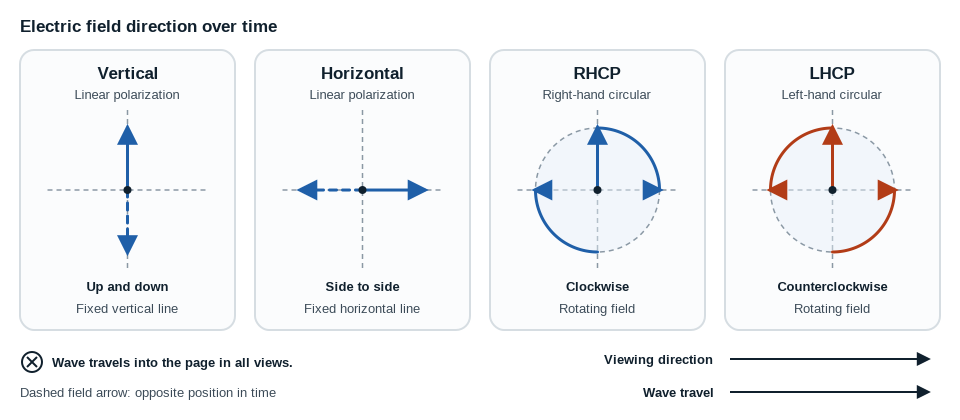
Linear polarization. The electric field oscillates along a fixed line. If the field moves up and down, this is vertical polarization. If it moves from side to side, this is horizontal polarization. Whip, dipole and T-shaped antennas are familiar examples of linear antennas.
Circular polarization. In an ideal circularly polarized wave, the electric field rotates while maintaining the same magnitude. You can think of it as an arrow whose tip traces a circle. As the wave travels, the pattern resembles a corkscrew. This happens when perpendicular linear field components of equal magnitude are separated in phase by 90 degrees.
Elliptical polarization. A real circularly polarized antenna may not produce a perfect circle. The path traced by the electric field can be more like an oval. Axial ratio, explained in the parameter table below, describes how different the long and short axes of that oval are.
The FPV parts glossary explains other common equipment terms. In antenna descriptions, the letters CP stand for circular polarization. They describe the radio wave rather than the antenna's plug or protective cover.
RHCP vs LHCP
Circular polarization comes in right-hand and left-hand forms. The difference is the direction in which the electric field rotates.
- RHCP (Right-Hand Circular Polarization). The field rotates clockwise when viewed along the direction of wave travel.
- LHCP (Left-Hand Circular Polarization). The field rotates counterclockwise from the same viewing direction.
The direction from which you look at the wave matters. Think of watching a clock through a transparent sheet. If you move around to the back, the hands appear to turn the other way. A drawing of circular polarization needs a direction-of-travel arrow to make the description unambiguous.
Neither RHCP nor LHCP is inherently better than the other. They represent opposite senses of rotation under the same definition. The polarization label on the antenna is distinct from the label on the video transmitter or the FPV goggles that describes its connector.
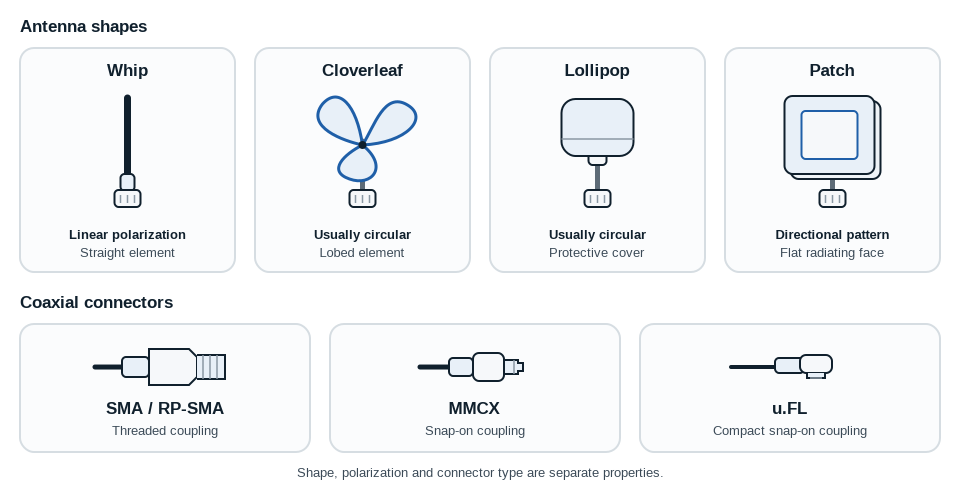
The shapes sold as FPV antennas also vary. A cloverleaf antenna has a lobed shape. A pagoda antenna has a stack of circuit boards, while a lollipop antenna has a protective cover around its radiating element. These are common forms of circularly polarized antennas.
You may also see the terms omnidirectional and directional. They describe an antenna's radiation pattern, not its polarization. An omnidirectional antenna has a pattern often illustrated as a doughnut. A directional antenna, such as a patch, has a radiation pattern concentrated around a main direction. A pattern drawing therefore answers a different question than an RHCP or LHCP label does.
What the antenna connector does
A coaxial connector is the physical interface between an antenna and a radio device. Examples of equipment with these interfaces include FPV video receivers and analog VTX modules.
Coaxial connections have an outer conductor and a center contact. SMA and RP-SMA use a threaded coupling. Other compact connectors, such as MMCX and u.FL, use snap-on connections instead.
The connector and the radiating element have separate roles. The connector is part of the electrical connection, and the radiating element determines the polarization of the emitted wave. A reverse-polarity connector has no special relationship to a left-hand circularly polarized wave.
SMA and RP-SMA. These threaded connector families look very similar on the outside. The RP in RP-SMA stands for reverse polarity. In this name, polarity refers to the arrangement of the center contacts, not to the rotation of the radio wave.
MMCX. This is a smaller snap-on coaxial connector. Its plug and socket join without a threaded coupling. The connected interface can rotate.
u.FL. This is a very small board-mounted coaxial interface designed for comparatively infrequent connection and disconnection. You may also see the name IPEX or MHF in antenna listings. Those labels can refer to different sizes of compact connectors, so they are not interchangeable names for every small plug.
SMA vs RP-SMA: how to tell them apart
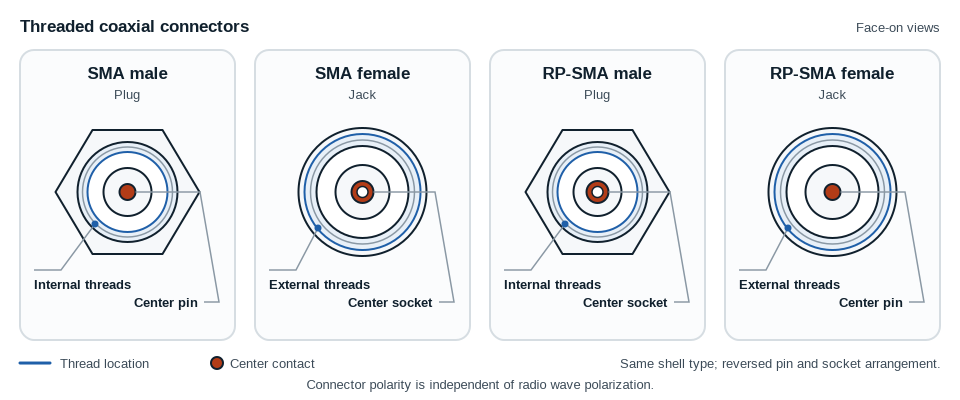
The shell determines whether the plug has threads on the inside or the outside. The center contact is the small pin or socket, separate from those threads.
| Feature | SMA | RP-SMA |
|---|---|---|
| Male (plug) threads | Internal | Internal |
| Male center contact | Pin | Socket |
| Female (jack) threads | External | External |
| Female center contact | Socket | Pin |
| Coupling mechanism | Threaded | Threaded |
| Determines wave polarization? | No | No |
An SMA male and an RP-SMA male look almost identical until you inspect the center. The same is true of the female variants. A male connector does not necessarily have a center pin. With RP-SMA, the male connector has a center socket instead.
The thread fit alone does not establish compatibility. Some mismatched connectors can screw together even though there is no center contact. Others bring the pins into contact with each other rather than into sockets, which can damage the pins.
This is why a picture of the side of a plug is not enough to identify its type. A front view showing the center contact is helpful. The same principle applies whether the connector is shown in a photograph or in a line drawing.
Sourcing FPV antenna replacement parts for your shop or school? Ask our team.
How to identify an antenna and connector before buying a replacement
When browsing FPV drone parts, keep separate notes for the polarization label and the connector name. You can use the same approach to inventory parts for a recreational flying club or a commercial repair counter.
Step 1. Read the polarization label. Look for RHCP, LHCP or linear polarization in the part description or on the antenna packaging. Do not guess the polarization from the housing color. Write the full label in your inventory.
Step 2. Identify the connector family. Examine the connector on the replacement listing. Is it a threaded SMA-style connector or a small snap-on connector? For compact connectors, record the specific interface name rather than simply writing miniature.
Step 3. Identify the shell and center contact. For a threaded connector, record the thread location and whether the center is a pin or a socket. Compare the combination to the table above. This gives the full connector designation rather than just male or female.
Step 4. Check the condition of the part. With equipment such as analog FPV goggles switched off, inspect removable connectors for damaged threads or bent center contacts. A squeezed or sharply creased coaxial cable can also be damaged internally, even if the outside does not look torn.
Step 5. Handle the connector gently. Do not force a connector that does not seat normally or try to use the threads to push a pin into place. Avoid unnecessary disconnection of small board-mounted plugs. Their mechanical life is limited compared with that of larger threaded interfaces.
Common FPV antenna specifications
A spec sheet may describe the radiating element, the electrical interface or the mechanical connector. It helps to know which feature each parameter belongs to before comparing listings.
| Parameter | Meaning | Common range or reference value | Unit |
|---|---|---|---|
| Phase difference | Difference in phase between field components of ideal circular polarization | 90 | Degrees |
| Axial ratio | Ratio of the major and minor electric field axes | Ideal 0; good below 3 | dB |
| Characteristic impedance | Electrical property of the coaxial interface | 50 | Ohms |
| VSWR | Voltage standing wave ratio; describes impedance matching | Ideal 1.0:1 | Ratio |
| SMA/RP-SMA connector mating life | Rated connection and disconnection durability | Brass: typically 100–250; stainless steel: typically 500 or more | Cycles |
| MMCX connector mating life | Rated connection and disconnection durability | 500 or more | Cycles |
| u.FL connector mating life | Rated connection and disconnection durability | About 30 | Cycles |
Axial ratio can be expressed either as a plain ratio or in decibels, abbreviated dB. An ideal circle has equal axes, so the ideal plain ratio is 1:1. The same ratio expressed in decibels is 0 dB. These values describe the same field shape.
VSWR is a different ratio. It describes the relationship between the transmission line and the antenna's electrical impedance. The ideal ratio in the table represents no reflected power at the interface. It is not a description of whether the field rotates clockwise or counterclockwise.
Mating cycles are a mechanical specification. They describe how many connection and disconnection cycles a connector is rated to withstand. The ratings for u.FL help explain why these plugs are generally used inside equipment instead of as everyday removable connectors.
The impedance value is an electrical specification, not a measure of the connector's physical size. Both a small snap-on interface and a larger threaded interface can have the same nominal characteristic impedance.
Common mistakes
- Assuming reverse polarity means LHCP. The RP in RP-SMA describes the connector's center contact arrangement. It does not specify an antenna's circular polarization.
- Identifying SMA by its threads alone. The SMA and RP-SMA shells can look alike. A visible center contact is necessary to distinguish them.
- Assuming every male plug has a pin. RP-SMA male connectors have a socket. Read the complete connector designation.
- Forcing a mismatched connector. If center pins meet each other, tightening the coupling can bend or break them. Do not force the connection.
- Treating all tiny snap-on connectors as identical. MMCX, u.FL and the smaller MHF variants have different physical interfaces.
- Unplugging a u.FL connector repeatedly. A small board-mounted connector has a limited mating life. Repeated handling can wear out its connection.
- Running a video transmitter with an open antenna port. An open output can reflect radio-frequency energy into the transmitter and cause damaging heat. Keep the equipment switched off while inspecting the port or changing the antenna.
- Confusing axial ratio with VSWR. Axial ratio describes the shape of the polarized electric field. VSWR describes electrical impedance matching. The values are not substitutes for each other.
Frequently asked questions
What does circular polarization mean on an FPV antenna?
It means the electric field of the radio wave rotates as the wave travels. In ideal circular polarization, the tip of the electric field arrow traces a circle.
What is the difference between RHCP and LHCP?
RHCP means right-hand circular polarization, while LHCP means left-hand circular polarization. The electric field rotates in opposite directions when viewed along the direction of wave travel.
How can I tell if a connector is SMA or RP-SMA?
Look at both the threads and the center contact. An SMA male has internal threads and a center pin, while an RP-SMA male has internal threads and a center socket.
Is an RP-SMA antenna always LHCP?
No. RP-SMA describes the arrangement of the connector contacts, while LHCP describes the radio wave's polarization.
Are MMCX and u.FL the same connector?
No. Both are compact snap-on coaxial interfaces, but u.FL is a much smaller board-mounted connector with a lower rated mating life.
What does axial ratio mean for a circular polarized antenna?
Axial ratio describes the ratio of the long and short axes traced by the electric field. Ideal circular polarization has an axial ratio of 0 dB.
Can a video transmitter be damaged without an antenna?
Yes. Operating a transmitter with an open antenna port can reflect radio-frequency energy back into its output stage and cause damaging heat.