Drone Propeller Size and Pitch Explained: How to Read Prop Specs
Drone propeller size and pitch are the two numbers that describe how a propeller is built and how it will behave. If you have ever asked what propeller pitch is, or whether a 2 vs 3 blade propeller is the better choice, this guide explains it in plain language. You will learn how to read a code like 5x4.3x3, how each number changes thrust, current and flight time, and how to pick and fit a propeller safely.
What the numbers on a propeller mean
A propeller is a rotating wing. Each blade has an airfoil shape, like a small aircraft wing. As it spins, it creates lower pressure above the blade and higher pressure below it. The pressure difference speeds the air downward, and the reaction pushes the drone up. That push is thrust.
Blade tips move much faster than the center of the blade. So a blade is twisted. It is set at a steeper angle near the hub and a flatter angle near the tip. This keeps the angle between the blade and the oncoming air roughly even along its length and helps stop the blade from stalling.
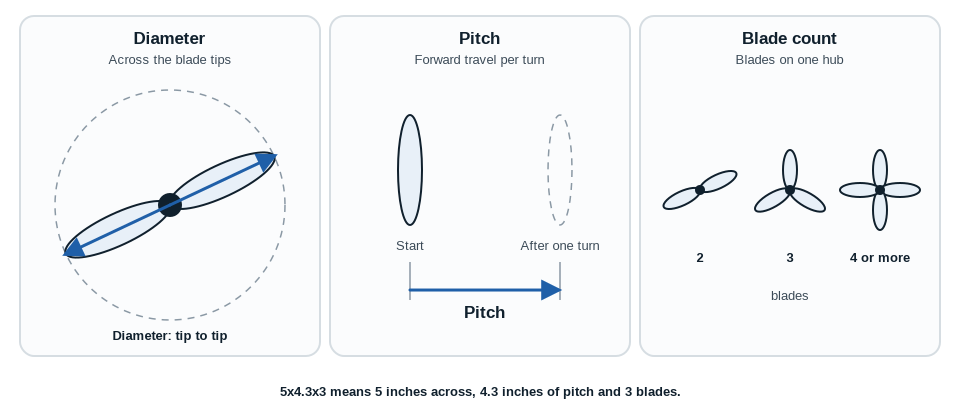
Three numbers describe most propellers.
- Diameter is the width of the circle swept by the blade tips. It is usually measured in inches. The frame and arm length limit how large it can be.
- Pitch is the distance the propeller would move forward in one full turn if it screwed through a solid, like a wood screw in a block. It is also measured in inches. In real air, a propeller always slips, so the real distance is shorter.
- Blade count is the number of blades on one hub.
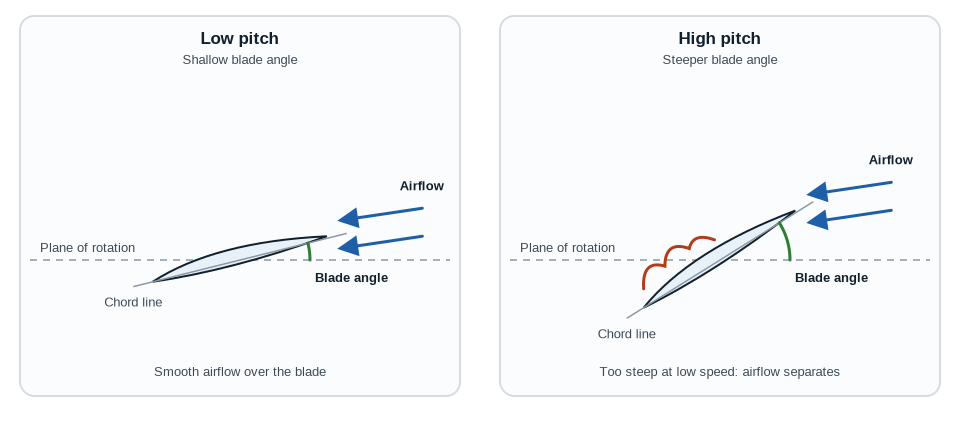
Aviation manuals describe pitch in a second way, as the blade angle. This is the angle between the blade's chord line and the plane of rotation. The chord line is an imaginary line from the leading edge to the trailing edge. A fine, or low, pitch means a small blade angle. A coarse, or high, pitch means a large one.
How to read a code like 5x4.3x3
Many drone propellers are named in the order diameter, pitch and blade count.
- 5x4.3x3 means 5 inches across, 4.3 inches of pitch and 3 blades.
- 5043 is a four-digit shorthand for the same size: 5.0 inches of diameter and 4.3 inches of pitch. It often leaves out the blade count.
- 5030 means 5.0 inches by 3.0 inches.
Rotation direction is marked in different ways. Some makers add an R to mean reversed rotation. It often means clockwise, but brands define it differently, so it cannot be treated as the same thing as CW. Others label the same part CW or CCW, A or B, or use rings and colored dots on consumer camera drones. Brands do not agree, so do not trust the letters alone. Check the shape of the blade and the motor it goes on.
How size, pitch and blade count change flight
Think of pitch like the gears of a car. A low pitch is a low gear. A high pitch is a high gear. Diameter and blade count then change how much air the propeller moves and how smoothly.
Diameter
For the same thrust, a larger propeller can turn slower and move more air. That lowers losses and usually gives better efficiency, measured in grams of thrust per watt. A large propeller is heavier to spin up, so it reacts more slowly and needs more motor torque. Motors with a lower KV rating suit large propellers. A small propeller changes speed very quickly, which feels agile, but it is less efficient.
Size also has a speed limit. Tips cannot get too close to the speed of sound. In engineering tests, tip speed is normally kept below about Mach 0.7 to 0.8. Beyond that, drag rises sharply and efficiency collapses.
Pitch
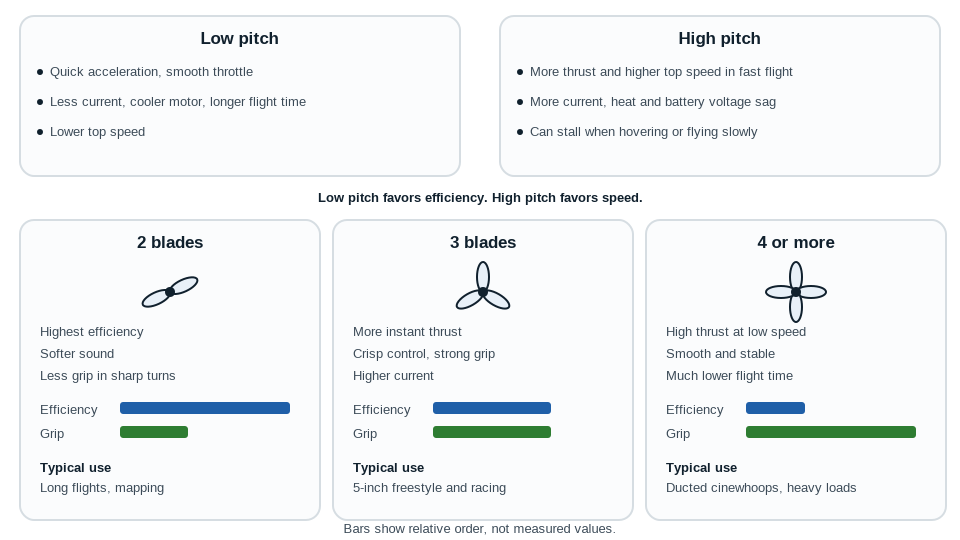
A low pitch gives quick acceleration and smooth, easy throttle control. It draws less current, keeps the motor cooler and gives longer flight time. Its top speed is lower.
A high pitch bites more air on each turn. It gives more thrust and a higher top speed when the drone is moving fast. But it draws more current, heats the motor and speed controller and causes more battery voltage sag.
Many beginners think a higher pitch always means more thrust. That is not true. When a drone hovers or flies slowly, a very steep blade meets the air at too sharp an angle. The airflow separates from the blade. This is called blade stall. Thrust feels soft at low throttle, efficiency drops and current climbs. A high pitch pays off in fast forward flight, where the oncoming air reduces the effective angle.
Blade count
| Blade count | Strengths | Trade-offs | Typical use |
|---|---|---|---|
| 2 blades | Least drag and wake interference, highest efficiency, softer sound | Less grip in sharp turns, can feel floaty | Long flights, aerial photography, mapping |
| 3 blades | More instant thrust, crisp control, strong grip in turns | Lower efficiency than a 2-blade prop of the same size, higher current | 5-inch freestyle and racing |
| 4 or more blades | High thrust at low speed, smooth airflow, stable | Much lower efficiency and flight time, very high current | Ducted cinewhoops, some heavy loads |
So in a 2 vs 3 blade propeller choice, the 2-blade version wins on efficiency and the 3-blade version wins on punch and control. A classic theory says a single blade should be most efficient because it never flies in another blade's wake. Thrust-stand tests found that a single blade only wins at very low thrust. As thrust rises, a standard 2-blade propeller quickly overtakes it.
Looking for propellers for your drone range or project? Ask our team.
Folding and fixed propellers
A folding propeller has blades on hinges or pins. The blades fold flat when the motor stops and swing open by centrifugal force when it spins. This makes the drone easy to carry and quick to set up. On fixed-wing and VTOL aircraft, blades can fold back when the motor is off to cut drag. The downsides are extra wear points and a little throttle lag during fast changes. Uneven opening or loose fits can cause vibration.
A fixed propeller is one rigid piece. It has no hinge play, so the throttle response is direct. It is simple, vibrates less and has few parts to maintain. It takes more space to carry, and it has no give when it hits something hard.
Fixed propellers suit agile FPV drones. Folding ones suit portable camera drones and aircraft that spend time gliding.
Key specifications
| Parameter | What it means | Typical range | Unit |
|---|---|---|---|
| Diameter, micro and indoor | Width of the circle swept by the tips | 1.2–3.5 | inch |
| Diameter, standard FPV | Mainstream freestyle and racing size | 4.0–5.1 (5.0 is the usual standard) | inch |
| Diameter, long range and cinema | Larger FPV and camera-lifting sizes | 6.0–10.0 | inch |
| Diameter, commercial and heavy lift | Inspection, mapping, agriculture | 11–30 and above | inch |
| Pitch, 5-inch props | Low pitch, balanced and high pitch | 2.5–3.5 low; 4.0–4.3 balanced; 4.5–5.5 and above high | inch |
| Blade count | Blades on one hub | 2, 3, or 4 and more | blades |
| Shaft bore, small | Hole that fits the motor shaft | 1.0, 1.5 or 2.0 | mm |
| Shaft bore, standard | M5 nut mount | 5.0 | mm |
| Shaft bore, heavy | M6 nut or multi-hole flange | 6.0 and above | mm |
| Propulsive efficiency | Propulsion power divided by shaft power, a forward-flight figure (for hovering, use figure of merit or grams per watt instead), measured for small propellers | About 30–65 at peak in forward flight; excellent propellers at high Reynolds number can reach 65–75 | % |
Materials differ by size. Polycarbonate or other engineering plastic suits micro drones such as the tiny whoop and tough 5-inch props. Glass-fiber reinforced nylon suits stiff, low-cost 7 to 15 inch props. Carbon fiber propellers suit commercial aircraft from about 10 to 30 inches or more, where low flex matters.
How to choose and fit a propeller
1. Check the frame. Find the largest propeller your frame allows. A 5-inch frame takes 5-inch props. Check clearance from the tips to the arms, body, camera and standoffs.
2. Match the motor and battery. Choose a size, pitch and blade count that your motor, ESC and battery can handle without over-propping. For a large multirotor, such as an agricultural drone, aim for total maximum thrust of at least twice the maximum takeoff weight. Try for a hover throttle of about 40 to 50 percent.
3. Match the mission. For long flights, camera work and survey drones, choose a large diameter, low to medium pitch and 2 blades. For 5-inch freestyle and racing, a 3-blade propeller with medium to high pitch is the common choice. If turns feel floaty, add a blade for more grip in the turn. Lower the pitch only when a very high pitch makes the drone feel mushy at low speed. If the motors run hot or the battery sags hard, lower the diameter or pitch when you add blades.
4. Check the direction. A standard quad runs "props in", with the front-left motor clockwise, front-right counterclockwise, rear-left counterclockwise and rear-right clockwise. "Props out" reverses all four. It throws grass and mud away from the camera. Changing it means reversing the motors in the ESC setup and flight controller settings too.
5. Remove the propellers for any software work. Unplug the battery first, then take off every propeller. For settings work, keep the battery unplugged and connect only by USB. To test motor direction, keep the propellers off, connect the battery, and unplug it again as soon as the test ends. Do this whenever you connect a computer to the flight controller.
6. Mount the right way up. The printed or curved side usually faces up. The thick, rounded leading edge must cut into the air in the direction of spin. Put a CW propeller on a CW motor and a CCW propeller on a CCW motor.
7. Tighten correctly. Hold the motor bell and snug the nylon lock nut. Replace it when the nylon ring wears. For self-tightening and twist-lock mounts, the locking direction is opposite to the motor's spin, so the motion keeps tightening it. Press until you hear the click and give a gentle pull. For bolt mounts, use the screw length the maker specifies. Folding blades should swing freely.
8. Spin by hand. Turn each propeller gently. It should move smoothly without touching the frame or wires.
9. Balance when it matters. Small plastic props are usually fine as they come. Large carbon props on camera and survey aircraft benefit from balancing. Static balancing uses a magnetic balancer. Tape on the lighter blade, then retest. Dynamic balancing measures vibration on a thrust stand at working speed. Fix the vibration at the source. Do not hide it with software filters. Do not sand pre-balanced folding props.
For the full power chain, see how a brushless motor works, what an ESC is and the FPV wiring diagram. Ready-made options are listed under motors, ESCs and propellers.
Common mistakes
- Mounting the propeller upside down. The drone will not lift or will spin on the ground. Printed side up, thick leading edge into the airflow.
- Wrong direction for the motor. The drone flips to one side the moment it takes off. Two neighboring motors spin opposite ways to cancel torque. Check the layout and test each motor with the propellers off. If you change props in or out, change the setup too.
- Loose nut or unlatched quick-release. The propeller can slip on the shaft or fly off. Tighten with a tool, replace worn nylon locks, and pull-test quick-release props.
- Overtightening or using long screws. White stress marks, cracked hubs and stripped shafts follow. A screw that is too long can reach the motor windings and damage the wire insulation. Tighten until snug, then a little more, never by force.
- Folding-propeller pivot too tight. The blades cannot open evenly. You see strong vibration, whining and sometimes a desync. The blade should swing out with a light flick.
- Flying nicked, bent or cracked propellers. Noise, hot motors, shorter flights and wobbly video follow. Even a small imbalance greatly increases vibration and wears the bearings. Check the leading edge and root before each flight, and replace damaged props. On camera drones, replace in pairs or sets.
- Chasing high pitch or big size. Slow lift-off, weak low throttle, battery sag and hot motors are the signs. Check frame clearance first. Then change pitch in small steps and lower it or use fewer blades if parts run hot.
- Testing with propellers on. A single wrong touch on a throttle slider can spin the motors at full speed and cause serious injury. Every flight controller guide gives the same first rule: props off whenever you connect a computer or test motors.
Frequently asked questions
What is propeller pitch on a drone?
Pitch is the distance a propeller would move forward in one full turn if it screwed through a solid, like a wood screw. It is measured in inches. In real air the propeller slips, so the actual distance is shorter.
What does 5x4.3x3 mean on a drone propeller?
The first number is the diameter, 5 inches. The second is the pitch, 4.3 inches. The third is the number of blades, 3. A shorthand such as 5043 means the same diameter and pitch and often leaves out the blade count.
What is the difference between low pitch and high pitch propellers?
A low pitch gives smooth throttle control, lower current, a cooler motor and longer flights. A high pitch gives more thrust and a higher top speed in fast flight, but it draws more current and heats the motor and ESC.
Are 2 blade or 3 blade propellers better for drones?
It depends on the job. Two blades are the most efficient and suit long flights, camera work and mapping. Three blades give more instant thrust and grip in turns, so they are the common choice for 5-inch freestyle and racing, at the cost of efficiency.
Does higher propeller pitch always give more thrust?
No. In fast forward flight a high pitch can raise top speed. When hovering or flying slowly, a very high pitch can stall the blade, which makes thrust feel soft and raises the current.
Are folding propellers less efficient than fixed propellers?
Not necessarily. Fixed propellers respond more directly and vibrate less, which suits agile flying. Folding propellers are easier to carry and cut drag when the motor is off, and the exact efficiency gap depends on the propeller and motor.
How do I know if a drone propeller is CW or CCW?
Do not rely on an R in the name, because brands use it differently. Check which edge leads into the air as the blade spins, and match the propeller to the motor direction. On camera drones, match the ring or colored dot marks to the arm.
Do I need to balance new drone propellers?
Small plastic propellers are usually fine as they come. Large carbon fiber propellers on camera and survey aircraft benefit from static or dynamic balancing. Pre-balanced folding propellers should not be sanded.