How Do Agricultural Spray Drones Work?
A spray drone is a multirotor aircraft that carries a tank, a pump and nozzles to apply liquid products over a field. Drone spraying works by pumping the liquid to the nozzles at a rate matched to the flying speed. The aircraft follows a pre-planned route over the crop. This guide explains the parts, the two main nozzle types, how a crop spraying mission runs and which settings matter most.
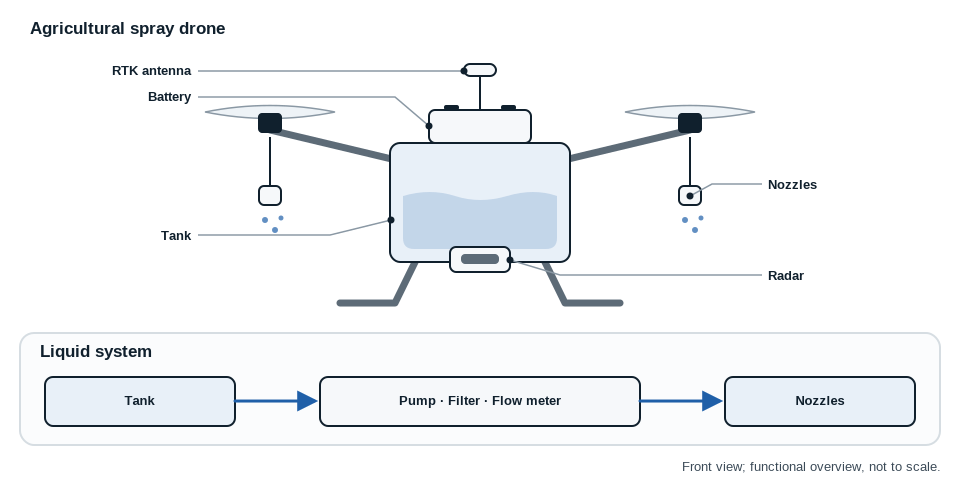
What a spray drone is
An agricultural drone built for spraying carries diluted crop protection products or liquid fertilizer. A drone sprayer flies low over the crop and releases the liquid as fine droplets. Size classes are roughly small (8–10 L tank), medium (20–30 L), large (40–50 L) and extra large (70–80 L).
Drones use far less water than a tractor sprayer. A drone usually applies about 10–50 liters per hectare, or 1–5 gallons per acre. The strong downwash from the rotors also pushes droplets down into the crop canopy. Drones work well on wet ground, slopes, tall crops and small or awkward fields. On large, flat fields where the label calls for a high water volume, ground sprayers still move more area per day. The two tools complement each other.
Main parts and what each does
| Part | What it does |
|---|---|
| Tank | Holds the diluted product. It is made of chemical-resistant plastic, and internal baffles reduce sloshing in flight. |
| Pump | Moves liquid to the nozzles. Types include diaphragm, impeller and peristaltic pumps, usually driven by a brushless motor. The flight controller changes pump speed with ground speed. |
| Filter | Catches undissolved powder and debris so they do not block the pump, flow meter or nozzles. |
| Nozzles or atomizers | Break the liquid into droplets of a chosen size. |
| Flow meter | Measures how much liquid flows and reports it to the flight controller, which adjusts the pump in a closed loop. |
| Level or weight sensor | Tracks what is left in the tank, stops the pump from running dry and can trigger a return when the tank is empty. |
| Radar and vision | Forward and backward radar can detect wires, branches and poles from about 50 m away, in dust, spray mist and low light. Stereo cameras add a 3D view for braking or going around obstacles. |
| Downward radar or altimeter | Measures height above the ground or crop canopy so the drone can follow terrain at a steady spray height. |
| RTK positioning | Corrects ordinary satellite positioning to roughly 1–2 cm, so neighboring passes join up without gaps or overlaps. |
Components such as an RTK module, millimeter-wave radar and radar altimeter work together with the agricultural spraying system components to keep the spray even. A drone battery powers both the flight motors and the pump.
Looking for a spray drone or spare parts for a farm business? Ask our team.
Pressure nozzles vs centrifugal atomizers
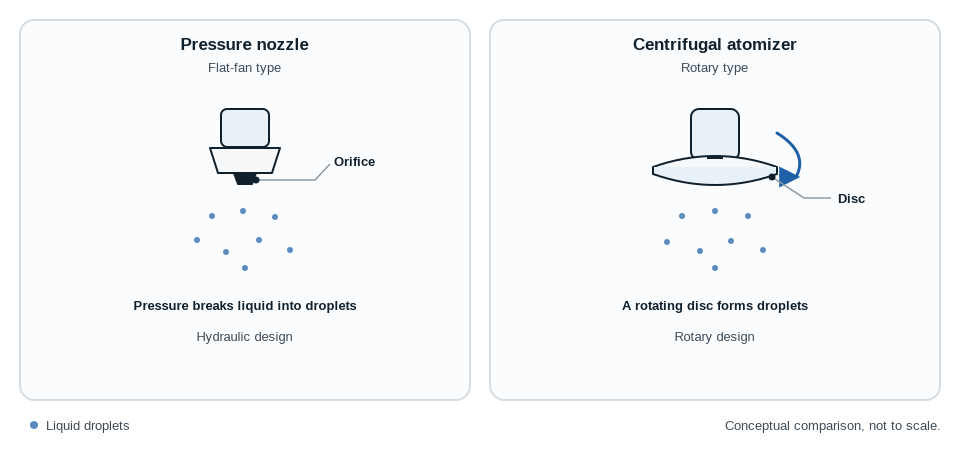
Spray drones use two main atomizer designs.
| Item | Pressure (hydraulic) nozzle | Centrifugal (rotary) atomizer |
|---|---|---|
| How it works | Pump pressure forces liquid through a small orifice, and the sheet of liquid breaks into droplets | Liquid at low pressure falls on a fast-spinning disc or cup and is thrown off as droplets |
| Types | Flat-fan and air-induction (low-drift) | Spinning disc or cage |
| Changing droplet size | Change the nozzle or the pressure | Change the disc speed (RPM) in the app |
| Droplet spread | Wider; more fine, drift-prone droplets unless a low-drift type is used | Narrower and more uniform |
| Clogging | Small orifices clog more easily | Wider passages, so usually more resistant |
| Complexity | Simple and durable | Needs a motor and speed controller per atomizer |
Neither is better in every case. Pressure nozzles are simple and well understood. Centrifugal atomizers suit jobs where you want to change droplet size on the fly, apply variable rates or spray products that tend to clog.
How a spraying mission works
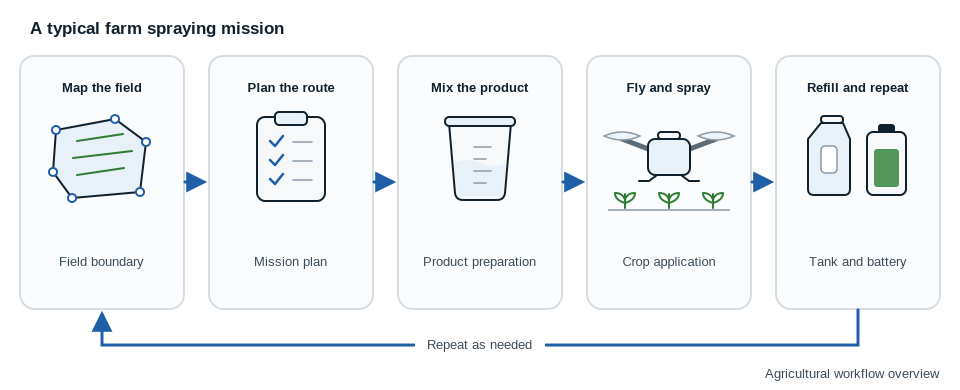
1. Map the field. Set up an RTK base station or network correction so the field coordinates stay accurate from season to season. Then capture the field boundary. Options include an aerial survey that produces an orthomosaic and elevation model or walking the edges with an RTK handheld to mark corner points. Mark poles, wires, tall trees, ditches, wells and nearby sensitive crops.
2. Plan the route. Set no-spray buffer zones, flight height, speed and application rate in the ground station. The software creates back-and-forth passes, turns and a refill point. The effective swath width should come from a test, not from the maximum width on the data sheet.
3. Mix the product. Read the label to confirm the product may be applied by drone at low volume. Drone tanks hold more concentrated mixes than tractor tanks, so do a jar test with the actual mix and let it stand for 15–30 minutes. Look for clumps, sediment or heat. Never pour powder straight into the tank. Pre-mix it in a separate container in the right order and pass it through a strainer on the way in.
4. Calibrate and fly. Prime the system with clean water, spray for one minute and catch the output under each nozzle. If the measured volume differs from the flow meter by more than ±5 percent, calibrate the flow meter, check for air leaks or replace worn nozzles. Repeat this check whenever you change to a product with a different thickness. Then fly the route. Keep the aircraft in sight so you can take over if needed.
5. Refill and repeat. The aircraft returns to the refill point when the tank, or the battery, runs low. Swap batteries and refill. Flights with a full tank last roughly 8–20 minutes, and heavily loaded flights are often 8–12 minutes. So most operations rotate several charged battery sets.
After the job, empty the tank, flush the lines with clean water and rinse at least two or three times. Clean the filter and nozzles with a soft brush. Never poke the openings with wire. Wipe the airframe and radar covers, and avoid high-pressure water on the flight controller, ESCs, motors and connectors.
Droplet size and drift
Droplet size is measured in microns. Small droplets cover well but drift easily. Large droplets resist drift but give less coverage. The usual field choice is medium to coarse, with a volume median diameter of roughly 150–350 microns. The class ranges are:
- Fine: 106–235 microns.
- Medium: 236–340 microns.
- Coarse: 341–403 microns.
Rotor downwash helps droplets reach the underside of leaves. But when the air hits the ground or canopy, it can also spread out and carry fine droplets away. Flying too high lets the downwash fade before it reaches the crop, which increases drift and evaporation.
To keep droplets in the field:
- Spray when the wind is about 3–7 mph (1.5–3 m/s). Stop if sustained wind goes above 10 mph (about 4.5 m/s).
- Do not assume dead calm is safest. A calm early morning or evening can mean a temperature inversion, where fine droplets hang in cold air near the ground and move sideways over long distances.
- Leave a buffer zone on the downwind edge.
- In rising wind, move to larger droplets, using a lower disc speed, an air-induction nozzle or a drift-reduction additive.
Key settings: height, speed, swath and rate
The numbers below are typical ranges. They differ by drone size, crop and product label.
| Setting | What it means | Typical range | Unit |
|---|---|---|---|
| Tank size | Liquid carried per flight | 8–80 | L |
| Swath width | Width covered per pass; real effective swath is often 65–75% of the stated maximum | 3–11 | m |
| Flight height | Height above the crop canopy | 1.5–4; usually 2–3 | m |
| Flight speed | Ground speed while spraying | 3–10; commonly 4–7 | m/s |
| Droplet size | Volume median diameter | 50–500 on hardware; 150–350 in field practice | microns |
| System flow | Total liquid output | 1.8–46 | L/min |
| Application rate | Liquid applied per area | 10–50 | L/ha |
| Work rate | Area covered per hour | Realistic all-day: about 2–10; theoretical peak: 16–30+ | ha/h |
The work rate row shows a gap. The peak figure assumes continuous flying. The realistic figure includes mixing, battery swaps and obstacle detours, and is only about 30–50 percent of the peak.
The settings are linked by one formula:
Application rate (L/ha) = flow (L/min) × 600 ÷ (speed (km/h) × swath (m))
For example, a system giving 7.2 L/min, flying at 18 km/h (5 m/s) with a 6 m effective swath, applies 7.2 × 600 ÷ (18 × 6) = 40 L/ha. Doubling the speed without raising the flow would halve the rate. That is why the flow meter and ground speed work as a pair.
To find the real swath width, fly over water-sensitive paper or dyed paper strips laid across the passes. Check where the droplets land. Choose the width that gives even coverage with no skipped stripes.
Heights matter too. Fly about 2–3 m above the crop. Higher, and downwash fades. Lower, and the airflow can flatten young plants or leave striped gaps.
Spreading and seeding systems
Many spray drones can swap the liquid tank for a hopper and a spreader. This turns them into heavy-lift drones for dry material, with a payload of roughly 10–80 kg depending on size. The system can spread granular fertilizer, cover crop seed, rice seed and granular crop protection products. Typical granule sizes are about 0.5–6 mm.
Most spreaders use a spinning disc. A gate or screw feeder meters material onto the disc, which throws it into a fan or ring. Some systems use air to carry light seeds and reduce wind drift.
Different seeds and fertilizers vary in size, weight and flow. Before each new material, weigh the output and test the spread pattern with catch pans so you know the true swath. A prescription map can then vary the rate across the field. Multispectral images of crop health, like those explained in our multispectral and hyperspectral camera guide, are often the basis for such maps.
Common mistakes
- Spraying in strong wind or an inversion. Droplets leave the field, treatment fails and neighbors' crops can be damaged. Measure wind on site, follow the label limit, avoid still dawn and dusk air and use larger droplets with a downwind buffer.
- Flying at the wrong height. Too high gives drift and evaporation. Too low flattens seedlings or leaves stripes. Hold about 2–3 m above the canopy and check with water-sensitive paper.
- Skipping flow and swath calibration. Last season's settings or the data-sheet swath give the wrong rate. Test for one minute before work and after a product change, keep error within ±5 percent and measure the swath with test paper.
- Letting nozzles and lines clog. Poorly mixed products and dried residue cause forked spray, drips or no flow. Do a jar test, pre-mix off the aircraft, use the filter and flush after every job. Clean nozzles only with soft brushes or water.
- Poor battery handling. Charging a hot pack, charging outside roughly 5–40 °C or storing at full charge shortens life and can cause swelling. Cool packs first, rotate sets and store at about 40–60 percent charge.
- Trusting terrain following blindly. Radar can fail when the lens is covered in spray, over reflective flooded fields or near thin wires. Wipe the radar and cameras between loads, map the terrain beforehand on complex slopes and keep the aircraft in sight.
- Overlooking long storage. Before winter or long storage, dry the lines. In freezing climates, drain them or protect the pump with antifreeze so it does not crack.
Frequently asked questions
How high and how fast do agricultural spray drones fly?
They usually fly low above the crop canopy at roughly 4–7 m/s. Downward radar holds the height, and the flow meter adjusts the pump to the ground speed.
How much water does a spray drone use per acre or hectare?
Spray drones apply low volumes, usually about 1–5 gallons per acre (roughly 10–50 L per hectare). A tractor sprayer typically uses far more water.
How many hectares can a spray drone cover in an hour?
Theoretical peak figures can reach 16–30+ ha per hour. Realistic all-day rates, including mixing, battery changes and detours, are about 2–10 ha per hour.
How long does a spray drone battery last per flight?
A loaded flight typically lasts about 8–20 minutes, and heavy loads are often 8–12 minutes. Operators rotate several charged battery sets to keep working.
Can spray drones replace tractors and ground sprayers?
They complement ground sprayers rather than replace them. Drones suit wet ground, slopes, tall crops and small fields, while large flat fields needing high water volume still favor ground sprayers.
What is the maximum wind speed for drone spraying?
A wind of about 3–7 mph (1.5–3 m/s) is ideal. Stop when sustained wind passes about 10 mph (4.5 m/s), and avoid heavy rain or storms.
What is the difference between pressure nozzles and centrifugal atomizers?
Pressure nozzles force liquid through a small orifice, and you change droplet size by changing the nozzle or pressure. Centrifugal atomizers throw liquid off a spinning disc, so you change droplet size by changing the disc speed.
Can spray drones also spread seeds and granular fertilizer?
Yes. With a hopper and spinning-disc spreader in place of the liquid tank, many models spread seed and granules. The spread pattern and feed rate must be calibrated for each material.