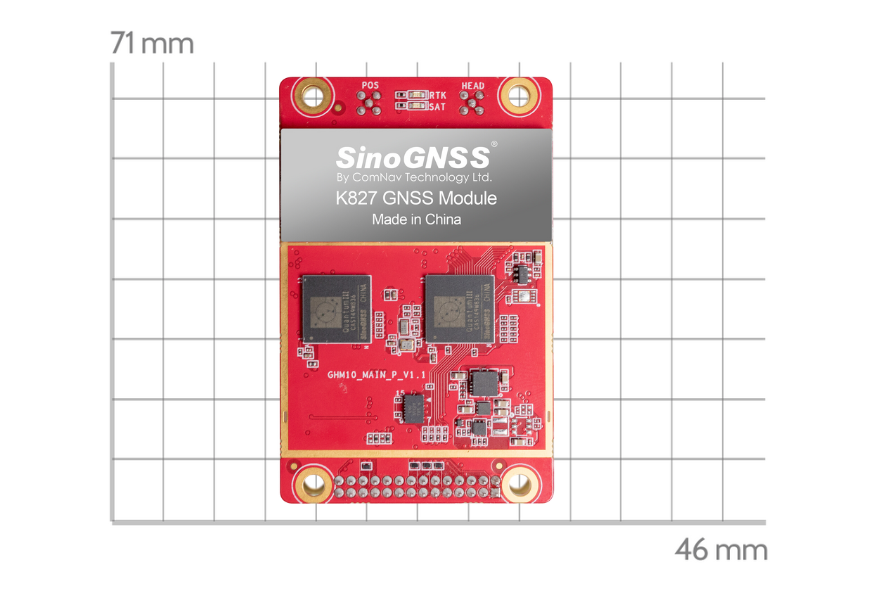
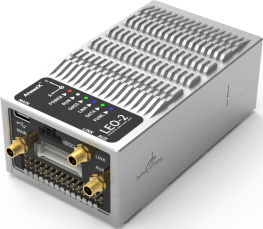
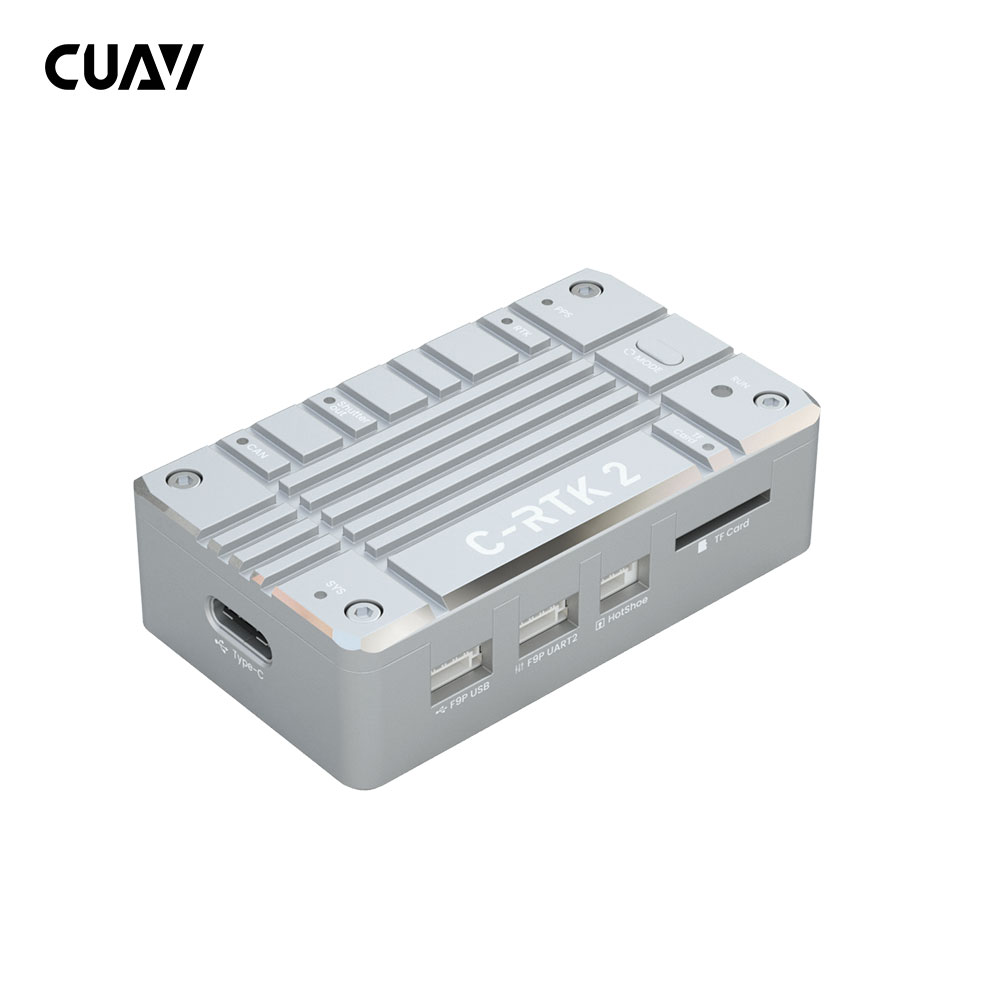
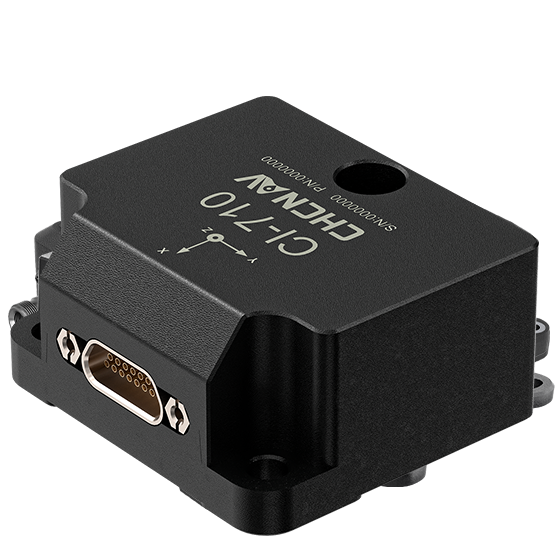
| Product and applications | ComNav K827 K8 series multi-frequency GNSS board with two independent RTK engines; designed for land surveying, autonomous driving, precision agriculture, machine control, robotics and UAV applications. |
|---|
| Dual-antenna positioning and heading | Dual-antenna design provides centimeter-accuracy positioning and high-precision heading in static and dynamic operation.Static and dynamic operation. |
|---|
| Processor and interference suppression | QUANTUM III SoC with self-adaptive suppression of wideband, narrowband and continuous-wave interference. |
|---|
| Integrated IMU and positioning continuity | Onboard IMU combined with GNSS; maintains centimeter-level positioning for 3s and meter-level positioning for 10s during GNSS signal loss.During loss of GNSS signal. |
|---|
| Navigation and protocol support | INS+GNSS navigation, L-Band and CAN protocol support. |
|---|
| Positioning signals | GPS: L1C/A, L1C, L2P, L2C, L5; BDS-2: B1I, B2I, B3I; BDS-3: B1I, B3I, B1C, B2a, B2b; GLONASS: G1, G2, G3; Galileo: E1, E5b, E5a, E5 AltBoC, E6c; QZSS: L1C/A, L2C, L5, L1C; SBAS: L1C/A; NAVIC: L5; L-Band.Positioning. |
|---|
| Orientation and secondary positioning signals | GPS: L1C/A, L1C, L2P, L2C, L5; BDS-2: B1I, B2I, B3I; BDS-3: B1I, B3I, B1C, B2a, B2b; GLONASS: G1, G2, G3; Galileo: E1, E5b, E5a, E5 AltBoC, E6c; QZSS: L1C/A, L2C, L5, L1C; SBAS: L1C/A; NAVIC: L5; L-Band.Orientation and Positioning 2. |
|---|
| Start and reacquisition times | - Cold start: less than 20s with added Acceleration Capture Module;
- hot start with RTC: less than 10s typical;
- reacquisition: less than 1s.
Cold start with added Acceleration Capture Module; typical hot start with RTC. |
|---|
| RTK initialization | RTK initialization time: less than 5s at baseline less than 10km; initialization reliability: greater than 99.9 %.Initialization time measured with baseline less than 10km. |
|---|
| Velocity accuracy | ≤ 0.02 m/s.PDOP ≤4. |
|---|
| Acceleration and overload | Acceleration: 4 g; overload: 15g. |
|---|
| Time accuracy | 20ns. |
|---|
| Post-processing positioning accuracy | Horizontal: 2.5 mm + 1 ppm; vertical: 5 mm + 1 ppm.Post processing. |
|---|
| Single-baseline RTK accuracy | Horizontal: 8 mm + 1 ppm; vertical: 15 mm + 1 ppm.Single baseline RTK. |
|---|
| DGPS accuracy | Less than 0.4 m RMS.DGPS. |
|---|
| SBAS accuracy | 1 m 3D RMS.SBAS. |
|---|
| Standalone accuracy | 1.5m 3D RMS.Standalone positioning. |
|---|
| Dimensions and weight | Size (L × W × H): 46mm×71mm×10mm; weight: 15.0 g. |
|---|
| Hardware interface | 2 x 14 pin. |
|---|
| Power consumption | 1.8 W with anti-interference off; enabling anti-interference adds about 0.2W.1.8 W with anti-interference off; approximately 0.2W additional consumption with anti-interference on. |
|---|
| Operating and storage temperatures | Operating: -40 °C to + 85 °C; storage: -55 °C to + 95 °C. |
|---|
| LNA power | +3.3V ~ +5V ± 5%VDC @ 0-100mA. |
|---|
| LNA gain | 20 ~ 35dB.External LNA. |
|---|
| Impedance matching | 50 Ohm. |
|---|
| LVTTL and SPI interfaces | 3 LVTTL ports; 2 SPI interfaces. |
|---|
| Event and timing connections | 2 event marker inputs; 1 Pulse Per Second (PPS) output. |
|---|
| Status indication | 3 indicator pins show working status. |
|---|
| Correction data input/output | RTCM 2.X, 3.X; CMR (GPS only); CMR+ (GPS only).CMR and CMR+ support GPS only. |
|---|
| Position data output formats | ASCII: NMEA-0183 GGA, GSA, GSV, RMC, HDT, VHD, ZDA, VTG, GST, GLL; PTNL, PJK; PTNL, AVR; PTNL, GGK. ComNav Binary. BINEX Data: 0x00, 0x01-01, 0x01-02, 0x01-05, 0x7d-00, 0x7e-00, 0x7f-05. |
|---|
| Position data output rates | 1 Hz, 2 Hz, 5 Hz, 10 Hz, 20Hz (optional), 50Hz.20Hz is optional. |
|---|