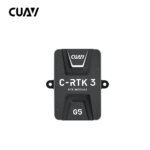
Product overview
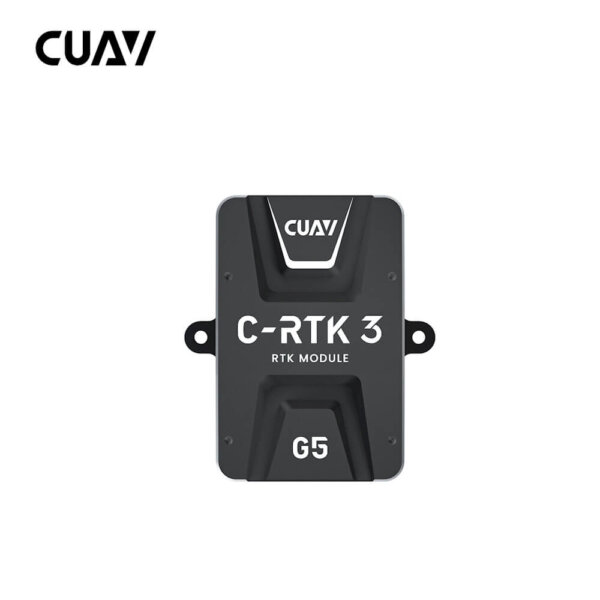
The CUAV C-RTK 3 G5 GNSS Module provides satellite positioning and orientation data for civilian unmanned systems, including multirotors, VTOL fixed-wing aircraft, helicopters, robots and unmanned surface vessels. Its 250 MHz STM32H5 Arm Cortex-M33 processor works with 789 hardware channels receiving multiple bands from GPS, GLONASS, BeiDou, Galileo and QZSS. The module supports single- or dual-antenna configurations. Dual-antenna operation provides heading with pitch or roll and can replace electronic-compass heading without compass calibration, while an RM3100 electronic compass is also built in.
Specified positioning accuracy varies by mode: standalone operation provides 1.2 m horizontal and 1.9 m vertical accuracy, while DGNSS provides 0.4 m horizontal and 0.7 m vertical accuracy. RTK specifications are 0.6 cm + 0.5 ppm horizontally and 1 cm + 1 ppm vertically, with 7 s initialization for a baseline below 40 km. Heading accuracy depends on antenna separation: 0.15° at 1 m and 0.03° at 5 m. The maximum update rate is 20 Hz, and specified velocity accuracy is 3 cm/s.
Integration options include one CAN interface, one UART interface, USB 2.0 HS, two EVENT input channels and configurable PPS output. The module supports DroneCAN and integration with ArduPilot and PX4, with communication rates of 1 Mbit/s over CAN and 8 Mbit/s over CAN FD. TF card logging records raw GNSS data, positioning results, attitude data and interference logs. The module measures 55.5 × 50 × 16.5 mm including screw holes and weighs 43.5 g excluding the antenna and feeder cable. Its operating temperature range is −10°C to +80°C.
The GNSS+ suite combines AIM+ anti-jamming and anti-spoofing functions, APME+ multipath mitigation, IONO+ ionospheric protection and RAIM+ integrity monitoring. LOCK+ is designed to maintain satellite tracking under vibration and shock. Interference detection information can be transmitted to the controller through DroneCAN or UART for display at the ground station. Galileo OSNMA support adds navigation-message authentication, while the Galileo HAS precision-service look-ahead function requires a software update. These functions support positioning and heading operation in environments affected by signal interference, reflected signals and mechanical vibration.
Specifications
| Specification | Value & conditions |
|---|---|
| Processor | STM32H5 Arm Cortex-M33, 250 MHz |
| Hardware channels | 789 |
| Supported constellations and bands |
|
| Antenna support | Dual antennaConfigurable single- or dual-antenna operating mode. |
| GNSS+ protection suite |
|
| Supported services | Galileo HAS precision service; Galileo OSNMA serviceGalileo HAS look-ahead function enabled upon software update. |
| Raw data output and recording | Raw data output supported; TF card recording |
| Positioning accuracy |
|
| Velocity accuracy | 3 cm/s |
| Heading accuracy | 0.15° at 1 m antenna separation; 0.03° at 5 m antenna separationAntenna separation of 1 m or 5 m, respectively. |
| Maximum update rate | 20 Hz |
| RTK initialization time | 7 sBaseline less than 40 km. |
| Timing and acquisition times |
|
| Tracking and acquisition thresholds | Tracking: 20 dB/Hz; acquisition: 30 dB/Hz |
| Electronic compass and measurement range | RM3100; ±1100 μT, with wide dynamic magnetic field adaptation |
| Compass resolution and sensitivity | Resolution: 13 nT; detection sensitivity: 2.7 nTResolution at 200 cycle count; detection sensitivity at 1 Hz. |
| Compass noise | Noise level: 15 nT; noise floor: 4 pT/√HzNoise level at 200 cycle count; noise floor at 1 Hz. |
| Compass linearity | 0.50%Within ±200 μT. |
| Communication protocol and rates | DroneCAN; CAN: 1 Mbit/s; CAN FD: 8 Mbit/s1 Mbit/s for CAN; 8 Mbit/s for CAN FD. |
| Upgrade support and firmware | Upgrades supported; firmware: C-RTK 3 M4C |
| Data connectors | JST GH 1.254P / USB Type-C |
| Module dimensions | 55.5 × 50 × 16.5 mmIncludes screw holes. |
| Module weight | 43.5 gExcludes antenna and feeder cable. |
| Operating temperature | −10°C to +80°C |
| Antenna coverage and polarization | Horizontal coverage: 360°; right-hand circular polarizationCRA-602 antenna. |
| Antenna gain and connector | Gain: 38 ± 2 dB; connector: SMA-JCRA-602 antenna. |
| Antenna dimensions and weight | Diameter 40 × 84.5 mm; 36 gCRA-602 antenna. |
| Additional weight and dimensions | Weight: 0.5 kg; dimensions: 10 × 10 × 5 cm |
| Integration interfaces and platform support | One CAN interface, one UART interface and USB 2.0 HS; DroneCAN communication; ArduPilot and PX4 support |
| Event inputs, PPS and dual-antenna orientation | Two EVENT input channels; configurable PPS output; dual-antenna orientation can replace electronic-compass heading without calibrationDual-antenna configuration for compass replacement without calibration. |
Request a quote for CUAV C-RTK 3 G5 GNSS Module
Send your application, destination country and expected quantity to the ChinaDrone team. We can discuss product selection, configuration and sourcing from China.
Submit your procurement requirements ↗No account needed. A model number is optional. Your enquiry is handled by ChinaDrone.