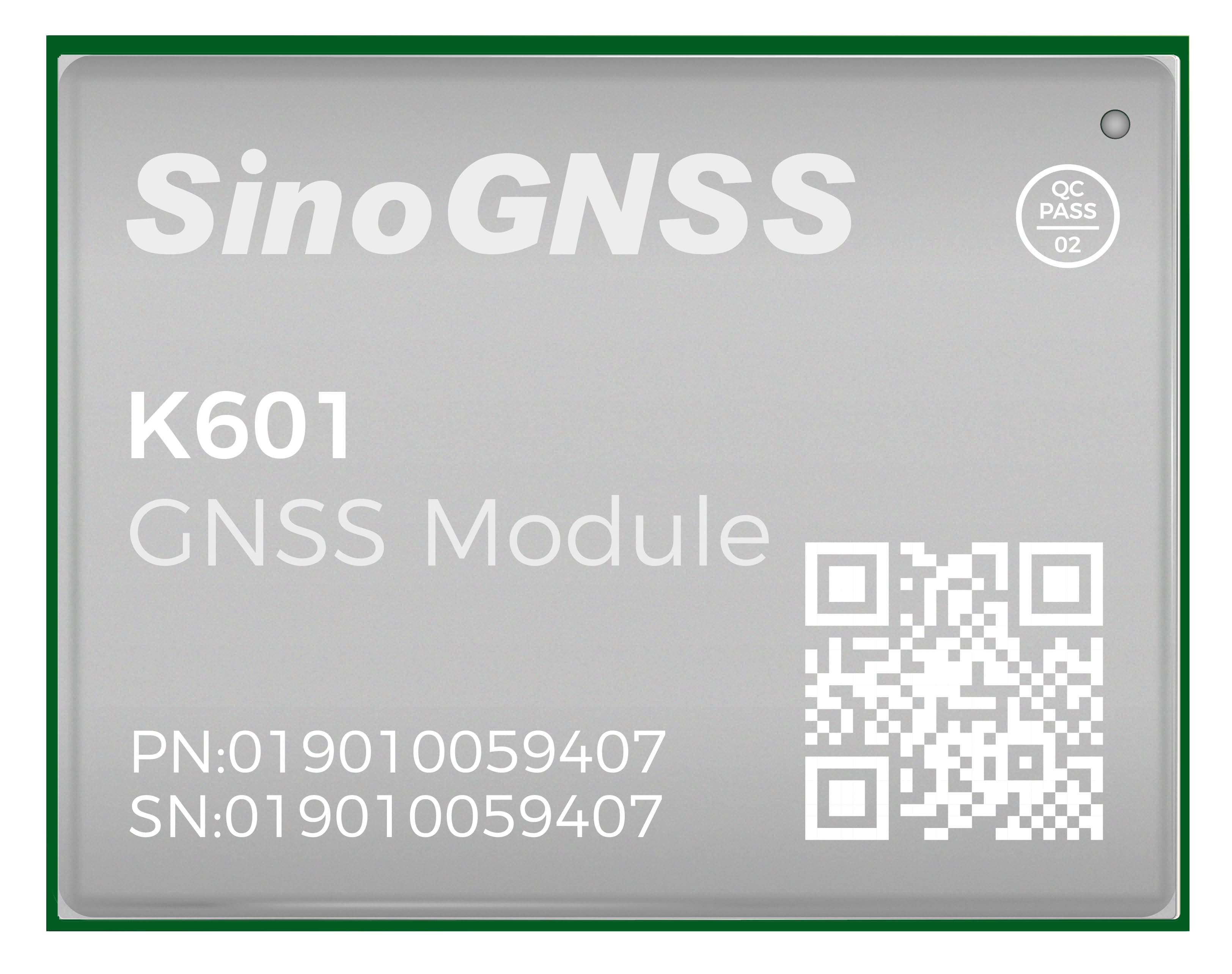
| Product and processing platform | ComNav K601 GNSS Module with TC1720 SoC, on-chip RTK processing, raw data output, IMU-assisted navigation and anti-jamming; applications include UAVs, personnel positioning, handheld devices and unmanned systems. |
|---|
| Signal tracking | - GPS: L1, L5;
- BDS: B1I, B1c*, B2a, B2b*;
- GLONASS: G1;
- Galileo: E1, E5a;
- QZSS: L1, L5;
- SBAS: L1, L5*;
- NAVIC: L5*. Items marked * require specific firmware versions.
BDS B1c and B2b, SBAS L5 and NAVIC L5 require specific firmware versions. |
|---|
| Start times | Cold start: less than 24 s; hot start with RTC: less than 1 s (typically).Hot start requires RTC; hot-start time is typical. |
|---|
| Signal reacquisition | Less than 1 s |
|---|
| RTK initialization time | Greater than 10 sOpen sky, D greater than 10 km. |
|---|
| Initialization reliability | Greater than 99.9% |
|---|
| Velocity accuracy | ≤ 0.02 m/s |
|---|
| Time accuracy | 30 nsPPS. |
|---|
| Post-processing accuracy | Horizontal: 2.5 mm + 1 ppm; vertical: 5 mm + 1 ppm.Post processing. |
|---|
| Single-baseline RTK accuracy | Horizontal: (8 + 1ppm × D) mm; vertical: (15 + 1ppm × D) mm.Single-baseline RTK; D = baseline length in mm. |
|---|
| DGPS accuracy | Less than 0.4 m RMSDGPS; RMS. |
|---|
| SBAS accuracy | 1 m 3D RMSSBAS; 3D RMS. |
|---|
| Standalone accuracy | 1.5 m 3D RMSStandalone positioning; 3D RMS. |
|---|
| ADR position error | Less than 3% of distance travelled without GNSSDistance travelled without GNSS. |
|---|
| Gyroscope | Range: ±250°/s; zero bias stability: 3.5°/h.Optional hardware configuration. |
|---|
| Accelerometer | Range: ±8g; zero bias stability: 25μg (x,y), 100μg (z).Optional hardware configuration. |
|---|
| Dimensions | 12 mm × 16 mm × 2.4 mmWidth × length × height. |
|---|
| Weight | 0.9 g |
|---|
| Hardware interface | LGA, 24 pins |
|---|
| Power consumption | 100 mWDuring tracking. |
|---|
| Input voltage | +3.3 V ±5% DCDC input. |
|---|
| Working temperature | -40 °C to +85 °COperation. |
|---|
| Storage temperature | -40 °C to +90 °CStorage. |
|---|
| Impedance matching | 50 Ω |
|---|
| LNA gain | 20 ~ 35 dB (suggested)Suggested LNA gain. |
|---|
| External LNA power | +3.3 V ~ +5 V ±5% VDC @ 0–100 mAExternal LNA; 0–100 mA. |
|---|
| Communication interfaces | 2 UART; 1 USB*, 1 SPI*, 1 I2C*. Interfaces marked * require specific firmware.USB, SPI and I2C require specific firmware. |
|---|
| Correction data format | RTCM 3.XCorrection data input/output. |
|---|
| Position output formats | ASCII (NMEA-0183): GGA, GSA, GSV, RMC, HDT, VHD, ZDA, VTG, GST, GLL; binary: STB Binary.Position data output. |
|---|
| Output rates | - Raw data: 10 Hz;
- RTK: 20 Hz;
- DR: 20 Hz.
Raw data, RTK and DR output modes respectively. |
|---|