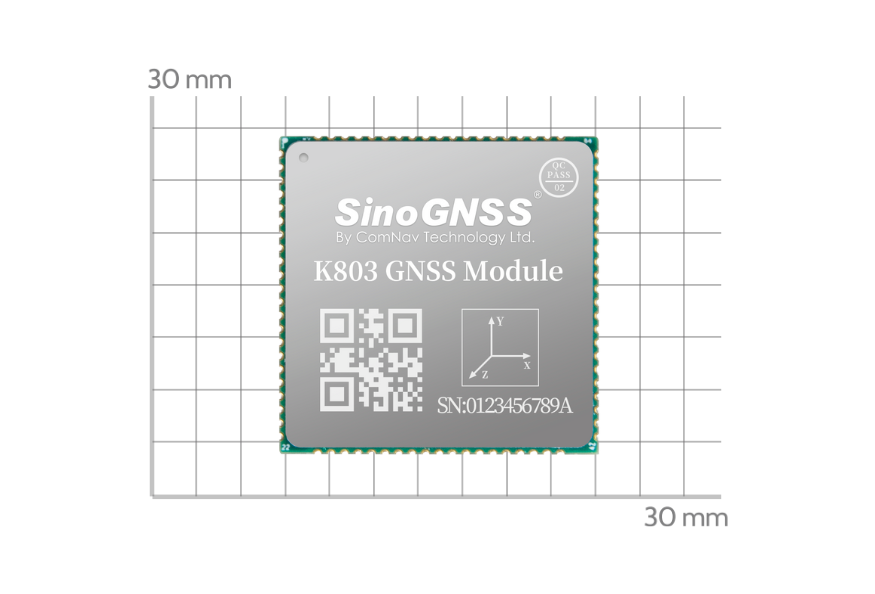
Product overview
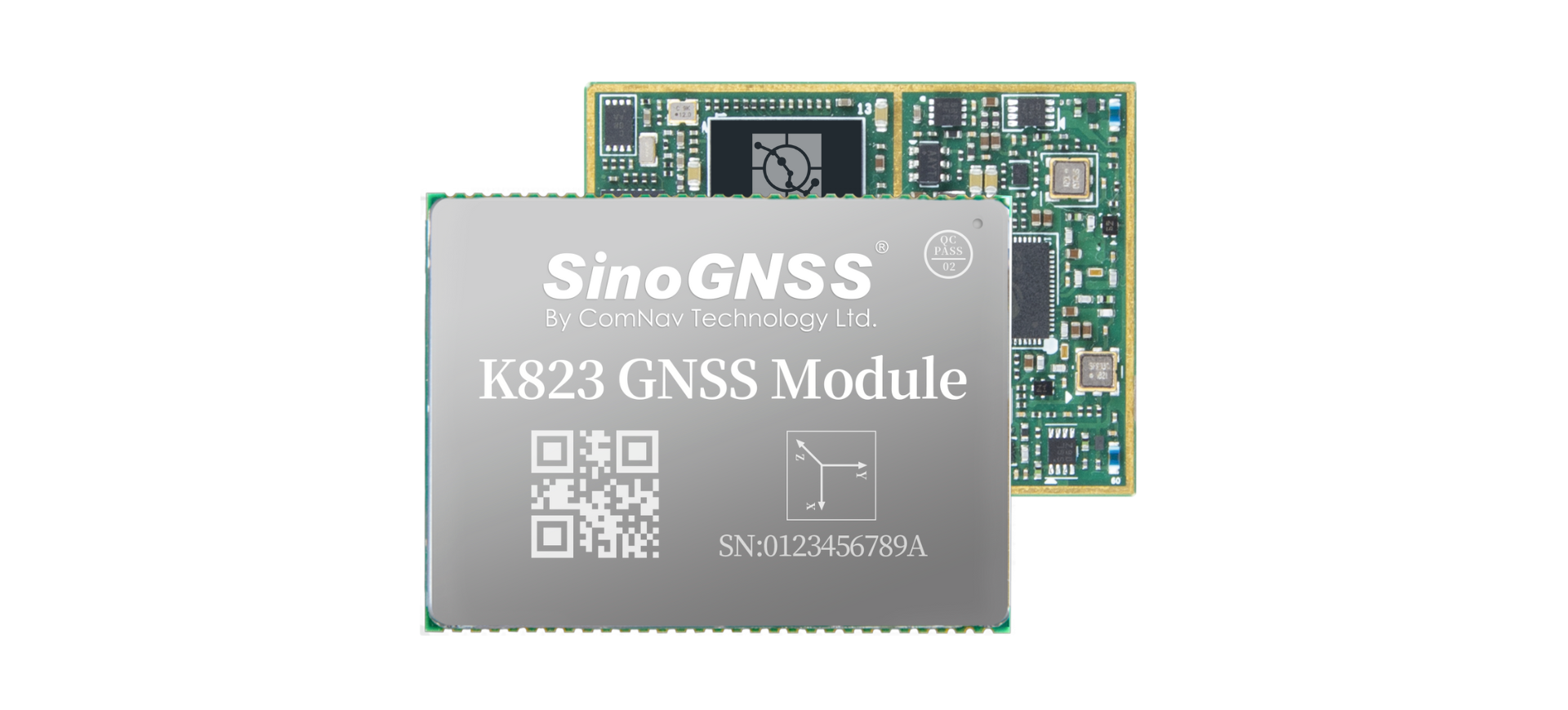
The ComNav K803 is a GNSS module from ComNav Technology, a developer and manufacturer of GNSS OEM boards and receivers for high-precision positioning applications. Its positioning role provides the context for its event function: associating an external trigger with time and antenna-position information. The K803 belongs to the K8 series, whose event option requires manual activation and configuration of the relevant output messages. This function supports tasks such as recording where and when an aerial photograph was taken.
In the K803 event setup example, the module is connected to power, an antenna and a serial cable, with a cable linking the PPS and Event ports so that PPS supplies the trigger. After PPS and event processing are enabled and the message outputs are configured, each received trigger produces Marktime and Markpos messages. Marktime records the leading-edge time of the detected pulse, while Markpos contains the estimated antenna position at that event. Configuration options include pulse polarity, a constant time bias to account for transmission delay, and a minimum interval between accepted pulses.
For civilian UAV integration, K8-series event processing can associate camera exposures with positioning records and help synchronize data from multiple sensors, such as a camera and lidar. These uses depend on supplying the appropriate event trigger and enabling the required messages; event output is not automatic before configuration. The K803 example demonstrates this trigger-and-message workflow, providing a concrete basis for integrating event-linked position and time records into aerial mapping systems.
Specifications
| Specification | Value & conditions |
|---|---|
| Event message output | Markpos and MarktimeAfter the documented setup, upon receipt of a trigger. |
| Model and architecture | ComNav K803 GNSS Module; full-constellation, triple-frequency GNSS OEM board with IMU |
| Tracked signals | GPS: L1C/A, L2C, L2P, L5, L1C; BeiDou BDS-2: B1I, B2I, B3I; BDS-3: B1I, B3I, B1C, B2a, B2b; GLONASS: G1, G2, G3; Galileo: E1, E5a, E5b, E6c, E5 AltBOC; QZSS: L1C/A, L2C, L5, L1C; SBAS: L1C/A, L5; NavIC: L5; L-Band |
| Navigation support | L-Band, PPP and GNSS+INS navigation |
| Inertial navigation | Onboard high-precision IMU with inertial navigation fusion algorithm |
| Processing and interference suppression | High-performance floating-point arithmetic; internal adaptive anti-interference algorithm |
| Post-processing accuracy | Horizontal: 2.5 mm + 1 ppm; vertical: 5 mm + 1 ppmPost-processing; horizontal and vertical components. |
| RTK accuracy | Horizontal: 8 mm + 1 ppm; vertical: 15 mm + 1 ppmSingle-baseline RTK; horizontal and vertical components. |
| DGPS accuracy | Less than 0.4 mDGPS; RMS. |
| SBAS accuracy | 1 mSBAS; 3D RMS. |
| Standalone accuracy | 1.5 mStandalone; 3D RMS. |
| Startup time | Cold start: less than 20 s; hot start: less than 10 sCold start and hot start, respectively. |
| RTK initialization time | Less than 10 sRTK initialization. |
| Signal reacquisition time | Less than 1 s |
| Initialization reliability | Greater than 99.9% |
| Velocity accuracy | ≤0.02 m/s |
| Acceleration and overload | Acceleration: 4 g; overload: 15 g |
| Time accuracy | 20 ns |
| Dimensions and mounting | 30 mm × 30 mm × 3.2 mm; surface-mountedLength × width × height. |
| Weight | 8 g |
| Hardware interface | 82-pin LGA |
| Power consumption | 1.0 W |
| Input voltage | +3.3 V ±5% DC |
| Temperature ranges | Operating: -40 °C to +85 °C; storage: -55 °C to +95 °COperating and storage, respectively. |
| LNA power supply | +3.3 V to +5 V DC ±5% at 0–100 mAExternal LNA power. |
| LNA gain | 20–40 dBSuggested range. |
| Wiring impedance | 50 Ω impedance matching |
| Communication ports and signal pins | 4 LVTTL ports; 1 SPI; 2 event marker inputs; 1 PPS output; 3 working-status indicator pins |
| Correction data input/output | RTCM 2.X, RTCM 3.X, CMR, CMR+CMR and CMR+ are GPS only. |
| Position output formats | ASCII: NMEA-0183 GGA, GSA, GSV, RMC, HDT, VHD, ZDA, VTG, GST, GLL; PTNL, PJK; PTNL, AVR; PTNL, GGK. ComNav Binary. BINEX: 0x00, 0x01-01, 0x01-02, 0x01-05, 0x7d-00, 0x7e-00, 0x7f-05 |
| Position output rates | 1 Hz, 2 Hz, 5 Hz, 10 Hz, 20 Hz |
Request a quote for ComNav K803 GNSS Module
Send your application, destination country and expected quantity to the ChinaDrone team. We can discuss product selection, configuration and sourcing from China.
Submit your procurement requirements ↗No account needed. A model number is optional. Your enquiry is handled by ChinaDrone.