Product overview
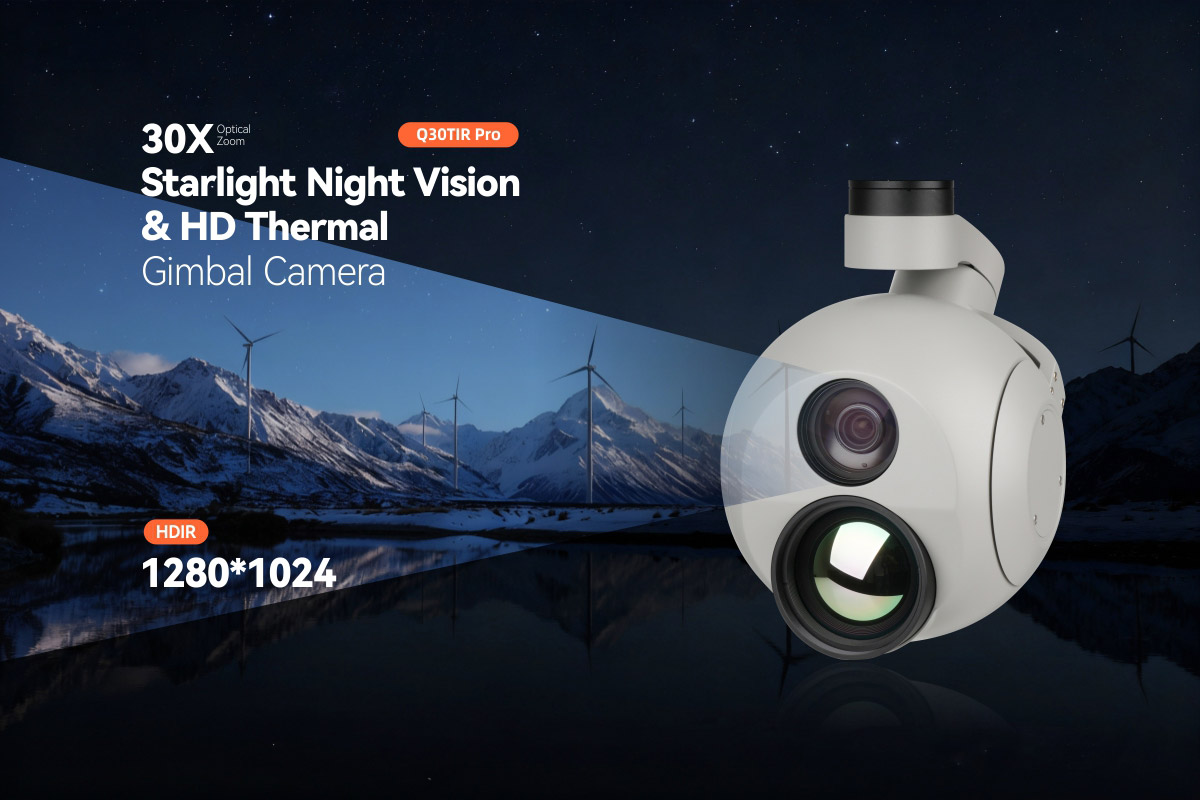
The Viewpro Q30TIR Pro from Shenzhen Viewpro Technology Co., Ltd. is a dual-sensor gimbal camera payload for visible-light and thermal observation, with civilian applications including search and rescue, infrastructure inspection and forest monitoring. Its visible-light camera pairs a 1/2.8-type STARVIS2 CMOS sensor with 2.13MP effective pixels and 1920×1080 resolution. A 4.3–129mm lens provides 30× optical zoom, supplemented by 12× digital zoom. The thermal channel uses a 1280×1024 uncooled long-wave infrared detector with 12μm pixel pitch and a 50mm athermal prime lens operating in the 8–14μm band. It supports thermal imaging but does not measure temperature.
The thermal camera has a 17.5° horizontal and 14.0° vertical field of view, white, black and pseudocolor palettes, and 1×–4× digital zoom. EO/IR object tracking supports target sizes from 32×32 to 128×128 pixels, with minimum object contrast of 5%, an SNR requirement of 4 and tracking speed of ±48 pixels per frame. Object memory is specified as 100 frames, or four seconds. The gimbal provides one-key centering and controllable pitch from −45° to 125°, within a mechanical pitch range of −110° to 130°. Its specified vibration angle is ±0.02° on pitch, roll and yaw.
The payload accepts a 4S–6S input of 14.8–25.2V, with a working voltage of 16V, average power consumption of 13.1W and maximum consumption of 24W. Its operating temperature range is −20°C to +50°C. Control interfaces include PWM, TTL, S.BUS, TCP and UDP. Optional IP output supports RTSP/UDP at 720p or 1080p, 25 or 30fps, using H264/H265; optional SDI output delivers 1080p at 30fps. Local recording uses a class 10, FAT32 TF card up to 512G, storing 1920×1080 JPG stills and 1080p MP4 video at 30fps.
Specifications
| Specification | Value & conditions |
|---|---|
| Electrical supply | Working voltage: 16V. Input: 4S–6S (14.8V–25.2V). Output: 5V when connected with PWM.5V output when connected with PWM. |
| Current and power consumption | Dynamic current: 820–1500mA at 16V. Average power: 13.1W; maximum: 24W.Dynamic current measured at 16V. |
| Operating temperature | −20°C to +50°C. |
| Video outputs | Optional IP output: RTSP/UDP, 720p/1080p, 25fps/30fps, H264/H265. Optional SDI: 1080P at 30fps.Optional output configuration. |
| Local storage and recording formats | TF storage up to 512G, class 10, FAT32. Still images: JPG, 1920×1080. Video: MP4, 1080P at 30fps.TF card up to 512G, class 10, FAT32 format. |
| Control interfaces | PWM, TTL, S.BUS, TCP and UDP. |
| Gimbal movement ranges | Mechanical range: pitch/tilt −110° to 130°, roll ±40°, yaw/pan ±360°×N. Controllable range: pitch/tilt −45° to 125°, yaw/pan ±360°×N. |
| Gimbal vibration angle and centering | Pitch, roll and yaw vibration angle: ±0.02°. One-key centering supported. |
| Visible-light sensor and image resolution | 1/2.8-type STARVIS2 CMOS sensor; Full HD 1080 (1920×1080); 2.13MP effective pixels. |
| Visible-light lens and zoom | 30× optical zoom, F=4.3–129mm; 12× digital zoom; 360× with optical zoom.360× combined zoom uses optical and digital zoom. |
| Visible-light close focus and horizontal field of view | Minimum object distance: 10mm at the wide end to 1200mm at the telephoto end. Horizontal viewing angle: 64.0° at the wide end to 2.4° at the telephoto end.Values correspond to the wide and telephoto lens ends. |
| Visible-light signal quality and minimum illumination | Signal-to-noise ratio: more than 50dB. Color minimum illumination: 0.009 lux with high-sensitivity mode on; 0.09 lux with it off.Color minimum illumination at 1/30 second and 50%, with high-sensitivity mode on or off as stated. |
| Exposure and gain controls | Exposure: auto, manual, shutter/iris priority, EV compensation and slow AE. Gain: auto/manual, 0–50.0dB (0–28 steps). Maximum gain limit: 10.7–50.0dB (6–28 steps). |
| White balance | Auto, ATW, indoor, outdoor, one-push, manual, outdoor auto and sodium-vapor lamp modes (fixed/auto/outdoor auto). |
| Visible-light shutter speed | 1/1s to 1/10,000s, in 22 steps. |
| Visible-light image controls | Backlight compensation, noise reduction, image stabilization and defog each offer on/off control. |
| Thermal optics and field of view | 50mm focal length; horizontal field of view 17.5°; vertical field of view 14.0°. |
| Thermal human-target distances | Detection: 2083 meters. Recognition: 521 meters. Verification: 260 meters.Human target measuring 1.8×0.5m. |
| Thermal car-target distances | Detection: 6389 meters. Recognition: 1597 meters. Verification: 799 meters.Car target measuring 4.2×1.8m. |
| Thermal detector and focusing | Uncooled long-wave thermal imager operating at 8–14μm; 1280×1024 detector; 12μm pixel pitch; athermal prime lens. |
| Thermal sensitivity | NETD ≤40mK; MRTD ≤400mK, both at 25°C and F#1.0.At 25°C, F#1.0. |
| Thermal shutter, display modes and thermometry limitation | Bistable shutter; white, black and pseudocolor palettes; 1×–4× digital zoom. Thermometry is not supported. |
| EO/IR tracking update and delay | Deviation-pixel update rate: 50Hz. Deviation-pixel output delay: 5ms. |
| Tracking contrast and signal-to-noise requirements | Minimum object contrast: 5%. SNR: 4. |
| Tracking object sizes and speed | Minimum object size: 32×32 pixels. Maximum: 128×128 pixels. Tracking speed: ±48 pixels/frame. |
| Tracking memory and position noise | Object memory: 100 frames (4s). Root-mean-square pulse noise in object position: less than 0.5 pixel. |
| Product mass and dimensions | Net weight: 1432±10g for the Viewport version with Viewport. Product dimensions: 140.9×120×216.1mm / 140.9×120×221.8mm, with the latter specified for the Viewport version with Viewport.1432±10g applies to the Viewport version with Viewport; 140.9×120×221.8mm is the dimension entry qualified as the Viewport version with Viewport. |
| Supplied equipment and case | One gimbal camera device, screws, copper cylinders, damping balls and one USB-to-TTL cable; plastic box with foam cushion. |
| Gross weight | 3159g.Packed configuration. |
| Package dimensions | 350×300×250mm.Packed configuration. |
Request a quote for Viewpro Q30TIR Pro gimbal camera
Send your application, destination country and expected quantity to the ChinaDrone team. We can discuss product selection, configuration and sourcing from China.
Submit your procurement requirements ↗No account needed. A model number is optional. Your enquiry is handled by ChinaDrone.