Product overview
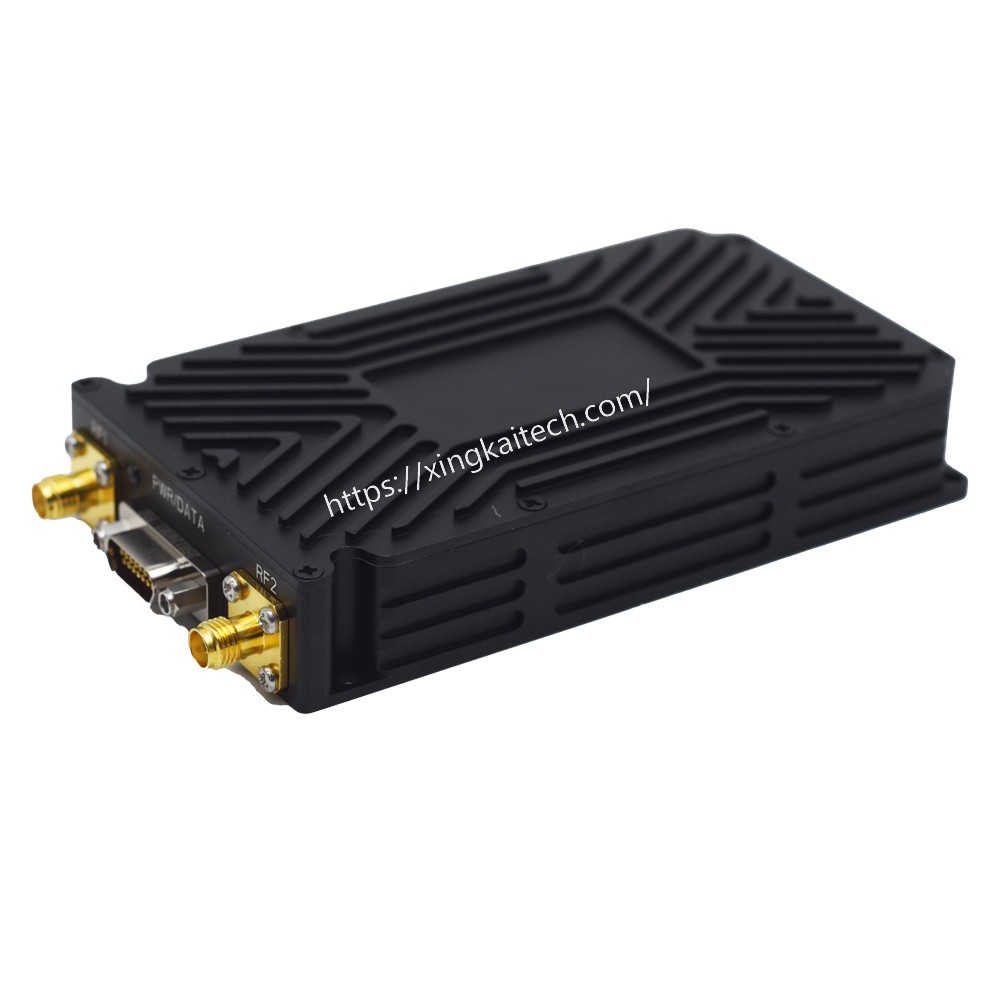
The Xingkai XK-F359 2*20W MIMO MESH Radio Network FHSS HOPPING is an airborne communications radio for voice, data and imagery. Its distributed, centerless architecture supports direct links and multi-hop relay networks, including point-to-point, point-to-multipoint and multipoint-to-multipoint arrangements. Air-to-air, air-to-ground and ground-to-ground applications place it within unmanned-system communications. The dual 20W RF configuration supports transmission power control and adaptive modulation. At 20MHz bandwidth, its data rate is 1-100Mbps and average single-hop delay is 7mS.
The airborne radio body measures 12.7×11.0x3.3cm, weighs 635g and has four mounting holes. Its basic connections include two TNC RF interfaces, one to three RJ45 Ethernet interfaces supporting 100/1000BaseT, WiFi AP, GPS/BD, serial connections and DC input. Auxiliary interfaces include microphone, speaker, push-to-talk, RS485/422 and USB2.0 OTG connections. Power can be supplied through a twist-lock battery or main cable. The 20Watts×2 configuration specifies an 18-32VDC supply and lists operating current of 3-7A and standby current of 0.7-0.9A@16.8V.
Optional network extensions include public network routing/4G LTE, WB-NB integration, fiber and satellite. Optional video extensions provide low-delay HDMI/SDI/CVBS interfaces with 4K/2K/1080P/720P/D1 formats. Web management, an API and SNMP support administration and integration, while separate network-status and RSSI indicators communicate connection state and link quality. Operating temperature spans -40°C to +80°C, with IP66 protection and customized IP67/IP68 options. Single-hop communication distance is 100-300 KM under visible conditions and 1-30 KM in urban areas.
Specifications
| Specification | Value & conditions |
|---|---|
| Size and weight | 12.7×11.0x3.3cm/635g.20Watts×2 airborne radio configuration. |
| Color | Lron Gray. |
| Installation | 4 mounting holes. |
| Supply voltage | 18-32VDC.20Watts×2 configuration. |
| Operating and standby current | Operation 3-7A/Standby 0.7-0.9A@16.8V.20Watts×2 configuration; current entry specifies @16.8V. |
| Power connection options | Power supply by twist-lock battery or main cable. |
| Basic interfaces | 2xTNC RF, 1-3xRJ45 Ethernet 100/1000BaseT, WiFi AP, GPS/BD RS232/TTL(UART), Sbus/Bluetooth, 1.2-230.4Kbps, DC input. |
| Push-to-talk and auxiliary interfaces | MIC, SP, PTT, GND, RS485/422, USB2.0 OTG. |
| Network extensions | Public network routing/4G LTE, WB-NB integration, fiber, satellite.Optional network extensions. |
| Video extensions | Low-delay HDMI/SDI/CVBS; 4K/2K/1080P/720P/D1.Optional video extensions. |
| Link status indicator |
|
| RSSI link indicator |
|
| Management and control interfaces | Web-based network management/GUI, API for secondary development, SNMP. |
| Waveform | Mobile Network MIMO (MN-MIMO). |
| MIMO technology | Space-time coding, space diversity, TX/RX beamforming, spatial multiplexing. |
| Receive sensitivity | -103dBm.5MHz bandwidth. |
| Channel bandwidth | 1.25/2.5/5/10/20MHz.Optional channel bandwidth selections. |
| Data rate | 1-100Mbps; adaptive, QoS.20MHz bandwidth. |
| Modulation | TD-COFDM; BPSK/QPSK/16QAM/64QAM/256QAM/1024QAM.Adaptive modulation; fixed setting optional. |
| RF output power | 20Watts x2.Supports TPC, transmission power control. |
| Single-hop communication distance | 100-300 KM (visible); 1-30 KM (urban area).Visible conditions or urban area, respectively. |
| Network architecture and topology | Distributed, centerless operation; point-to-point, point-to-multipoint and multipoint-to-multipoint; Layer 2 or 3 dynamic routing; multi-hop relay; star, line, network and hybrid topologies. |
| Single-hop delay | Average 7mS.20MHz bandwidth. |
| Encryption | DES, AES128/256; optional SNOW3G/ZUC; customized chip/TF card encryption or external encryption machine.SNOW3G/ZUC optional; chip/TF card encryption customized, or external encryption machine. |
| Anti-jamming modes | Manual spectrum-scanning channel selection; full-band enhanced intelligent frequency selection with spectrum awareness; full-band adaptive frequency hopping; optional roaming mode.Roaming mode optional. |
| Frequency band configurations | Overall designation: 70M-6GHz. UHF: 430-550/570-700/800-950,225-400/320-470* MHz. L band: 1000-1200/1300-1500,1200-1700* MHz. S band: 1.6-1.8/1.8-2.0/2.0-2.2/2.2-2.5/2.5-2.7/2.7-2.9,1.6-2.3/1.9-2.7* GHz. C band: 4.4-5.0/5.25-5.85,4.2-5.2/5.5-6.0* GHz. MIIT: 336-344/512-582/566-626/606-678/1420-1520/1430-1444 MHz.2T2R at a single band, or selectable/smart-change 1T2R at dual band. |
| Operating temperature | -40°C to +80°C. |
| Protection level | IP66; customized IP67/IP68.IP67/IP68 require customization. |
| Startup and network transition times | Startup: less than 28 seconds; network access/update/switchover: less than 1 second. |
| Network capacity and multi-hop behavior | Unlimited single-system user capacity and mesh hop count stated, with 256 nodes or more; data 15+ hops, voice 10+ hops, video 8+ hops; total bandwidth loss across multiple hops less than 70%.Mesh networking; hop counts specified separately for data, voice and video. |
Ask for the XK-F359 2*20W MIMO MESH Radio Network FHSS HOPPING price ↑