Product overview
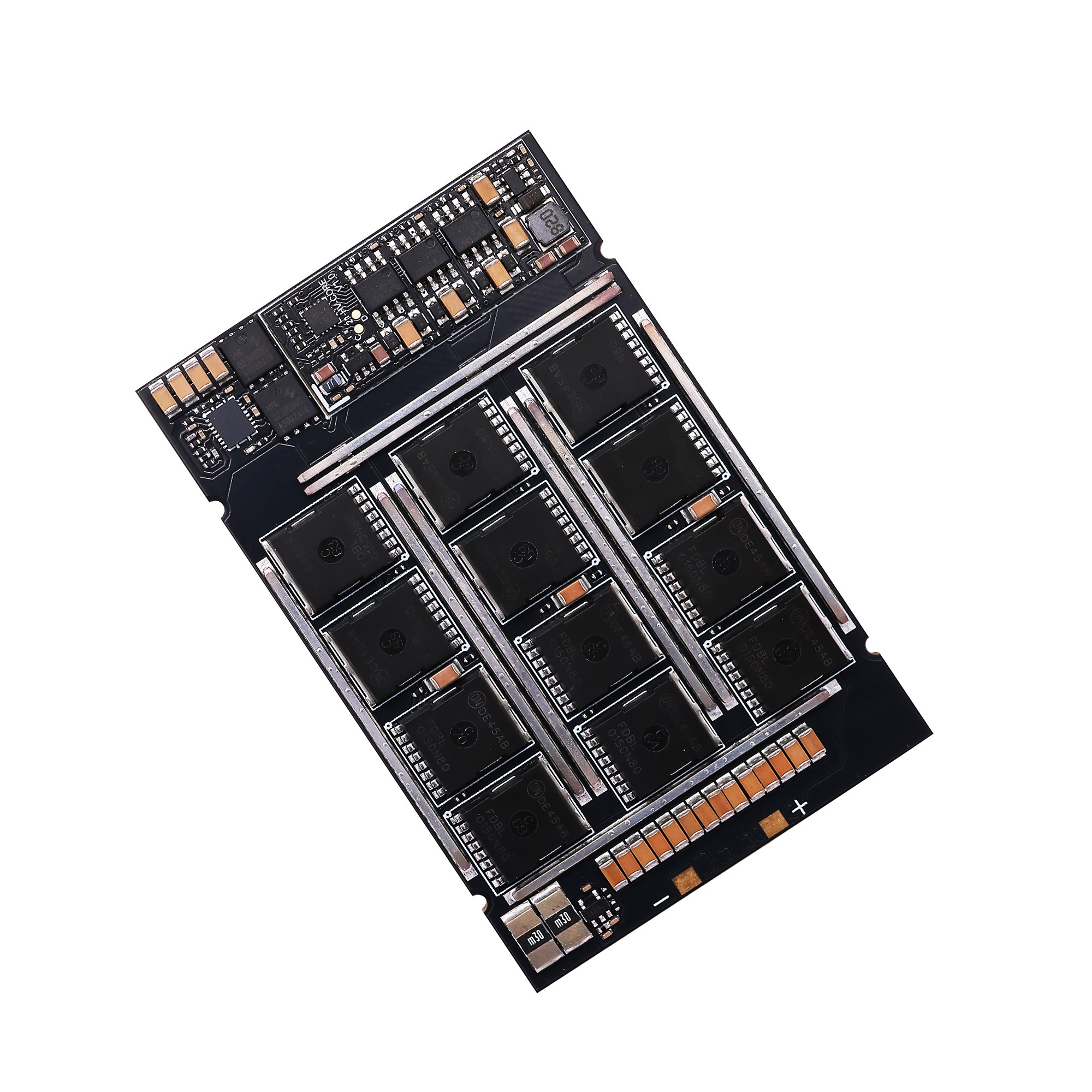
The HAKRC 2195 14S 120A Airplane ESC is an electronic speed controller for airplane propulsion integration. Its physical architecture stacks separately designed control and power boards within a specified size of 81*51mm and a net weight of 63g. The power board uses an eight-layer PCB with 2oz copper, resin-plugged construction and copper strips. Its electronics include an EFM8BB21F16G controller running at up to 50MHz, three SLM21867 drivers, 80V MOS devices in a quadruple-parallel arrangement, and Japanese Murata capacitors.
Electrical integration supports a 6S-14S LiPo input and PWM, Oneshot125, Oneshot42, Multishot, Dshot150, Dshot300 and Dshot600 control protocols. The specified firmware is G-H-40-Rev-16.7-MUIti. Included functions comprise real-time bus-current sensing and an adjustable BEC offering 5V, 6V or 7.2V at 10A sustained output, with 18A instantaneous output. The ESC has a stated peak current of 130A. Its 120A continuous-current specification carries a closed-incubator test qualification of 2min6s, a material duration condition when assessing the controller for a propulsion installation.
Specifications
| Specification | Value & conditions |
|---|---|
| Brand and model | HAKRC — HAKRC 2195 14S 120A Airplane ESC |
| Size | 81*51mm |
| Product net weight | 63g |
| ESC firmware | G-H-40-Rev-16.7-MUIti |
| Protocol support | PWM, Oneshot125, Oneshot42, Multishot, Dshot150, Dshot300, Dshot600 |
| BEC | 5V 10A; 6V 10A; 7.2V 10A; MAX:18ASelectable 5V, 6V or 7.2V output; 10A sustained and 18A instantaneous. |
| Input voltage | 6S-14S LipoLiPo battery input. |
| Continuous current | 120A (closed incubator test, can last 2min6s)Closed incubator test; can last 2min6s. |
| Peak current | 130A |
| Current ratio | 130 |
| Main control chip | EFM8BB21F16G, running at up to 50MHz |
| Board architecture | Stacked hardware with separate control and power boards |
| Power board construction | 8-layer PCB with 2oz copper |
| MOS arrangement | 80V MOS devices in a quadruple-parallel arrangement |
| Drivers | 3 SLM21867 drivers |
| PCB manufacturing process | Resin-plugged PCB construction |
| Voltage regulator | Industrial-grade LDO |
| Capacitors | Japanese Murata capacitors |
| Integrated current sensing | Integrated bus-current sensing in real time |
| Copper strips | Equipped with copper strips |