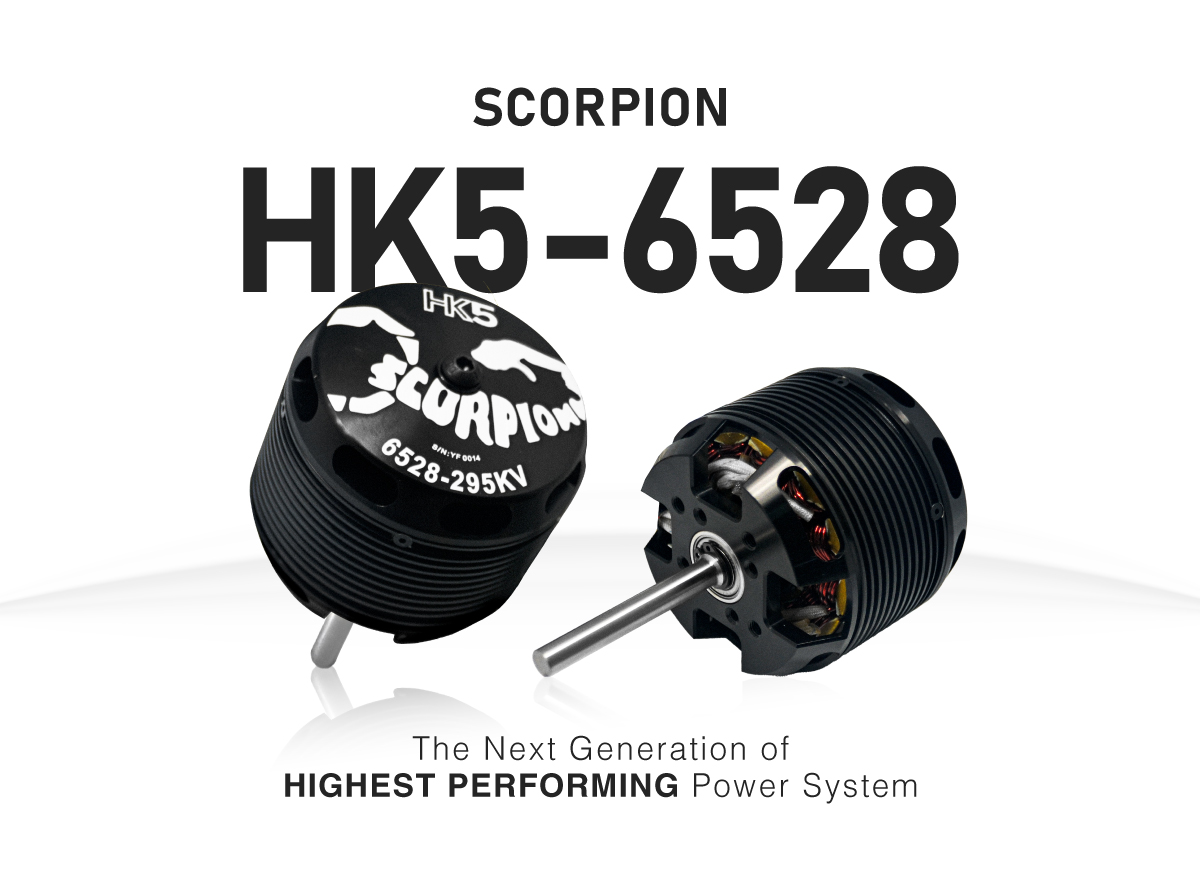
Product overview
The Scorpion HK5-6528-295kv (8 x 60mm shaft) is a helicopter propulsion motor intended primarily for 12s–14s operation in 900mm–1000mm+ helicopter applications. Its physical architecture combines a 65 mm diameter, 28 mm thick stator with an internal fan and an external centrifugal fan to move cooling air through the motor. The electrical construction specifies 12 stator arms, 10 stator poles, a 6+7T winding and 2 x 1.2mm motor wire, with a speed constant of 295KV RPM/Volt.
For mechanical integration, the motor body measures 78.0mm x 68.5mm, while the external shaft measures 7.98mm x 60mm; the model designation identifies the 8 x 60mm shaft configuration. Motor weight is 1070.0g (37.74oz), increasing to 1200g including packaging. Continuous ratings are 110 Amps and 5720 Watts. Peak ratings reach 220A and 11440w, each limited to two seconds. These continuous and short-duration ratings define distinct electrical operating limits for the motor within its intended 12s–14s helicopter installation.
Specifications
| Specification | Value & conditions |
|---|---|
| Manufacturer and model | Scorpion HK5-6528-295kv (8 x 60mm shaft) |
| Intended application | 900mm - 1000mm+ helicopter application12s -14s operation |
| Cooling architecture | Internal fan combined with an external centrifugal fan |
| Motor Kv | 295KV RPM/Volt |
| Weight | 1070.0g Grams (37.74oz) |
| Motor Body Dimensions | 78.0mm x 68.5mm (3.07" x 2.70 ") |
| External Shaft Dimensions | 7.98mm x 60mm (0.314" x 2.36") |
| Continuous Current | 110 Amps |
| Continuous Power | 5720 Watts |
| Peak Current | 220A (2 seconds)2 seconds |
| Peak Power | 11440w Watts (2 seconds)2 seconds |
| Max Lipo Cell | 12s - 14s |
| Stator Diameter | 65 mm ( 2.56 in) |
| Stator Thickness | 28 mm ( 1.10 in) |
| Number of Stator Arms | 12 |
| Number of Stator Poles | 10 |
| Motor Wind | 6+7T |
| Motor Wire | 2 x 1.2mm |
| Packaged Weight | 1200gIncluding packaging |
Request a quote for Scorpion HK5-6528-295kv (8 x 60mm shaft)
Send your application, destination country and expected quantity to the ChinaDrone team. We can discuss product selection, configuration and sourcing from China.
Submit your procurement requirements ↗No account needed. A model number is optional. Your enquiry is handled by ChinaDrone.