| Product type | Livox Avia 2 ultra-long range LiDAR |
|---|
| Laser wavelength | 1535nm |
|---|
| Laser eye safety | Class 1 eye safety |
|---|
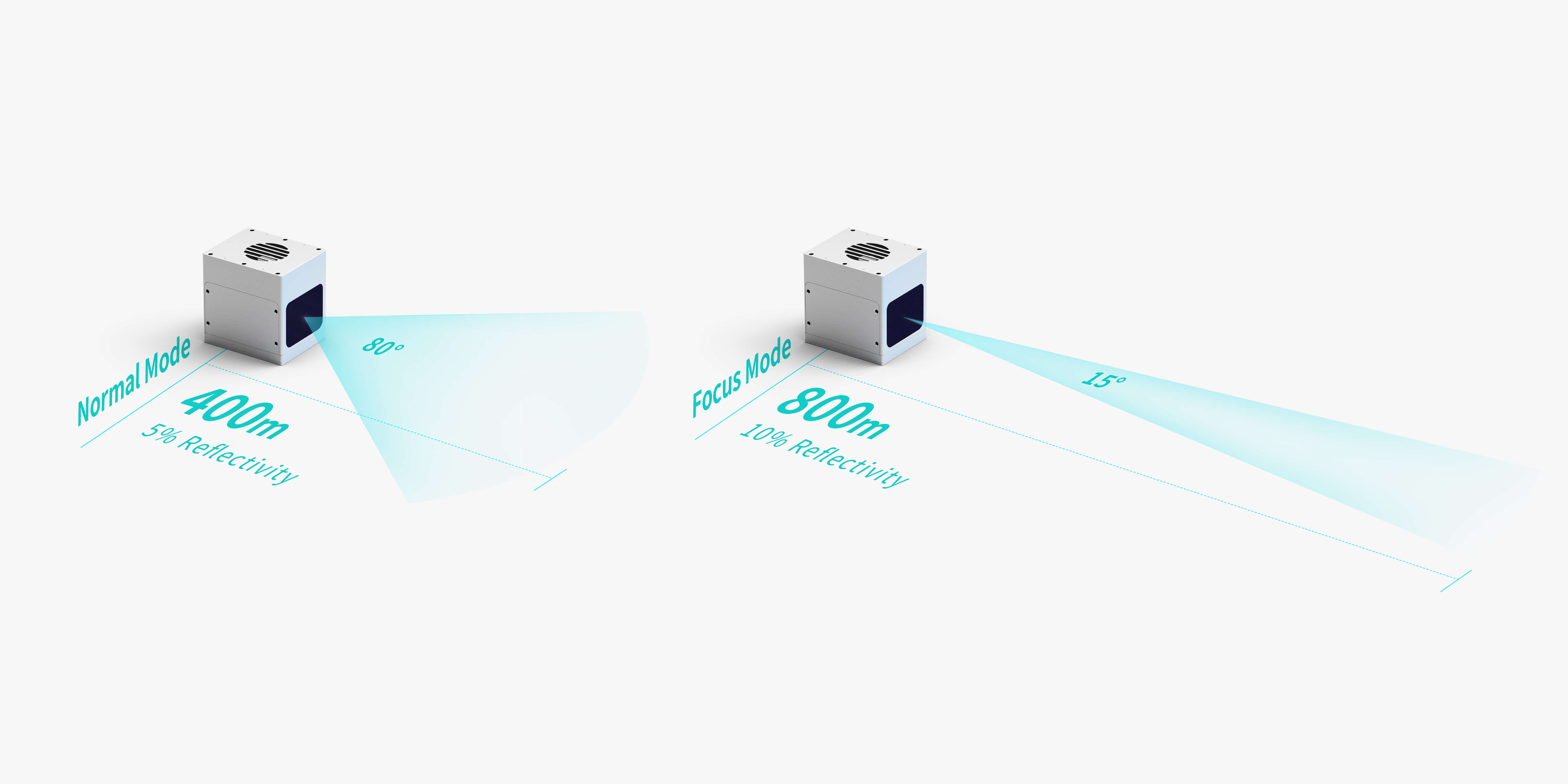
| Normal-mode detection range | 400m at 5% reflectivity, equivalent to approx. 600m at 10% reflectivityNormal mode; 5% target reflectivity; measured in a controlled environment; results may vary depending on the environment and actual use. |
|---|
| Normal-mode maximum detection potential | 600 m at 10% reflectivityNormal mode; 10% target reflectivity; operating cutoff locked at 400 m; measured in a controlled environment; results may vary depending on the environment and actual use. |
|---|
| Normal-mode cutoff range | 400 mNormal mode; stable output of 350,000 points per second; measured in a controlled environment; results may vary depending on the environment and actual use. |
|---|
| Point rate | 350,000 points per second (350 kHz)Normal mode; cutoff range locked at 400 m; measured in a controlled environment; results may vary depending on the environment and actual use. |
|---|
| Focus-mode detection range | ≥ 800m at 10% reflectivityFocus mode; 10% target reflectivity; measured in a controlled environment; results may vary depending on the environment and actual use. |
|---|
| Maximum cutoff range | 1000 mFocus mode; 20% target reflectivity; requires sufficient point cloud integration time depending on target size; measured in a controlled environment; results may vary depending on the environment and actual use. |
|---|
| Normal-mode field of view | 80° × 80°Normal mode. |
|---|
| Focus-mode field of view | 15° × 15°Focus mode. |
|---|
| Beam divergence | 0.25mrad × 0.25mradCalculated in a laboratory environment using an infrared camera and test distance; actual performance may vary slightly with ambient temperature and atmospheric conditions. |
|---|
| Laser spot diameter | 2.5 cmAt 100m; theoretical value derived from laboratory-calculated divergence; actual performance may vary slightly with ambient temperature and atmospheric conditions. |
|---|
| Angular precision | ≤ 0.02°At 1σ. |
|---|
| Range precision at 5–400 m | ≤ 4cmRange 5–400 m; at 1σ. |
|---|
| Range precision at 400–700 m | ≤ 6cmRange 400–700 m; at 1σ. |
|---|
| Estimated mean time to failure | 62,500 hoursTypical value calculated using a reliability formula and confidence level from high-temperature aging tests in a controlled environment; does not represent actual continuous operating time. |
|---|
| Operating temperature | -4° to 149° F (-20° to 65° C)Ambient temperature; measured in a controlled environment; actual temperature tolerance and operating status may vary with on-site conditions such as ventilation and sunlight. |
|---|
| Scanning method | Wedge prism non-repetitive scanning; coverage becomes denser as scan time increases |
|---|
| Built-in noise removal | Rain noise removal and fog noise removalRain noise removal is designed only for light to medium rain; actual noise reduction results may vary depending on the environment. |
|---|
| Power line monitoring coverage | Up to one kilometer per unitPowerline inspection. |
|---|
| Wayside monitoring coverage | Tunnel-entrance slopes and overhead catenary systemsNormal mode. |
|---|
| Bulk material volume measurement | Point cloud capture of material piles for automated inventory managementHigh-dust and low-light environments such as coal yards and granaries. |
|---|
| Waterway monitoring | Point cloud capture throughout a ship's transitDuring a ship's transit. |
|---|
| Optical exposure restrictions | Avoid direct exposure to strong external lasers around 1535 nm and close-range aiming at highly reflective targets such as Low-E glass or corner cube retroreflectors to prevent permanent sensor damageDuring deployment and operation. |
|---|
| Environmental durability limitation | May shorten lifespan and degrade detection range and overall reliabilityContinuous operation in extreme environments with high temperature and humidity, or salt spray corrosion. |
|---|