Product overview
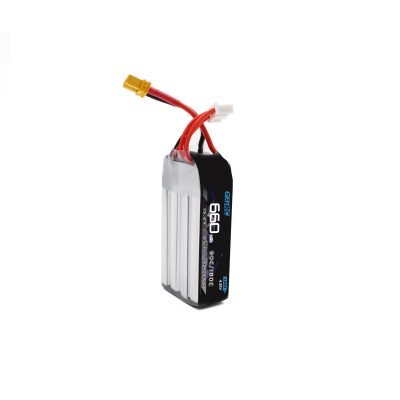
The GEPRC GEP 4S 660mAh is a LiHV battery intended to power 2-3 inch drones, including the CineLog series. Its 4S1P configuration provides a nominal 15.2V, with 660mAh capacity and 10.03WH energy. The pack measures 17*32*63(mm) and weighs 64.1g, establishing the space and mass needed for installation. Both charging and discharge connections are specified as XT30. The supplied configuration consists of one GEPRC 4S 660mAh 90/180C battery, with maximum continuous and burst discharge ratings of 90C and 180C respectively.
Charging requires attention to LiHV voltage limits: full charge must not exceed 4.35V per cell, and discharge must not fall below 3.5V per cell. The specified recommended charging current is 1C; additional charging guidance recommends 1-1.5C, with 3C as the maximum. Charge only within 0-45°C, allow a recently used pack to cool below 45°C, and supervise charging. Discharge operation spans -20-60°C. For long-term storage, maintain 3.80V-3.85V per cell within the -20-35°C storage range and perform a charge-discharge activation within three months.
Specifications
| Specification | Value & conditions |
|---|---|
| Model | GEP 4S 660mAh |
| Capacity | 660mAh |
| Configuration | 4S1P |
| Nominal voltage | 15.2V |
| Energy | 10.03WH |
| Dimensions | 17*32*63(mm) |
| Weight | 64.1g |
| Maximum continuous discharge rate | 90CContinuous discharge. |
| Maximum burst discharge rate | 180CBurst discharge. |
| Charge connector | XT30 |
| Discharge connector | XT30 |
| Recommended charging current | 1CCharging. |
| Maximum charging current | 3CCharging. |
| Working temperature for charging | 0-45°CCharging. |
| Working temperature for discharge | -20-60°CDischarging. |
| Working humidity | 65%RH +/-20%Operation. |
| Storage temperature | -20-35°CStorage. |
| Storage humidity | 65%RH +/-20%Storage. |
| Cycle life | 300+times |
| Maximum charging voltage | 4.35V per cell maximumSingle LiHV cell at full charge. |
| FAQ charging-rate guidance | Recommended 1-1.5C; supports up to 3CCharging; FAQ recommendation. |
| Recommended chargers | HOTA D6 PRO, ISDT 608AC and ToolkitRC M6DCharging. |
| Battery type | LiHV |
| Intended drone application | Power supply for 2-3 inch drones, including the CineLog series |
| Supplied configuration | 1 x GEPRC 4S 660mAh 90/180C battery |
| Minimum discharge voltage | Do not discharge below 3.5V per cell; over-discharge causes damage and swellingDischarging; per cell. |
| Long-term storage voltage | 3.80V-3.85V per cellLong-term storage; per cell. |
| Charge-discharge maintenance interval | Perform a charge-discharge activation within 3 monthsStorage maintenance. |
| Cooling requirement | Allow the battery to cool below 45°C before chargingCharging after use. |
| Charging supervision | Do not charge unattendedCharging. |
Request a quote for GEPRC 4S 660mAh 90/180C HV 3.8V/4.35V LiHV Battery
Send your application, destination country and expected quantity to the ChinaDrone team. We can discuss product selection, configuration and sourcing from China.
Submit your procurement requirements ↗No account needed. A model number is optional. Your enquiry is handled by ChinaDrone.