Product overview
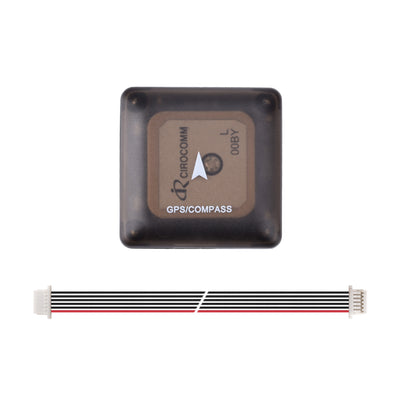
ZeroOne Flight (Nanjing) Technology Co., Ltd.'s OneRTK UM982 integrates with a flight controller for GPS positioning and dual-antenna heading determination. Its connection architecture provides CAN and UART interfaces. The recommended CAN arrangement links its CAN port to the controller's CAN interface through a CAN/I2C cable. Where CAN cannot be used, its UART port connects to the controller's Telem interface using the serial cable included among the accessories. Installation requires space to separate the primary and secondary antennas by at least 30 cm.
Integration also requires configuration of heading sources and installation offsets. DroneCAN operation uses GPS type 9, while the specified dual-antenna moving-baseline setup uses GPS_TYPE 25, with GPS heading alone or GPS backed by a compass. Antenna offsets are entered in meters, including displacement from the system's center of gravity when applicable; parameter names differ across the AP4.6 firmware boundary. Missing or incorrect offsets can produce inaccurate positions or position shifts during heading changes. After configuration and calibration, the MissionPlanner gpsyaw reading must track actual aircraft heading and rotation.
Specifications
| Specification | Value & conditions |
|---|---|
| Recommended CAN connection | Connect the OneRTK CAN port to the flight controller CAN interface using a CAN/I2C cable. CAN is the recommended connection for stable data transmission. |
| UART connection and supplied cable | Connect the OneRTK UM982 UART interface to the flight controller Telem interface using the serial cable included among the accessories.When a CAN connection cannot be used. |
| DroneCAN GPS selection | Set GPS_TYPE to 9, or GPS1_TYPE to 9 with AP4.6 and later firmware.For a DroneCAN connection; GPS1_TYPE applies to AP4.6 and later firmware. |
| CAN1 driver and automatic configuration | Set CAN_P1_DRIVER to 1 and GPS_AUTO_CONFIG to 2 for automatic DroneCAN GPS configuration.When connected to the CAN1 interface. |
| Heading source selection | Set EK3_SRC1_YAW to 2 to use GPS heading, or 3 to prioritize GPS with a compass as backup.For CAN1 configuration or dual-antenna heading operation. |
| Minimum antenna separation | At least 30 cm between the primary and secondary antennas to maintain accuracy and avoid signal interference.For installation of the primary and secondary antennas. |
| Relative antenna offsets | GPS_MB1_OFF_X/Y/Z specifies the primary antenna's X, Y and Z offsets relative to the secondary antenna, in meters.According to the actual primary and secondary antenna installation. |
| Relative antenna offset signs | Positive X indicates forward, positive Y indicates right, and positive Z indicates downward displacement of the primary antenna relative to the secondary antenna.When the primary antenna is displaced relative to the secondary antenna. |
| Position offsets and firmware parameters | Set the primary antenna's X/Y/Z offsets from the center of gravity in meters using GPS_POS1_X/Y/Z below AP4.6, or GPS1_POS_X/Y/Z with AP4.6 and later firmware.When OneRTK cannot be installed at the unmanned system's center of gravity. |
| Positioning limitation | Missing or incorrect offsets cause erroneous position information, position shifts during heading changes, or inaccurate positioning.When installation offsets are omitted or configured incorrectly. |
| Moving-baseline configuration | Set GPS_TYPE to 25 (UnicoreMovingBaseline), EK3_SRC1_YAW to 2 or 3, and GPS_MB1_TYPE to 1; configure the corresponding offsets.When OneRTK is used for dual-antenna heading determination. |
| Heading verification | Check that MissionPlanner's gpsyaw value matches the aircraft's actual heading and responds correctly as the aircraft is manually rotated.After GPS system configuration and calibration. |