Product overview
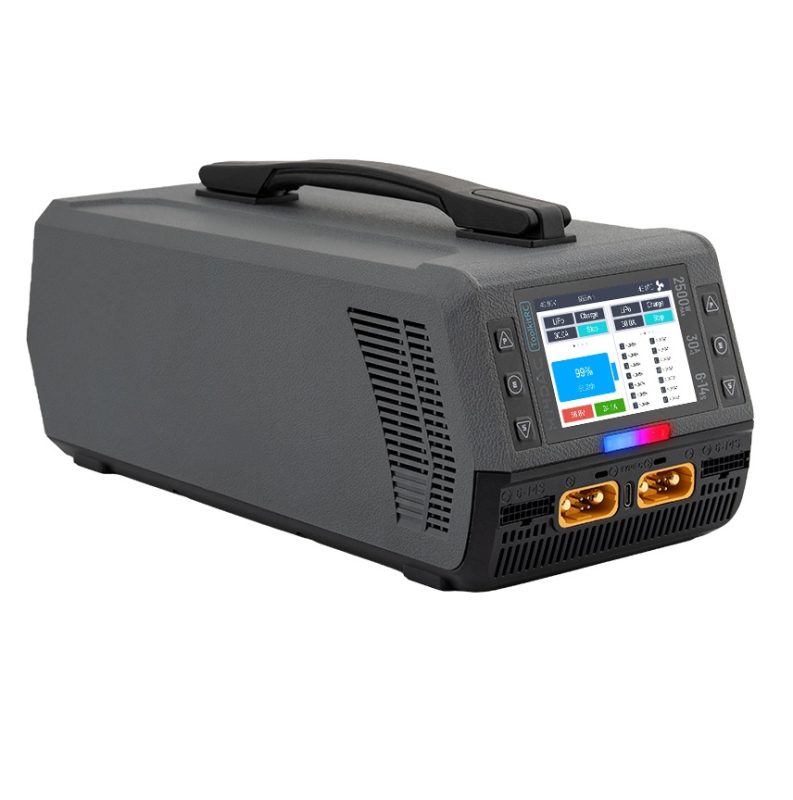
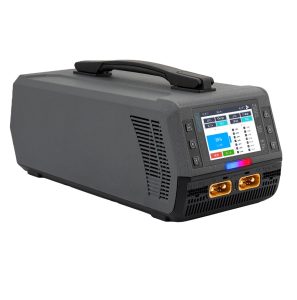
The ToolkitRC M14DAC is a dual-output drone battery charger for charging, storing and discharging 6–14S LiPo and LiHV batteries. It combines smart power distribution with two AS150U male ports and support for DroneCAN smart battery communication through the AS150U interface. Two sets of buttons provide control alongside a 3.5-inch IPS RGB display with 480×320-pixel resolution and a multilanguage interface. A carrying handle supports transport, while a dynamic light strip indicates charging status in real time.
Charging limits depend on the AC supply and operating mode. At AC 220V, the M14DAC supports 1.0–30.0A per channel at 1250W per channel; at AC 110V, the same current range is limited to 600W per channel. Synchronized operation supports 1.0–50.0A at 2500W with AC 220V or 1200W with AC 110V. Discharging supports 1.0–5.0A at 60W per channel. Balancing current reaches a maximum of 2000mA at 2–14S, while the specified charging battery range remains 6–14S.
A separate Type-C output supplies a maximum of 65W at a maximum of 20V. Protection features cover short circuits, voltage, reverse polarity, current, capacity, temperature, timeout and cutoff. The charger is available in EU, US, AU and UK regional options, with package choices comprising the M14DAC alone or the M14DAC plus an AS150U-to-XT90 male connector. Its DroneCAN communication support applies through the AS150U interface and does not imply compatibility with every smart battery.
Specifications
| Specification | Value & conditions |
|---|---|
| Manufacturer, model and purpose | ToolkitRC M14DAC dual drone battery charger.And intended battery functions; this product is charging equipment rather than a flight platform or airframe kit. |
| Battery functions | Charge, storage and discharge functions for 6–14S LiPo and LiHV batteries.Battery scope and operating modes. |
| Product size | 314.7×153.9×145.6mm |
| Product weight | 3100g |
| Packing size | 344.7×184×198mm |
| Packaging weight | 3850g |
| LCD | 3.5″ IPS RGB, 480×320px |
| Input voltage and maximum power | AC 220.0–240.0V at maximum 2600W; AC 100.0–120.0V at maximum 1300WMaximum input power differs between the specified AC voltage ranges. |
| Battery type | LiPo and LiHV, 6–14SPublished charging battery scope is LiPo and LiHV at 6–14S. |
| Charging power | 1.0–30.0A at 1250W×2 with AC 220V; 1.0–30.0A at 600W×2 with AC 110V; synchronized 1.0–50.0A at 2500W with AC 220V; synchronized 1.0–50.0A at 1200W with AC 110VDual-output and synchronized ratings depend on AC supply voltage; retain the stated current and power limits for each mode. |
| Discharging power | 1.0–5.0A at 60W×2 |
| Balance current | Maximum 2000mA at 2–14SThe balancing specification states 2–14S; the separate charging battery specification states 6–14S. |
| Type-C output | Maximum 65W at maximum 20VBoth output power and voltage are published as maximum values. |
| Internal resistance | 1mΩ–9.9Ω at 6–14SPublished internal-resistance range applies at 6–14S. |
| Operating controls | 2 sets of buttons |
| Output connectors | 2×AS150U male ports and 1×Type-CConnector configuration; confirm battery connections and the selected adapter package. |
| Additional-information weight | 671586 gThis additional-information entry conflicts with the separately published 3100g product weight and 3850g packaging weight; obtain clarification before using it for procurement or logistics. |
| Regional options | EU, US, AU, UKListed regional options. |
| Package options | M14DAC; M14DAC plus AS150U-to-XT90 male connectorTwo package choices are listed; the AS150U-to-XT90 male connector is explicitly named in the combined package. |
| Protection features | Short-circuit, voltage, reverse-polarity, current, capacity, temperature, timeout and cutoff protection; V0 flame-retardant designationManufacturer-listed protections and flame-retardant designation. |
| Power distribution | Dual outputs with smart power distributionDual-output architecture. |
| Smart battery communication | AS150U battery interface supporting DroneCAN smart battery communicationSupport is stated through the AS150U battery interface. |
| Handling and status indication | Carrying handle and dynamic light strip indicating charging statusPhysical and status features. |
| Interface languages | Multilanguage user interface |
Request a quote for ToolkitRC M14DAC
Send your application, destination country and expected quantity to the ChinaDrone team. We can discuss product selection, configuration and sourcing from China.
Submit your procurement requirements ↗No account needed. A model number is optional. Your enquiry is handled by ChinaDrone.