Product overview
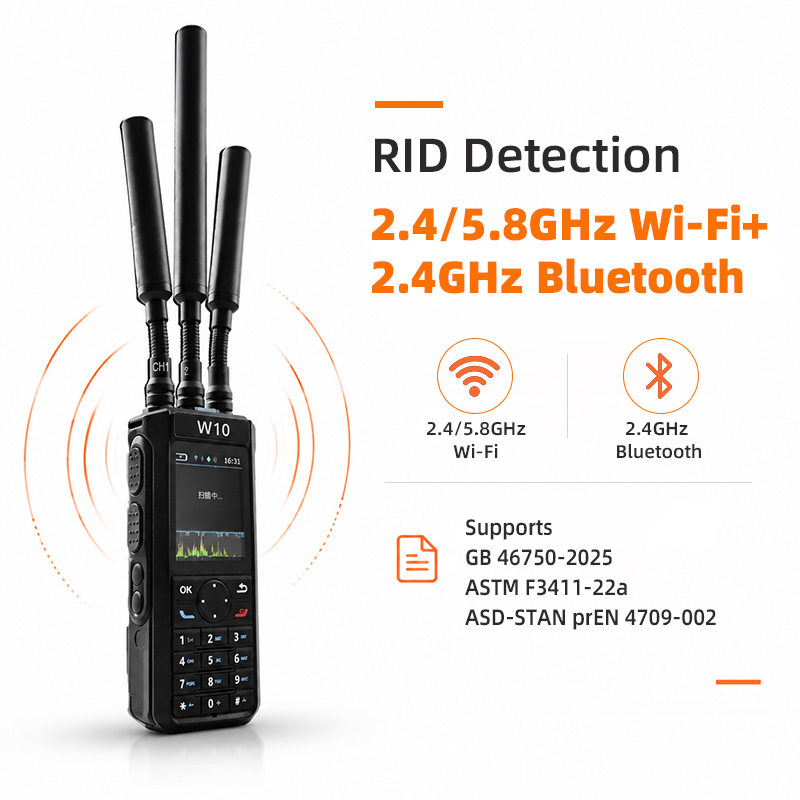
The Tatusky W10 is a portable passive RF detector for field inspection, event security and protection of critical sites. It receives signals across 300MHz–13400MHz and presents drone identification, operating frequency, signal strength and spectrum information. Its identification library covers more than 100 drone types, including mainstream consumer aircraft, analog FPV, digital FPV and Wi-Fi drones. Remote ID reception uses Wi-Fi and Bluetooth. Typical detection distance is 500 m–5 km, with the 5 km maximum qualified by unobstructed line-of-sight and full-power analog video transmission.
The handheld architecture combines three probe antennas, a 2.4-inch 240×320 TFT display, physical controls and a removable battery. The main unit measures 140 × 63 × 41 mm without the antenna back clip, increasing to 360 × 63 × 54 mm with it; weight including battery and antenna is 450g. Integration connections comprise Type-C, Bluetooth and GPIO. Audible and vibration alerts support local use, while GPIO provides an electrical alarm output for external countermeasure equipment. Internal storage retains detection logs, and USB-C or Bluetooth supports firmware and signature updates.
The supplied configuration identifies one main host, one replaceable battery and detection antennas. The battery specification gives 7.4V and 2800mAh, with approximately eight hours of operation per battery at room temperature; charging at Type-C 5V/1A takes approximately five to six hours. Battery chemistry is described as lithium-ion and Li-polymer in the package listing. The IP54 housing provides dust and splash protection but is unsuitable for immersion. Operation spans -25°C to +55°C, with reduced battery life possible in cold conditions; obstacles and heavy RF noise can also degrade identification.
Specifications
| Specification | Value & conditions |
|---|---|
| Manufacturer and model | Tatusky W10; item number TTSK-W10-006. |
| Product purpose and detection method | Portable drone detection handset for on-site airspace security, using passive RF detection and signal analysis. |
| Receiving frequency band | 300MHz-13400MHz. |
| Frequency step and target information | Minimum frequency step: 1 MHz. Displays drone model, operating frequency, signal strength and real-time full-band spectrum. |
| Receiving sensitivity | -101 dBm. |
| Detection range | Typical working range: 500 m–5 km; maximum: up to 5 km.Maximum 5 km under unobstructed line-of-sight for full-power analog video-transmission drones; distance varies with obstacles, interference, transmit output power and signal bandwidth. |
| Identifiable UAV types | Mainstream brands include DJI, AUTEL, Fimi, Hubsan and Skydroid. Analog FPV support includes PAL/NTSC video transmission. Digital FPV examples include Walksnail, HDZero, Artosyn ArtLynk series (e.g., BetaFPV P1), Antigravity A1 and OpenIPC. Wi-Fi drone examples include PowerEgg X, Parrot Disco, Yuneec, 3DR Solo, GDU Byrd, Xiaomi, ZLL-XL-PRO, Syma X30, SJRC drones, Skydio, Walkera T210 Mini and SwellPro SplashDrone. |
| Identification library | More than 100 drone types; new signatures can be added through OTA firmware updates. |
| Remote ID reception and standards | 2.4 GHz Wi-Fi, 5.8 GHz Wi-Fi and 2.4 GHz Bluetooth; compliant with GB 46750-2025, ASTM F3411-22a and ASD-STAN prEN 4709-002. |
| Screen | 2.4-inch TFT, 240×320 resolution; displays drone detection lists, real-time spectrum, target details and menu settings. |
| Alarm outputs | Three outputs: local buzzer, motor vibration and external GPIO electrical alarm signal. |
| Detection logging | Detection events can be saved as internal storage logs. |
| External interfaces | Type-C, Bluetooth and GPIO. |
| Antenna interface | 3 probe antennas (SMA male connector with female port). |
| Firmware and signature updates | Bluetooth supports remote data checking; Type-C USB or Bluetooth supports OTA firmware and signature database updates. |
| Countermeasure integration | GPIO can connect to and trigger an external backpack-style countermeasure device when a drone is detected.Connected to external backpack-style countermeasure equipment through the GPIO alarm output. |
| Battery type | Removable lithium-ion battery. |
| Battery nominal voltage | 7.4V. |
| Battery capacity | 2800mAh. |
| Charging | Type-C, 5V/1A; approximately 5–6 hours to fully charge.Type-C charging at 5V/1A. |
| Battery life | Approximately 8 hours.Single battery, at room temperature. |
| Controls | Power button, volume controls, menu button and OK button. |
| Operating temperature | -25°C to +55°C.Battery life may decrease in low-temperature environments. |
| Storage temperature | -30°C to +60°C. |
| Protection rating | IP54; dust and splash protection.Not suitable for immersion. |
| Maximum safe input level | +1dBm. |
| Dimensions with antenna back clip | 360 × 63 × 54 mm.Main unit with antenna back clip; dimensions in L × W × H order. |
| Dimensions without antenna back clip | 140 × 63 × 41 mm.Main unit without antenna back clip. |
| Weight | 450g.Main unit including battery and antenna. |
| Supplied configuration | Main host ×1, replaceable Li-polymer battery ×1 and detection antennas.Package listing identifies the battery as Li-polymer; battery specifications identify it as lithium-ion. |