Product overview
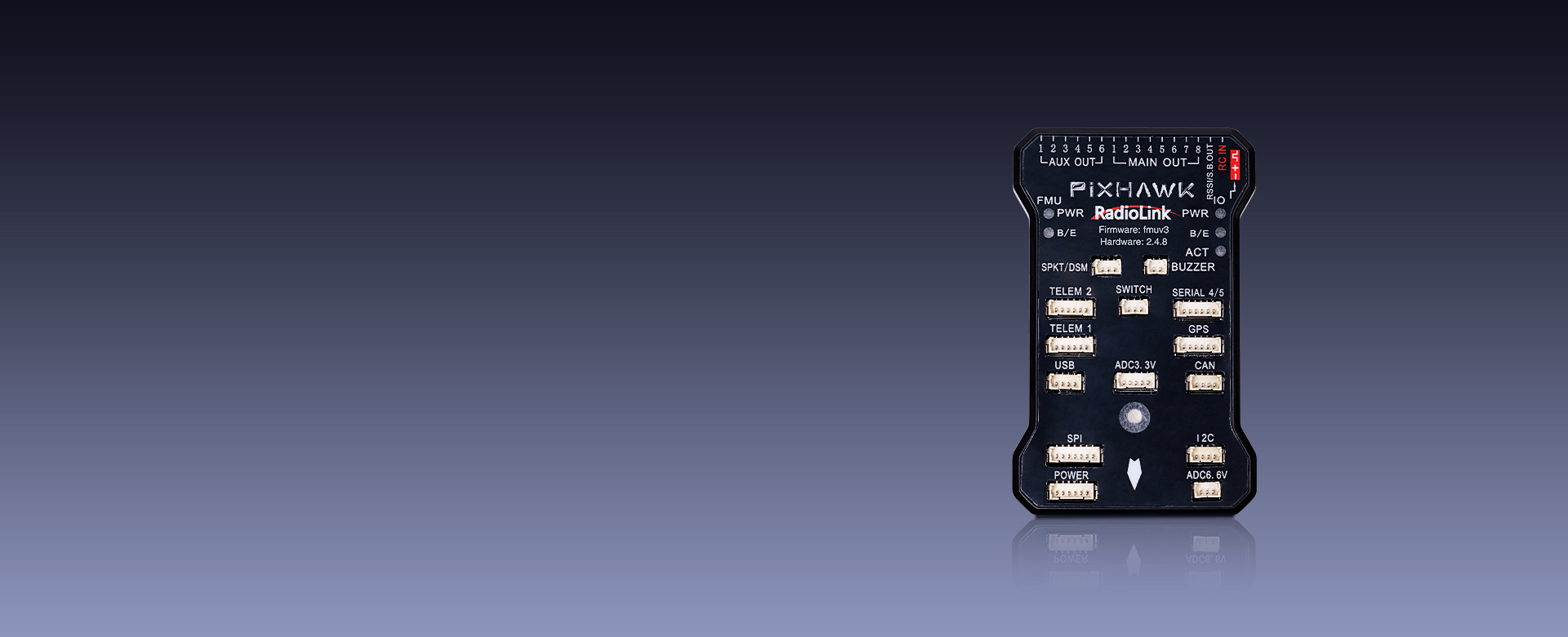
The RadioLink PIXHAWK is a version 2.4.8 flight controller for helicopters, racing drones, fixed-wing aircraft, gliders, cars and boats. Its onboard hardware includes an MS5611 barometer, MPU6000 six-axis sensor and FM25V02 FRAM with 256Kb capacity for waypoint storage. A revised circuit design reduces internal interference and noise. The controller occupies 82.2mm × 16.5mm × 51.8mm and incorporates a micro-USB port, SD card provision, and separate reset buttons for input/output and flight management.
Connections support SBUS input, a Spektrum DSM receiver, main motor outputs and auxiliary outputs. GPS, CAN, SPI and I2C connections accommodate navigation and peripheral integration, alongside telemetry interfaces for an on-screen display and radio telemetry. Analog-to-digital converter connections are identified at 3.3V and 6.6V. Adding an external I2C expansion board enables connection of up to six SUI04 ultrasonic modules for front, back, left, right and upward obstacle avoidance, together with downward altitude hold. Parameter setup supports Radiolink Mission Planner, ArduPilot Mission Planner and QGC Mission Planner.
The supplied controller package includes one 2-12S power module, buzzer, safety switch, 4G micro SD card, two pieces of double-sided adhesive tape, connection cables, USB cable, manual and packing box. The power module accepts 7.4-50.4V and provides a 5.3±0.2V, 2A BEC output. Its maximum detection current is 90A, with a 22.5A maximum for a single ESC. Factory packing includes only one of two power module options, so the selected package version must suit the installation requirements.
Specifications
| Specification | Value & conditions |
|---|---|
| Manufacturer and model | RadioLink PIXHAWK |
| Product type and applications | Flight controller for helicopters, racing drones, fixed-wing aircraft, airplanes, gliders, cars and boats. |
| Hardware version | 2.4.8 |
| Circuit design | Redesigned circuit to reduce internal component interference and noise. |
| Barometer | MS5611 |
| Replacement sensor | IST8310 replaces the discontinued L3GD20 and LSM303D sensor arrangement.Hardware version 2.4.8. |
| Six-axis accelerometer and gyro | MPU6000 |
| FRAM | FM25V02 (256Kb), providing increased waypoint storage.Hardware version 2.4.8. |
| Automated functional testing | Automated software functional testing system. |
| Obstacle sensor expansion | Supports up to 6 SUI04 ultrasonic obstacle avoidance modules.With an external I2C expansion board. |
| Obstacle sensing directions | Front, back, left, right and upward obstacle avoidance, plus downward altitude hold.With an external I2C expansion board and SUI04 modules. |
| Input voltage | 2-12S (7.4-50.4V)Supplied power module. |
| Maximum current detection | 90A; single ESC maximum detection current is 22.5A.Supplied power module. |
| BEC output voltage | 5.3±0.2VSupplied power module. |
| BEC output current | 2ASupplied power module. |
| Power module configuration | One of two power module options included; select the package version according to installation requirements.Default factory package. |
| Physical dimensions | 82.2mm × 16.5mm × 51.8mm |
| SBUS interface | SBUS signal input. |
| Peripheral connections | Buzzer, serial, safety switch, GPS module and CAN bus connections. |
| Analog and I2C connections | 3.3V and 6.6V analog-to-digital converter connections; I2C splitter or compass module connection. |
| Power, SPI and indicator connections | Power module, SPI bus, LED indicator and USB connections. |
| Telemetry connections | Telemetry connections for on-screen display and radio telemetry. |
| Receiver and actuator interfaces | Spektrum DSM receiver connection, auxiliary outputs and main motor outputs. |
| Reset controls | Input/output reset button and flight management reset button. |
| USB and storage hardware | Micro-USB port and SD card provision. |
| Parameter configuration software | Radiolink Mission Planner, ArduPilot Mission Planner and QGC Mission Planner. |
| Included controller and electronics | PIXHAWK ×1; power module (2-12S) ×1; buzzer ×1; safety switch ×1; micro SD card (4G) ×1.Standard PIXHAWK package. |
| Included mounting materials and cables | Double-sided adhesive tape ×2; receiver connection cable ×1; power module connection cable ×1; safety switch connection cable ×1; USB cable ×1.Standard PIXHAWK package. |
| Included documentation and packaging | User manual ×1; packing box ×1.Standard PIXHAWK package. |
Request a quote for RadioLink PIXHAWK
Send your application, destination country and expected quantity to the ChinaDrone team. We can discuss product selection, configuration and sourcing from China.
Submit your procurement requirements ↗No account needed. A model number is optional. Your enquiry is handled by ChinaDrone.