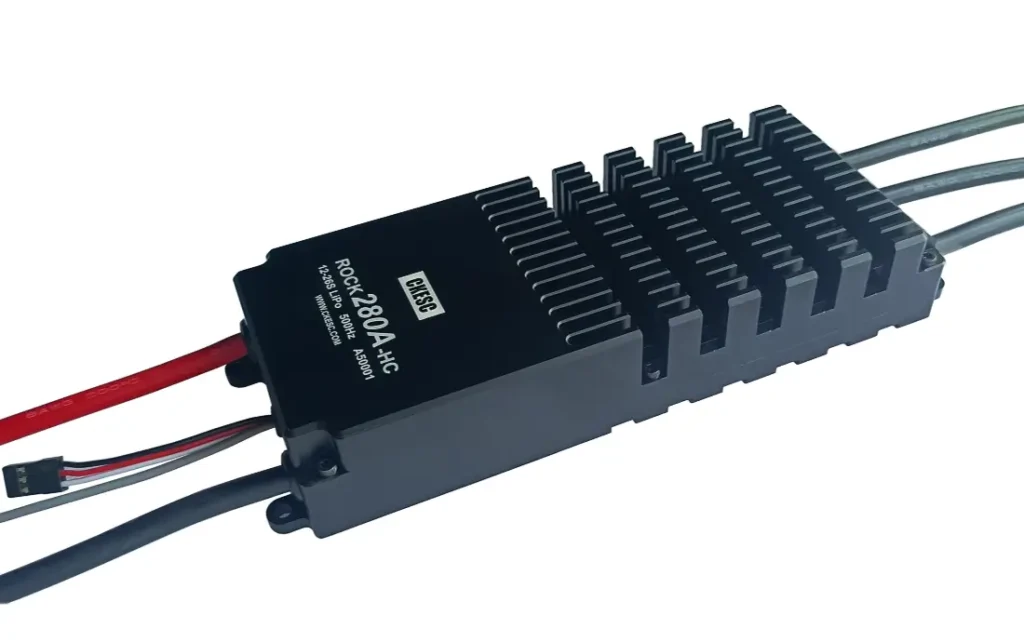
Product overview
The Nanchang ChangKong Technology Co., Ltd CKESC ROCK 280A-HC is a brushless UAV electronic speed controller for integrating motor control into a propulsion system. Its 175 × 69.8 × 33.5 mm body and 594.5 g weight including wiring define its installation envelope. The power stage uses low-resistance MOS devices, while shielded signal wiring and optically isolated input/output interfaces address interference. PWM communication is standard, with a PWM+CAN version optional. Serial telemetry supplies voltage, motor speed, current, ESC temperature and debugging data.
The controller supports 12–26S operation, with 140 A continuous current requiring specified cooling and 280 A maximum current limited to three seconds. Standard firmware supports timing adjustment; a fixed version is optional, and maximum-power mode can be enabled. Standard ingress protection is IP54, with IP67 available through customization. Low-voltage protection is disabled by default. Other protections address excessive voltage, startup failure, stalls, current, load, temperature and signal loss. Above 115°C, output can fall to 40% of full-throttle power before recovering after cooling. A stall at high throttle may damage the ESC.
Specifications
| Specification | Value & conditions |
|---|---|
| Manufacturer and model | Nanchang ChangKong Technology Co., Ltd — CKESC ROCK 280A-HC UAV electronic speed controller |
| Rated specification | 280A 12~26S |
| Dimensions | 175 × 69.8 × 33.5 mm |
| Weight | 594.5 gIncluding wiring. |
| Continuous operating current | 140 AWith specified cooling. |
| Maximum operating current | 280 AFor 3 seconds. |
| Standby consumption | ≤10 mAAt 100 V. |
| Throttle pulse range | 1000–2000 µs |
| Throttle refresh rate | 50–500 HzRecommended refresh rate: 100–400 Hz. |
| BEC | None |
| Input signal level | 3.3–5 V |
| Temperature protection threshold | 115°C |
| Communication interface | PWMOptional PWM+CAN version. |
| Operating ambient temperature | -20 to +65°C |
| Throttle response time | 400 ms |
| Ingress protection | IP54IP67 can be customized. |
| Firmware configuration | Timing-adjustment firmware is standard; a fixed version is optional, and maximum-power mode can be enabled.Default timing-adjustment firmware; optional fixed version. |
| Power-stage components | Low-resistance MOS devices with high transient-current capability. |
| Serial telemetry | Real-time serial output includes supply voltage, motor speed, current, ESC temperature and debugging data. |
| Signal interference control | Shielded signal wiring and optically isolated signal input/output interfaces reduce interference. |
| Low-voltage protection | Low-voltage protection is available through customization.Disabled by default; activation can be customized. |
| High-voltage protection | Prevents motor startup.When supply voltage exceeds the permitted value. |
| Startup protection | Limits starting current and automatically retries startup.Following an unsuccessful startup. |
| Stall protection | Attempts to restart the motor.When the motor stalls during normal operation; a stall at high throttle may damage the ESC. |
| Overtemperature protection | Maximum output power gradually decreases, potentially to 40% of full-throttle power.When temperature exceeds 115°C; original power returns after cooling. |
| Overcurrent protection | Limits peak current to the applicable limit. |
| Overload protection | Limits maximum throttle to protect the propulsion system.When excessive motor load is detected. |
| Signal-loss protection | Progressively reduces output, rapidly lowers throttle below 50% within 1–2 seconds, then slowly reduces throttle until shutdown.After signal loss lasting 200 ms. |
| Motor control | Updated control algorithms target improved motor compatibility and increased output power. |
| Startup and throttle control features | Startup control addresses opposing wind; throttle control resists phase loss during abrupt changes, with adaptive operating parameters.During startup into opposing wind and abrupt throttle changes. |