Product overview
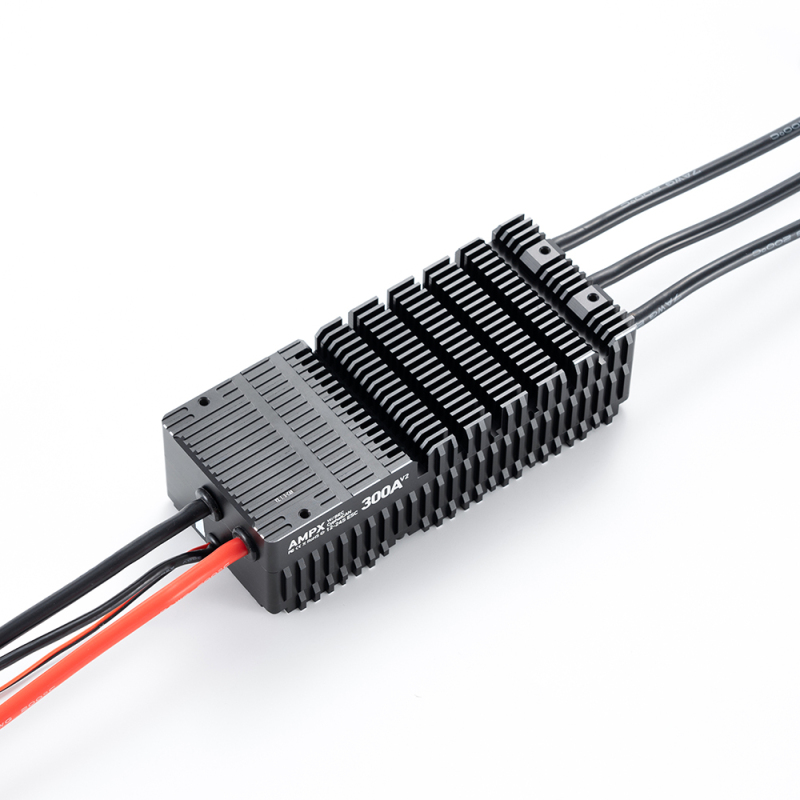
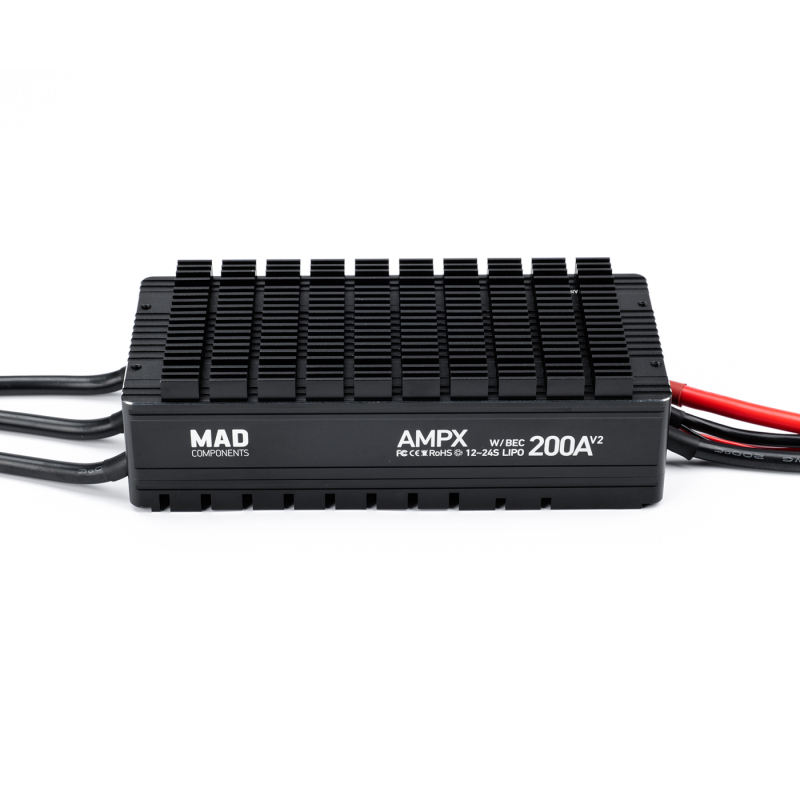
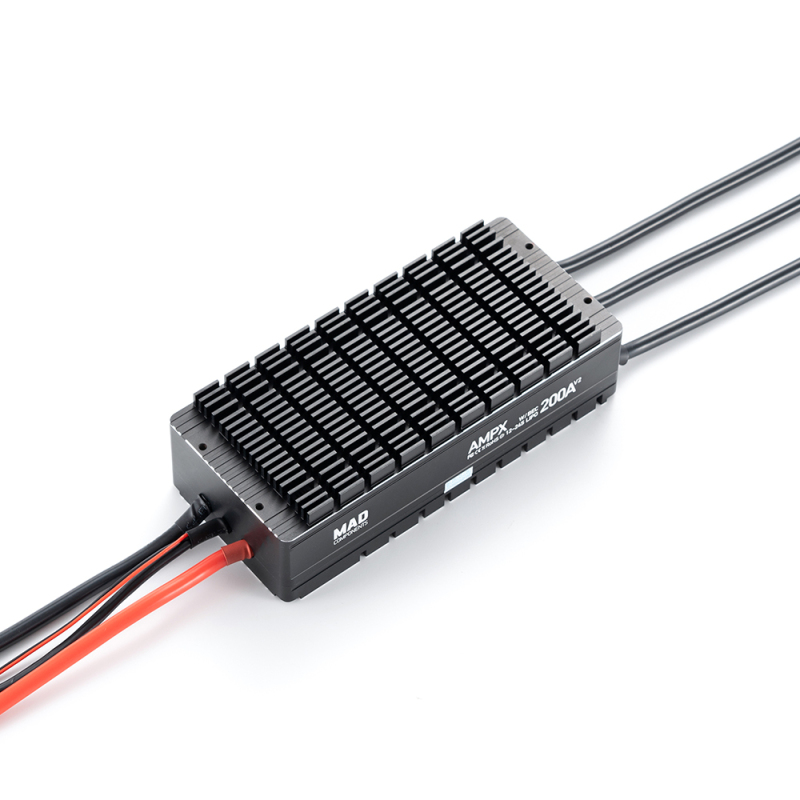
The MAD Components AMPX 200A (12-24S) HV Drone BLDC ESC is an electronic speed controller for integration into a propulsion system. Its supported electrical range is 12–24S and 40V–100V, with a maximum current of 200A. The named motor pairing is the M50C35 PRO EEE 35kv. Configuration choices comprise V2.0 and V3.0 with PPG, alongside DroneCAN and CyphalCAN options. V2.0 provides CAN and BEC and is recommended for new UAV projects; V3.0 provides CAN for electric paramotor use.
V3.0 adds a brake function and communication with a powered paraglider setup box, while its voltage protection mechanism differs from V2.0. The PPG Controller connects to the ESC through CAN to display operating information and set parameters. It reports voltage, current, power, ESC and motor temperatures, and flight altitude, with fall protection, high-temperature protection and mode switching. Its physical ventilation requirement is to keep the back-cover vents open during use so air can circulate and heat can dissipate.
The PPG Controller requires correct battery-capacity and cell-count settings, plus altitude calibration before use. Remaining battery capacity is a reference indication whose sampling limitations can cause deviation from actual charge; reaching the configured warning threshold makes both the LED and percentage display flash. Altitude appears in metres below 1km and with a k suffix above 1km, with 1 m accuracy under normal use. The legacy V1.0 configuration lacks CAN and BEC, making version selection consequential for system integration.
Specifications
| Specification | Value & conditions |
|---|---|
| Product type | High-voltage drone brushless DC electronic speed controller. |
| SKU | 0102DT0356 |
| Selectable versions | V2.0; V3.0 with PPG. |
| CAN protocol options | DroneCAN; CyphalCAN. |
| Supported battery cell count | 12–24S. |
| Supported voltage | 40V–100V. |
| Maximum current | 200A. |
| Named motor pairing | Described as working well with the M50C35 PRO EEE 35kv motor.M50C35 PRO EEE 35kv motor. |
| V1.0 interfaces | Without CAN or BEC.V1.0 configuration. |
| V2.0 interfaces | With CAN and BEC.V2.0 configuration. |
| V3.0 application and interface | With CAN for electric paramotor use.V3.0 configuration. |
| Recommended applications | V2.0 for new UAV projects; V3.0 for powered paraglider customers.Version selected for the intended application. |
| Voltage protection | V2.0 and V3.0 use different voltage protection mechanisms.V2.0 and V3.0 configurations. |
| Brake and setup communication | Brake function and communication with the powered paraglider setup box.V3.0 configuration. |
| PPG Controller function | Separate controller for displaying and setting ESC parameters through the CAN bus.PPG Controller connected to the ESC through CAN. |
| Displayed operating information | Voltage, current, power, ESC temperature, motor temperature and flight altitude.PPG Controller connected to the ESC through CAN. |
| Controller protection and modes | Fall protection, high-temperature protection and mode switching.PPG Controller configuration. |
| State of charge | SOC expressed as a percentage of remaining battery charge relative to current maximum capacity.PPG Controller battery display. |
| Battery capacity setup | Verify full-capacity and cell-count settings. With a fully charged battery, use the Up button to reset the charge indication to 100%; the device also recognizes full capacity when switched on.Before using the PPG Controller; battery fully charged for the manual reset. |
| Remaining-capacity limitation | Reference indication only; sampling accuracy limitations can cause deviation from actual remaining capacity.PPG Controller remaining-capacity indication. |
| Low-capacity indication | The LED and remaining-capacity percentage flash simultaneously.Remaining capacity reaches the configured prompt value. |
| Altitude calibration | Press and hold Up and Down together to clear the current flight altitude and calibrate it.Before using the PPG Controller altitude display. |
| Altitude display below 1km | Displayed in m, for example 999m.PPG Controller altitude below 1km. |
| Altitude display above 1km | Displayed using k without m, for example 1.99k.PPG Controller altitude greater than 1km. |
| Altitude accuracy | 1 m.PPG Controller under normal use. |
| Ventilation requirement | Keep the back-cover vents open for ventilation and heat dissipation.PPG Controller during use. |
Request a quote for MAD Components AMPX 200A (12-24S) HV Drone BLDC ESC
Send your application, destination country and expected quantity to the ChinaDrone team. We can discuss product selection, configuration and sourcing from China.
Submit your procurement requirements ↗No account needed. A model number is optional. Your enquiry is handled by ChinaDrone.