Product overview
The Ladasky LDK-K01 is a drone detection module for incorporation into monitoring equipment and host software. It extracts features from drone remote-control and image-transmission signals, then compares them with an upgradable model library to identify supported drones and their communication frequencies. Its 300 MHz–6 GHz operating range includes seven specified frequency bands. Detection distance is ≥3 km with the standard omnidirectional antenna, with results dependent on the environment and drone model. Identification response time is ≤2 s from drone power-on to discovery.
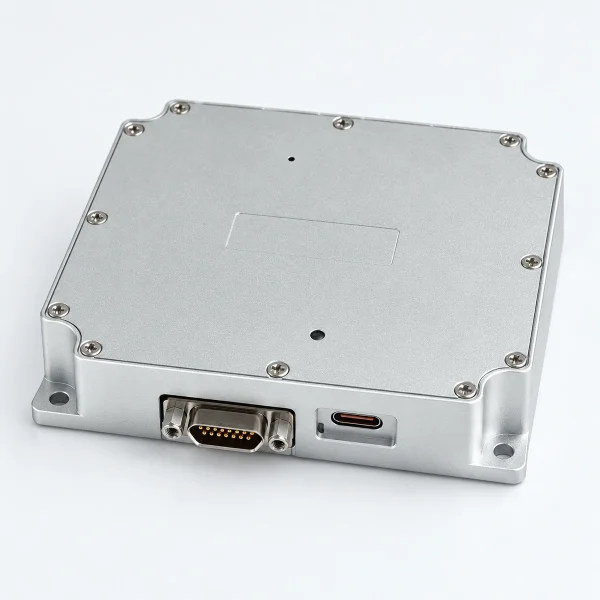
The hardware combines a compact enclosure, power and status indicators, and separate RF and debugging connections. Its dimensions are 88.0 ±1 mm long × 75 ±1 mm wide × 23.6 ±1 mm high, excluding the antenna, and its weight is 200 ±2 g. Integration requires DC 12–36 V, with consumption ≤10 W. A J30J-15ZKW-J connector combines DC power and Ethernet, an MCX-KHD input serves the 0.3–6 GHz RX1 channel, and a Type-C UART port supports debugging.
The module operates as a TCP/IP server using little-endian communication, sends device information every second, and supports host commands to start or stop measurement and transmit measurement parameters. Available target fields include identity, manufacturer/model, frequency, bandwidth, direction, signal strength, confidence, and signal category. Unique IDs may be empty, and direction can be invalid outside the antenna test range. Distance and position are estimates. Identification accuracy is ≥95% for library-listed models within 100 m, generally across 3–4 models, multiple flights, and 50–100 tests; the separate 0–100 confidence field expresses signal classification confidence.
Specifications
| Specification | Value & conditions |
|---|---|
| Brand | Ladasky |
| Model | LDK-K01 |
| Product category | Drone Detection Modules |
| Working frequency band | 300 MHz–6 GHz |
| Key frequency bands | 430–435, 840–845, 902–928, 1430–1444, 2400–2484, 5150–5250, and 5725–5850 MHz |
| Detection method | Radio signal detection and spectrum feature recognition |
| Detection distance | ≥3 km with standard omnidirectional antenna; varies with environment and drone modelWith standard omnidirectional antenna; varies with environment and drone model. |
| Identification accuracy | ≥95% for library-listed models within 100 m; generally 3–4 models, multiple flights, and 50–100 testsLibrary-listed models within 100 m; generally 3–4 models, multiple flights, and 50–100 tests. |
| Identification response time | ≤2 s from drone power-on to discoveryMeasured from drone power-on to discovery. |
| Model library | Supported mainstream drone models; library upgrades supported |
| Power supply | DC 12–36 V |
| Power consumption | ≤10 W |
| Dimensions excluding antenna | 88.0 ±1 mm (L) × 75 ±1 mm (W) × 23.6 ±1 mm (H)Excluding antenna. |
| Weight | 200 ±2 g |
| Indicators | Power and status lights |
| Power and network connector | J30J-15ZKW-J; combined DC supply and Ethernet interface |
| RF input | MCX-KHD; 0.3–6 GHz RX1 |
| Debugging interface | Type-C UART |
| Communication | TCP/IP; module operates as server; Little endian |
| Device information interval | 1 second |
| Target data fields | Available identity, manufacturer/model information, frequency, bandwidth, direction, signal strength, confidence, and signal category |
| Data availability | Unique ID may be empty; direction can be invalid outside the antenna test rangeDirection can be invalid outside the antenna test range. |
| Positioning limitation | Distance and position are estimates; no verified positioning accuracy specified. |
| Host control | Start/stop measurement and transmission of measurement parameters |
| Confidence field | 0–100; signal classification confidence, not identification accuracy |