Product overview
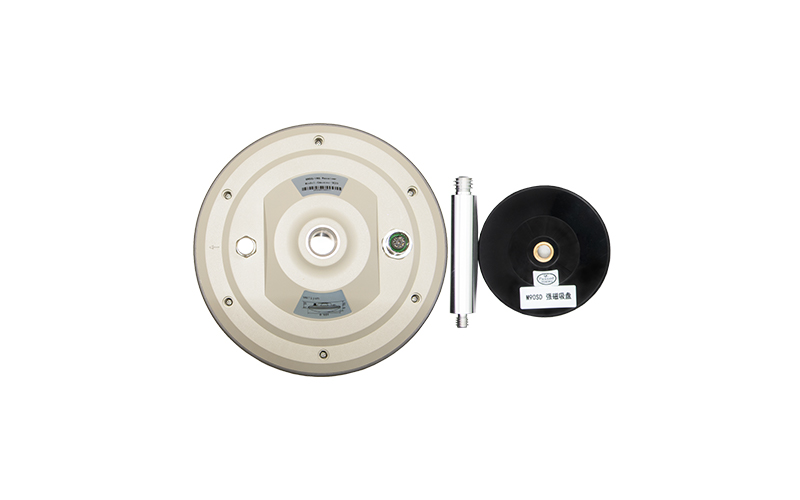
The bynav Gmouse combines an RTK antenna with an internal M2-series module, a high-precision positioning board and an IMU. Its integrated architecture provides positioning and attitude information for equipment integration, with agriculture, industrial machinery and automotive positioning among its stated uses. The product is a navigation component, rather than a flight platform or airframe kit. Its deeply coupled GNSS/INS engine and specialized multi-vector RTK engine support positioning when satellite reception is obstructed or interfered with, while GNSS and IMU raw data are available for post-processing.
Configuration selection affects output rates and inertial capability. Gmouse-M20 provides GNSS results at up to 10 Hz; Gmouse-M21 and Gmouse-M22 provide 5 Hz GNSS results and 100 Hz INS results, with GNSS output up to 10 Hz when combined navigation is disabled. Their stated dead-reckoning accuracies require LAND mode and effective speedometer input. Positioning accuracies are typical values influenced by satellite geometry, baseline length, multipath and interference. Starred signals require optional support or designated firmware, and optional timing accuracy excludes RF and antenna bias. Typical Gmouse power consumption is 550 mW.
Specifications
| Specification | Value & conditions |
|---|---|
| Manufacturer and model | Bynav Gmouse Module-integrated RTK Antenna |
| Configurations and integrated architecture | Gmouse-M20, Gmouse-M21 and Gmouse-M22 configurations |
| Built-in equipment | Integrated high-precision positioning board and IMU |
| Horizontal positioning accuracy | Single point: 1.5 m (RMS); RTK: 1 cm + 1 ppm (RMS)Typical values; affected by GNSS systematic characteristics, satellite geometry, baseline length, multipath and other interference. |
| Vertical positioning accuracy | Single point: 2.5 m (RMS); RTK: 1.5 cm + 1 ppm (RMS)Typical values; affected by GNSS systematic characteristics, satellite geometry, baseline length, multipath and other interference. |
| GPS signals | L1 C/A, L1C, L2, L5 |
| GLONASS signals | G1, G2 |
| BDS signals | B1I, B2I, B3I, B1C*, B2a, B2bB1C is optional or requires designated firmware. |
| Galileo signals | E1, E5b, E5a, E6*E6 is optional or requires designated firmware. |
| QZSS signals | L1 C/A, L2, L5, L6* (CLAS)L6 is optional or requires designated firmware. |
| L-Band reception | Sensitivity: -133 dBm; FEC bit: 10⁻⁵Optional or designated firmware required. |
| Observation accuracy | Carrier phase: ≤1 mm (RMS); pseudorange: ≤0.1 m (RMS)Typical values. |
| Dynamic performance | Velocity: ≤500 m/s; acceleration: ≤4 g |
| Dead-reckoning accuracy | Gmouse-M21: 0.8%; Gmouse-M22: 0.2%LAND mode selected and effective speedometer input. |
| Maximum GNSS result rate |
|
| Maximum INS result rate | 100 HzM21/M22 configurations. |
| Timing accuracy | 20 ns (RMS)Optional; RF and antenna bias excluded. |
| Velocity accuracy | 0.03 m/s (RMS) |
| Anti-jamming | 65 dBc (ISR)Multitone with no fewer than 6 pulses; narrowband bandwidth no less than 10% of the signal's; fast sweep interference. |
| Power consumption | 550 mWTypical power consumption. |
| Gyroscope range | M21: ±300 °/s; M22: ±300 °/s (XY), ±460 °/s (Z)Gmouse-M21 and Gmouse-M22 configurations, respectively. |
| Gyroscope bias over temperature | M21: 0.3 °/s; M22: 0.3 °/s (XY), 0.07 °/s (Z)Gmouse-M21 and Gmouse-M22 configurations, respectively; over temperature. |
| Gyroscope angular random walk | M21: 0.15 °/√h (X/Y), 0.2 °/√h (Z); M22: 0.5 °/√h (XY), 0.08 °/√h (Z)Gmouse-M21 and Gmouse-M22 configurations, respectively. |
| Gyroscope bias instability | M21: 5 °/h; M22: 5 °/h (XY), 1 °/h (Z)Gmouse-M21 and Gmouse-M22 configurations, respectively. |
| Gyroscope scale factor and cross-coupling errors | Scale factor error: M21 4‰; M22 4‰ (XY), 2‰ (Z). Cross-coupling error: both 1.7‰ (0.1°)Gmouse-M21 and Gmouse-M22 configurations, respectively. |
| Accelerometer range | Both: ±16 gGmouse-M21 and Gmouse-M22 configurations. |
| Accelerometer bias over temperature | Both: 5 mgGmouse-M21 and Gmouse-M22 configurations; over temperature. |
| Accelerometer velocity random walk | Both: 0.3 m/s/√hGmouse-M21 and Gmouse-M22 configurations. |
| Accelerometer bias instability | Both: 50 μgGmouse-M21 and Gmouse-M22 configurations. |
| Accelerometer scale factor and cross-coupling errors | Both: scale factor error 2‰; cross-coupling error 0.9‰ (0.05°)Gmouse-M21 and Gmouse-M22 configurations. |
Request a quote for Bynav Gmouse Module-integrated RTK Antenna
Send your application, destination country and expected quantity to the ChinaDrone team. We can discuss product selection, configuration and sourcing from China.
Submit your procurement requirements ↗No account needed. A model number is optional. Your enquiry is handled by ChinaDrone.