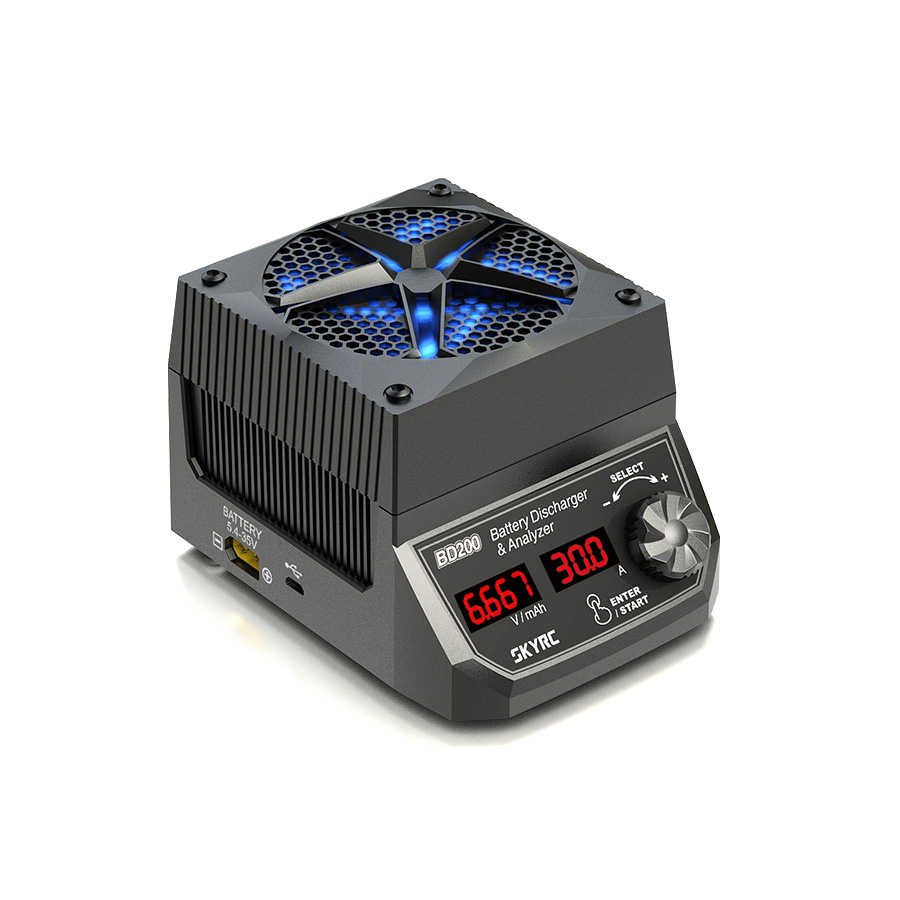
| Product | SkyRC BD200 battery discharger and analyzer; product code SK-600123. |
|---|
| Battery analysis and display | Displays real-time battery voltage, discharged capacity and discharge current; tests battery capacity to support battery selection. |
|---|
| Cooling and construction | Compact construction with IXYS MOSFETs and a cooling system supporting continuous discharge at 200 watts. |
|---|
| Heat sink and fan | A single large fan directs air downward through an extruded aluminum heat sink. |
|---|
| Controls | Rotary dial control and digital LED display. |
|---|
| Supported batteries | 2-8S LiPo, LiFe and LiHv; 6-23S NiMH and NiCd; 6-32V Pb (lead-acid), within the accepted 5.40V to 35.00V input range. |
|---|
| Discharge modes and analysis | Constant Power and Constant Current modes; automatic battery cell-count sensing and recommended minimum safe discharge voltage. Tests can be viewed in Amp Hours, Watt Hours or Minutes, with voltage graphed against each.With the supplied PC software. |
|---|
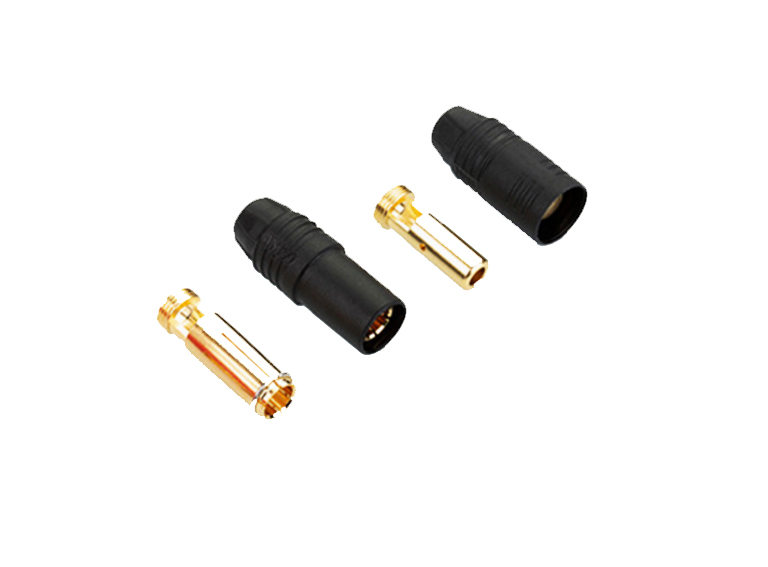
| Included equipment | BD200, discharging cable with XT60 connector and instruction manual. |
|---|
| Accepted voltage range | 5.40-35.00V |
|---|
| Low voltage alert | Less than 5.2V |
|---|
| High voltage alert | Greater than 35V |
|---|
| Maximum discharge power | 200W |
|---|
| Discharge current range | 0.01A-30.00A |
|---|
| Current consumption | Less than 100uASleep mode. |
|---|
| Standby current | ≤35mAStandby. |
|---|
| Current display accuracy | ±60mACurrent display range 0.01-10.00A. |
|---|
| Current display accuracy | ±2%Current display range 10.00-30.00A. |
|---|
| Voltage display accuracy | ±60mVVoltage display range 5.4-10V. |
|---|
| Voltage display accuracy | ±120mVVoltage display range 10-20V. |
|---|
| Voltage display accuracy | ±160mVVoltage display range 20-35V. |
|---|
| Capacity display accuracy | ±3% |
|---|
| Weight | 858g |
|---|
| Dimensions | 136.6x104.8x96mm |
|---|
| LiPo maximum discharge power chart | - 2s: 6.0 / 7.60 / 8.40 / 23.80 / 30.00;
- 3s: 9.0 / 11.40 / 12.60 / 15.87 / 22.20;
- 4s: 12.0 / 15.20 / 16.80 / 11.90 / 16.60;
- 5s: 15.0 / 19.00 / 21.00 / 9.52 / 13.30;
- 6s: 18.0 / 22.80 / 25.20 / 7.93 / 11.10;
- 7s: 21.0 / 26.60 / 29.40 / 6.80 / 9.52;
- 8s: 24.0 / 30.40 / 33.60 / 5.95 / 8.33.
LiPo batteries; each row gives cell count, minimum cut-off voltage, storage voltage, voltage, minimum discharge current (A), maximum discharge current (A). |
|---|
| LiHV maximum discharge power chart | - 2s: 6.2 / 7.70 / 8.70 / 22.98 / 30.00;
- 3s: 9.3 / 11.55 / 13.05 / 15.32 / 21.50;
- 4s: 12.4 / 15.40 / 17.40 / 11.49 / 16.12;
- 5s: 15.5 / 19.25 / 21.75 / 9.19 / 12.90;
- 6s: 18.6 / 23.10 / 26.10 / 7.66 / 10.75;
- 7s: 21.7 / 26.95 / 30.45 / 6.56 / 9.21;
- 8s: 24.8 / 30.80 / 34.80 / 5.74 / 8.06.
LiHV batteries; each row gives cell count, minimum cut-off voltage, storage voltage, voltage, minimum discharge current (A), maximum discharge current (A). |
|---|
| NiMH maximum discharge power chart | - 6s: 5.4 / 9.00 / 22.22 / 30.00;
- 7s: 6.3 / 10.50 / 19.04 / 30.00;
- 8s: 7.2 / 12.00 / 16.66 / 27.77;
- 9s: 8.1 / 13.50 / 14.81 / 24.69;
- 10s: 9.0 / 15.00 / 13.33 / 22.22;
- 11s: 9.9 / 16.50 / 12.12 / 20.20;
- 12s: 10.8 / 18.00 / 11.11 / 18.51;
- 13s: 11.7 / 19.50 / 10.25 / 17.09;
- 14s: 12.6 / 21.00 / 9.52 / 15.87;
- 15s: 13.5 / 22.50 / 8.88 / 14.81;
- 16s: 14.4 / 24.00 / 8.33 / 13.88;
- 17s: 15.3 / 25.50 / 7.84 / 13.07;
- 18s: 16.2 / 27.00 / 7.40 / 12.34;
- 19s: 17.1 / 28.50 / 7.01 / 11.69;
- 20s: 18.0 / 30.00 / 6.66 / 11.11.
NiMH batteries; each row gives cell count, minimum cut-off voltage, voltage, minimum discharge current (A), maximum discharge current (A). |
|---|