Product overview
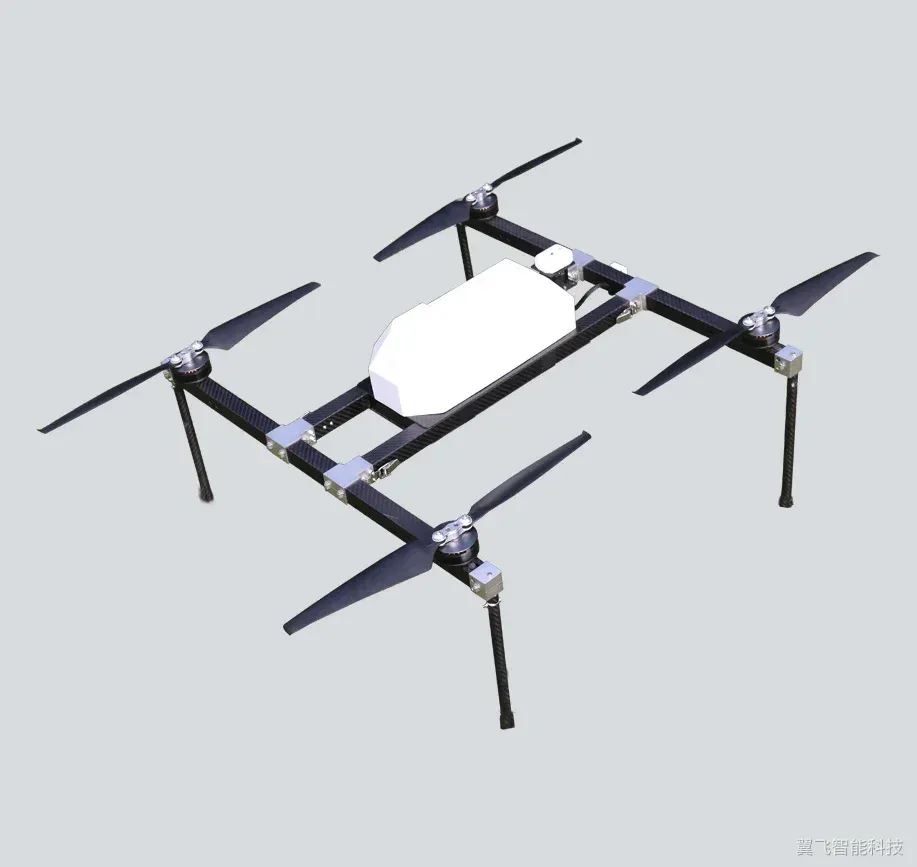
Anhui Lianghong Technology Co., Ltd’s VF20E is a battery-electric flight platform for surveying, mapping, infrastructure inspection and other aerial missions. Its composite-wing architecture combines vertical-lift propulsion with a high-aspect-ratio fixed wing and rear pusher propeller. After transition, the VTOL motors stop and their propellers fold while the wing supplies lift for cruise. Flight duration is specified as up to 90 minutes. Carbon fiber forms the wings, fuselage and tail, with aerospace-grade aluminum at load-bearing points including arm hinges and payload mounts.
The center-of-gravity payload bay provides integration space with standardized power and data connections, a vibration isolation mount and gasket sealing against dust and moisture. CAN and UART are example interfaces, with cameras, multispectral sensors, thermal imagers, LiDAR and communication relays identified as payload options. Equipped systems include redundant flight control, dual IMUs, dual GPS receivers and separate control and telemetry links. A hard case is provided. Operation calls for a clear site of at least 10 meters radius, wind below 12 m/s and good visibility; the stated propeller total conflicts with its enumerated arrangement.
Specifications
| Specification | Value & conditions |
|---|---|
| Manufacturer and model | Anhui Lianghong Technology Co., Ltd VF20E electric vertical takeoff and landing fixed-wing UAV. |
| Product configuration | Flight platform equipped with redundant flight control. |
| Power source | Battery-electric. |
| Launch and recovery | Vertical takeoff and landing without a runway, catapult or recovery net. |
| Flight duration | Up to 90 minutes.During fixed-wing forward flight. |
| Primary structure | Custom-laid carbon fiber composites and aerospace-grade aluminum alloys. |
| Carbon fiber components | Wings, fuselage and tail sections. |
| Aluminum structural components | Critical load-bearing points, including VTOL arm hinges and payload mounts. |
| Redundant navigation sensors | Two separate IMUs and two GPS receivers. |
| Sensor failover | Automatic switch to the secondary sensor unit.Primary sensor failure. |
| Communication architecture | Low-latency control link and independent long-range telemetry link. |
| Lost-link response | Pre-programmed lost-link procedure, typically autonomous return to the launch point and landing.Loss of the primary control signal. |
| Payload bay position | At the aircraft center of gravity. |
| Payload interfaces and integration options | Standardized power and data ports; CAN and UART are example buses. Integration options include RGB cameras, multispectral sensors, thermal imagers, LiDAR scanners and communication relays. |
| Payload vibration isolation | Custom isolation mount to reduce high-frequency propulsion vibration. |
| Payload bay sealing | Gasketed bay for protection against dust and moisture. |
| Site clearance | Clear, open area with a minimum radius of 10 meters, free from obstacles, people and power lines.Takeoff and landing site assessment. |
| Wind and visibility requirements | Wind speeds below 12 m/s and good visibility.Pre-flight weather assessment. |
| Propeller count inconsistency | The propulsion description specifies eight propellers but enumerates four VTOL propellers and one pusher; these counts are inconsistent.Propulsion inspection. |
| GPS acquisition | Strong GPS signal, typically greater than 10 satellites.Ground control setup before flight. |
| Takeoff authorization and altitude | Remote-controller safety switch held during command confirmation; vertical ascent to a preset safe altitude, with 25 meters given as an example.Automatic takeoff. |
| Cruise propulsion | VTOL motors shut down and their propellers fold; a rear pusher propeller provides primary forward thrust.Transition to fixed-wing flight. |
| Flight control modes | Manual remote control or autonomous execution of a flight plan uploaded to the ground control station. |
| Automatic recovery | Automatic return to the home point, transition to multirotor mode and vertical descent.Return to Launch command from the ground control station or RC transmitter. |
| Battery storage | Remove the battery and charge or discharge to approximately 3.8V per cell for storage.Batteries will not be reused within 24 hours. |
| Supplied storage case | Provided hard case; storage in a cool, dry environment. |
| Quality management certification | ISO 9001:2015 quality management certification.Production process. |
Request a quote for VF20E
Send your application, destination country and expected quantity to the ChinaDrone team. We can discuss product selection, configuration and sourcing from China.
Submit your procurement requirements ↗No account needed. A model number is optional. Your enquiry is handled by ChinaDrone.