| Brand | Ladasky |
|---|
| Model | LDK-DGA1 |
|---|
| Product Type | Fixed drone detection and jamming system with omnidirectional and directional jamming |
|---|
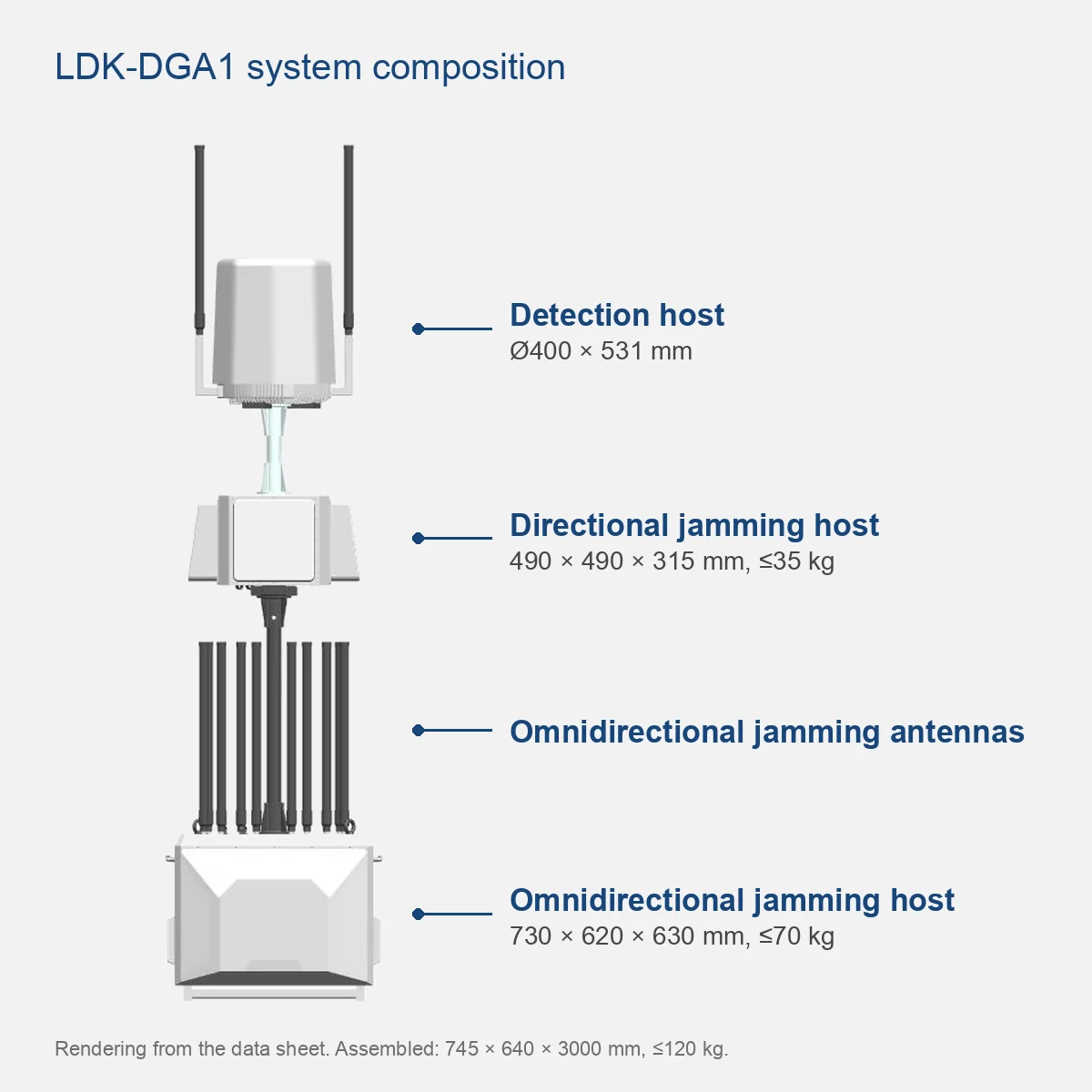
| System Composition | One detection host, one omnidirectional jamming host and one directional jamming host, with jamming antennas, cables and a support rod assembly |
|---|
| Detection Frequency Range | 70 MHz–6 GHz full-band scanning, detection and display |
|---|
| Key Detection Bands | 800 MHz, 900 MHz, 1.2 GHz, 1.4 GHz, 2.4 GHz, 5.2 GHz, 5.8 GHz |
|---|
| Detection Distance | ≥10 kmLine-of-sight environment with −90 to −95 dB electromagnetic noise. |
|---|
| DroneID / Remote ID Positioning Distance | DroneID: ≥10 km (O2 and O4 protocol models), ≥5 km (O3/O3+); Remote ID: ≥2 kmSuburban line of sight, −90 to −95 dB electromagnetic noise; DroneID distances apply to the stated protocol models. |
|---|
| Positioning Compatibility | Drones broadcasting DroneID (O2, O3, O3+, O4, O4+ protocols) or Remote ID, including DJI and Autel models with these protocolsDrones broadcasting the stated DroneID protocols or Remote ID. |
|---|
| Analog FPV Video Detection | 500 MHz–6 GHz scanning and display |
|---|
| Analog FPV Video Viewing Distance | ≥1.5 km with real-time video viewingGood visibility and video transmitter power ≥2.5 W. |
|---|
| Horizontal Detection Angle | Up to 360° |
|---|
| Detection Response Time | ≤5 s from drone power-on to reportTarget within 500 m, line of sight. |
|---|
| Direction-Finding Accuracy | ≤±15° RMSAt 2.4/5 GHz; no obvious obstructions or interference. |
|---|
| Target Information | Distance, altitude, speed, position (to 1 m), model, serial number, take-off point, return point and real-time trajectory |
|---|
| Software Functions | Unattended and manual control; allowlist and blocklist; GIS map of surroundings and device locations; intrusion logs with angle, time and frequency, playback and statistical reports; device status display; FPV analog video playback |
|---|
| Positioning and North Alignment | Built-in positioning with automatic north calibration |
|---|
| Signal Library | Collects unknown drone signals, extracts parameters and adds them to the feature library after manual confirmation; autonomous AI learning optionalFeature-library additions require manual confirmation; autonomous AI learning is optional. |
|---|
| Jamming Coverage | Omnidirectional: 360° horizontal; directional: focused coverage in a set direction |
|---|
| Omnidirectional Jamming Bands | - Band 1: 410–480 MHz, 50 W;
- Band 2: 650–740 MHz, 50 W;
- Band 3: 740–840 MHz, 50 W;
- Band 4: 860–930 MHz, 50 W;
- Band 5: 2400–2500 MHz, 100 W;
- Band 6: 4880–5080 MHz, 50 W;
- Band 7: 5150–5250 MHz, 50 W;
- Band 8: 5720–5860 MHz, 100 W;
- Band 9: 5870–6060 MHz, 50 W
Omnidirectional jamming host. |
|---|
| Directional Jamming Bands | - Band 1: 830–940 MHz, 30 W;
- Band 2: 2400–2500 MHz, 50 W;
- Band 3: 5150–5250 MHz, 30 W;
- Band 4: 5720–5860 MHz, 50 W
Directional jamming host. |
|---|
| Effective Jamming Range | Up to 3 kmDepending on operating conditions and drone model; drones taking off 5 km away and flying at 100–300 m. |
|---|
| Jamming Response Time | ≤7 s |
|---|
| System Power Consumption | ≤3500 W |
|---|
| Detection Host Dimensions, Power and Interfaces | Ø400 × 531 mm; AC 110–240 V; LAN, WAN and USB ports; 2.4 GHz and 5.8 GHz detection antennasDetection host. |
|---|
| Omnidirectional Jamming Host Dimensions, Weight, Power and Interfaces | 730 × 620 × 630 mm, ≤70 kg; AC 110–240 V; LAN and 9-pin data portsOmnidirectional jamming host. |
|---|
| Directional Jamming Host Dimensions, Weight, Power and Interfaces | 490 × 490 × 315 mm, ≤35 kg; DC 28 V input; 9-pin data port; 3.3 V enable control inputDirectional jamming host. |
|---|
| System Size and Weight | 745 × 640 × 3000 mm; ≤120 kgAssembled system. |
|---|
| Housing, Operating Temperature and Protection | Aviation aluminum; −40°C to +60°C; IP66 |
|---|
| Packaging | Four flight cases: detection host, omnidirectional host, directional host and support rod assembly |
|---|