ChinaDroneRequest a quote →
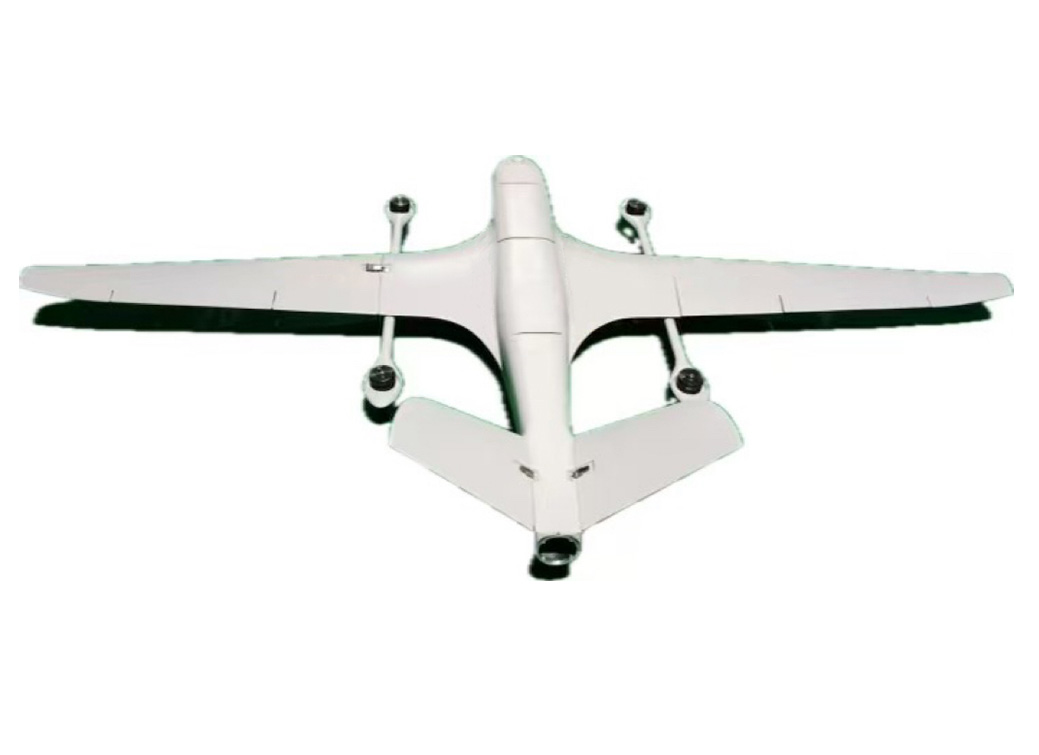
HY-V50 fixed-wing VTOL aircraft viewed from aboveHY-V50 fixed-wing VTOL aircraft viewed from above

Sinohawk Power HY-V50

The Sinohawk Power HY-V50 is a 50 kg-class vertical takeoff and landing fixed-wing UAV with a compound-wing layout. It combines four vertical-lift rotors, a high-aspect-ratio wing and piston forward propulsion. A quickly removable mission payload mounts beneath the nose, with a maximum mission payload of 3 kg.

Flight time
4h@15 kg.
Wingspan
3.8 m.

Get a free quote

Product overview

The Sinohawk Power HY-V50 combines a high-aspect-ratio, high-lift wing with a four-rotor system for vertical takeoff and landing. Two tail booms each carry two propeller propulsion systems. A horizontal tail spans the rear of the booms to provide longitudinal stability, while twin vertical tails provide directional stability. Two sets of outboard ailerons control lateral movement, and two elevators provide longitudinal control. Forward propulsion comes from a single electronically fuel-injected piston system with an integrated starter-generator.

Designed to carry interchangeable mission payloads, the HY-V50 positions its payload beneath the nose for quick removal and replacement. Its tricycle landing arrangement places the nose gear behind the payload, with the twin vertical tails also able to serve as rear landing gear. The aircraft measures 2.5 m long with a 3.8 m wingspan, a maximum takeoff weight of 50 kg and a maximum mission payload of 3 kg. Economical cruise speed is 100 km/h. Operating temperature extends from -20°C to 55°C, and drone hangar support is provided.

Specifications

Sichuan Hongying Dongli Keji Youxian Gongsi HY-V50 specifications
SpecificationValue & conditions
Product typeHY-V50 50 kg-class vertical takeoff and landing fixed-wing UAV.
Flight platform layoutCompound-wing.
Maximum takeoff weight50 kg.
Aircraft length2.5 m.
Wingspan3.8 m.
Maximum mission payload3 kg.
Flight time4h@15kg.At 15 kg.
Economical cruise speed100 km/h.
Service ceiling6500 m.
Drone hangar supportSupported.
Maximum takeoff altitude4500 m above sea level.
Wind resistanceLevel 6.
Operating temperature-20°C to 55°C.
Wing designHigh-aspect-ratio, high-lift wing layout.
Vertical lift systemTwo tail booms each carry two propeller propulsion systems, forming a four-rotor system for vertical takeoff and landing.
Tail arrangementA horizontal tail between the tail booms provides longitudinal stability; twin vertical tails beneath their rear ends provide directional stability.
Flight control surfacesTwo outboard aileron sets provide lateral control, and two elevators on the horizontal tail provide longitudinal control.
Mission payload mountingThe mission payload mounts beneath the nose for quick removal and replacement.
Landing gearTricycle landing gear places the nose gear behind the nose-mounted mission payload; the twin vertical tails can serve as rear landing gear.
Forward propulsion systemA single electronically fuel-injected piston propulsion system with an integrated starter-generator.