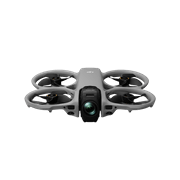
Product overview
DJI Avata 360 is a flight platform for panoramic aerial recording and immersive flying. Its approximately 455 g aircraft measures 246 × 199 × 55.5 mm and combines integrated propeller guards with two 1/1.1-inch square CMOS sensors. A single-axis mechanical pitch gimbal works alongside a panoramic virtual gimbal, providing distinct physical and virtual camera movement. Recording options include 8K panoramic video at up to 60fps and single-lens video, with 4:3 single-lens formats requiring Goggles 3/N3 and RC Motion 3 or FPV Remote Controller 3.
Control integration supports DJI RC 2, RC-N2 and RC-N3, or Goggles 3/N3 paired with RC Motion 3 or FPV Remote Controller 3. The aircraft incorporates 42GB of storage and O4+ video transmission. Aircraft sold in mainland China also incorporate an enhanced-transmission module using an IoT eSIM. That function operates only in mainland China, requires a supported conventional controller and depends on network coverage and operator requirements; Goggles 3/N3 cannot use it. The aircraft is not waterproof and does not support manual flight, ND filters or handheld shooting.
Maximum flight time is approximately 23 minutes, measured in a wind tunnel at equivalent sea level without wind, with obstacle avoidance set to Brake and the camera in photo mode, flying forward at 21.6 km/h until battery depletion and forced landing. Omnidirectional avoidance requires panoramic mode, textured surfaces and at least 1 lux; single-lens mode supports forward avoidance only. The charging hub supports three batteries simultaneously with a DJI 65W Portable Charger or DJI 100W Desktop Charger and at least 65 W charging power. Below 65 W, it charges batteries sequentially from highest to lowest remaining charge.
Specifications
| Specification | Value & conditions |
|---|---|
| Manufacturer | DJI |
| Model | DJI Avata 360 |
| Aircraft size and takeoff weight | Takeoff weight: approximately 455 g. Dimensions: length 246 mm, width 199 mm, height 55.5 mm. |
| Propeller protection | Integrated propeller guards. |
| Maximum vertical speeds | Ascent: 2/6/10 m/s. Descent: 1.5/6/10 m/s.Speeds correspond to Cine, Normal and Sport modes, respectively. |
| Maximum horizontal speed |
|
| Maximum takeoff altitude | 4500 m.Measured without wind after takeoff at 4500 m altitude, vertical ascent by 500 m and Sport-mode flight until 20% battery remained. |
| Maximum flight time | Approximately 23 minutes.Wind-tunnel measurement at equivalent sea level without wind; obstacle avoidance set to Brake, camera in photo mode, forward flight at 21.6 km/h until battery depletion and forced landing. |
| Maximum hover time | Approximately 22 minutes.No wind, hovering at sea level with obstacle avoidance set to Brake and camera in photo mode, until battery depletion and forced landing. |
| Maximum flight distance | 13.5 km.Wind-tunnel measurement at equivalent sea level without wind; obstacle avoidance set to Brake, camera in photo mode, forward flight at 39.6 km/h until battery depletion and forced landing. |
| Wind resistance, tilt and operating temperature | Maximum wind resistance: 10.7 m/s (force 5). Maximum tilt: 48°. Operating temperature: -10°C to 40°C. |
| Navigation and hovering accuracy | GPS + Galileo + BeiDou. Vertical accuracy: ±0.1 m with vision or ±0.5 m with satellite positioning. Horizontal accuracy: ±0.3 m with vision or ±1.5 m with satellite positioning.Hovering accuracy applies when the respective vision or satellite positioning system operates normally. |
| Onboard storage | 42GB. |
| Sensors and lenses | Two 1/1.1-inch square CMOS sensors, each with 64 million effective pixels. Lens FOV: 200°; equivalent focal length: 7.8 mm; actual focal length: 2.5 mm; aperture: f/1.9; fixed focus; focus range: 1.5 m to infinity. |
| Still photography |
|
| Recording resolutions | Panoramic 2:1: 7680 × 3840 (8K) or 6000 × 3000 (6K), each at 60/50/48/30/25/24fps. Single-lens 4K: 3840 × 2880 (4:3) or 3840 × 2160 (16:9), each at 60/50/48/30/25/24fps. Single-lens 2.7K: 2688 × 2016 (4:3) or 2688 × 1512 (16:9), each at 120/100/60/50/48/30/25/24fps.Single-lens 4:3 recording requires Goggles 3/N3 paired with RC Motion 3 or FPV Remote Controller 3. |
| Video formats, bitrate and color | OSV/MP4 (H.265); maximum bitrate: 180Mbps; Normal and D-Log M color modes. |
| Gimbal architecture and travel | Single-axis mechanical pitch gimbal and panoramic virtual gimbal. Mechanical design pitch range: -95° to 173°. Controllable mechanical pitch: -30° to 60° or -60° to 60°, depending on control equipment. Virtual pitch and roll: each -180° to 180°.Mechanical pitch control is -30° to 60° with RC 2/RC-N2/RC-N3, or -60° to 60° with Goggles 3/N3 paired with RC Motion 3 or FPV Remote Controller 3. |
| Sensing architecture and directional ranges |
|
| Obstacle-avoidance limitations | Omnidirectional avoidance is available only in 360° mode; single-lens mode supports forward avoidance only.Omnidirectional avoidance requires 360° mode, richly textured object surfaces and illumination of at least 1 lux. |
| Control equipment | Supports DJI RC 2, RC-N2 and RC-N3, or DJI Goggles 3/Goggles N3 paired with DJI RC Motion 3 or DJI FPV Remote Controller 3.Goggles 3/N3 require RC Motion 3 or FPV Remote Controller 3; those motion and FPV controllers require Goggles 3/N3. |
| Water resistance | Not waterproof; water exposure can damage the aircraft. |
| Unsupported camera functions | ND filters and handheld shooting are unsupported. |
| Manual flight | M mode/manual flight is unsupported. |
| Transmission system and live view | O4+. Single-lens live view: 1080p@100/60/50/48/30/25/24fps. Panoramic live view: 1080p@60/50/48/30/25/24fps.Single-lens 1080p/100fps transmission requires Goggles 3/N3 with RC Motion 3. |
| Maximum unobstructed communication distance |
|
| Communication distances with interference | Without obstructions: approximately 1.5–4 km with strong urban interference, 4–10 km with moderate suburban interference, or 10–20 km with low interference in remote suburbs/coastal areas. With low interference and building obstruction: approximately 0–0.7 km; with tree obstruction: approximately 0.7–4.5 km.FCC measurements under the stated interference and obstruction conditions. |
| Regional enhanced-transmission hardware | Mainland-China aircraft incorporate an enhanced-transmission module using an IoT eSIM.Aircraft sold in mainland China; enhanced transmission operates only in mainland China with RC 2/RC-N2/RC-N3, subject to operator coverage and requirements. Goggles 3/N3 do not support it. |
| Flight battery | Li-ion; capacity ≥2700 mAh; weight approximately 149 g; nominal voltage 14.32 V; charging voltage limit 17.2 V; energy ≥38.67 Wh; typical discharge rate 7C; charging temperature 5°C to 40°C.Discharge rate is typical; charging temperature is 5°C to 40°C. |
| Charging power and duration | Hub: maximum 100 W; one battery approximately 47 minutes from empty to full or 31 minutes from 10–90%; three batteries approximately 100 minutes from empty to full or 70 minutes from 10–90%. Aircraft charging: maximum 65 W; one battery approximately 73 minutes from empty to full or 51 minutes from 10–90%.Charging times measured at 25°C; higher ambient temperature or regional mains-voltage differences may increase charging time. |
| Charging hub electrical ratings and operation | Input: 5–20 V, up to 5 A. Power-accumulation output: maximum 60 W. Charging output: maximum 17.2 V. Supports simultaneous charging of up to three DJI Avata 360 Intelligent Flight Batteries.Simultaneous charging requires a DJI 65W Portable Charger or DJI 100W Desktop Charger and charging power of at least 65 W. Below 65 W, charging proceeds sequentially from the highest remaining battery charge to the lowest. |
Request a quote for DJI Avata 360
Send your application, destination country and expected quantity to the ChinaDrone team. We can discuss product selection, configuration and sourcing from China.
Submit your procurement requirements ↗No account needed. A model number is optional. Your enquiry is handled by ChinaDrone.