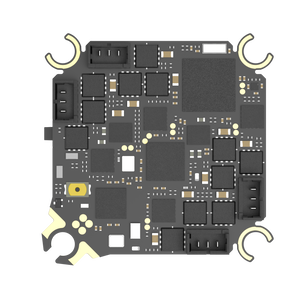
| Product | BETAFPV SuperX ELRS Gemini Xross Receiver |
|---|
| MCU | ESP32-C3 |
|---|
| Telemetry power | 20dBm |
|---|
| Input voltage | 5V |
|---|
| RF chips | Mono: Single LR1121; Nano: Dual LR1121SuperX Mono; SuperX Nano, respectively. |
|---|
| Reception mode | Mono: Single; Nano: Diversity/GeminiSuperX Mono; SuperX Nano, respectively. |
|---|
| Frequency bands | Mono: 900M/2.4G; Nano: 900M+2.4GSuperX Mono; SuperX Nano, respectively. |
|---|
| Antenna connectors | Mono: U.FL x1; Nano: U.FL x2SuperX Mono; SuperX Nano, respectively. |
|---|
| Weight | Mono: 0.82g; Nano: 1.45gSuperX Mono; SuperX Nano, respectively. |
|---|
| Dimensions | Mono: 12.3 x 18.6mm; Nano: 16.3 x 21.4mmSuperX Mono; SuperX Nano, respectively. |
|---|
| LUA names | Mono: BFPV SuperX Mon; Nano: BFPV SuperX NanSuperX Mono; SuperX Nano, respectively. |
|---|
| Recommended aircraft and applications | Mono: 2''- 5'' drones (racing, freestyle, long-range); Nano: 5'' + drones (freestyle, photography, long-range)SuperX Mono; SuperX Nano, respectively. |
|---|
| Modulation | LoRa, FSK |
|---|
| Packet rate | 1000HzFSK mode. |
|---|
| Gemini modes | 900M Gemini; 2.4G Gemini; 900M+2.4G GemX (simultaneous operation)SuperX Nano; GemX mode requires a dual-band TX. |
|---|
| Transmitter requirement | Requires a dual-band TX.GemX mode. |
|---|
| Band switching | Single LR1121 chip and dual-band antenna support switching between 900M and 2.4G.SuperX Mono. |
|---|
| Transmitter module compatibility | Micro, Micro V2, Nano V2 and SuperG TX modules |
|---|
| Band variants | Nano (ELRS 2.4G+915M); Nano (ELRS 2.4G+868M); Mono (ELRS 2.4G/915M) |
|---|
| Connector pin sequences | Betaflight: 5V (V+), GND, RX, TX; ExpressLRS: GND, 5V (V+), TX, RX.Terminal-wire connections using JST SH connectors. |
|---|
| Firmware | ExpressLRS V3.x official protocol, without a pre-set binding phraseDefault receiver firmware. |
|---|
| Transmitter firmware requirement | ExpressLRS V3.x or later firmware with no pre-set binding phraseBinding with the default receiver firmware. |
|---|
| Binding controls and indication | Enter binding mode with 3 power cycles at a 1-second interval or a 2-second BOOT-button hold; the RGB indicator flashes orange twice.Without a configured binding phrase. |
|---|
| Binding memory | Stores the binding phrase and device for automatic binding after restart.After initial binding. |
|---|
| Binding phrase requirement | Requires the same binding phrase on the transmitter module for automatic binding; the power-cycle/BOOT-button binding method does not apply.Firmware flashed with a configured binding phrase. |
|---|
| GPS interference precaution | Avoid a 1:2 telemetry ratio unless necessary to minimize GPS interference.Using 868MHz, X150 or LowBand packet rates, especially at 100mW telemetry power. |
|---|
| Receiver placement | Position the receiver as far as possible from the GPS and avoid pointing its antenna toward the GPS during satellite acquisition.Using MAVLink or a 1:2 telemetry ratio; during GPS satellite acquisition. |
|---|
| Supplied equipment | 1 SuperX Nano Receiver; 2 dual-band T antennas; 1 double-ended SH1.0 connector; 2 heat shrink tubes; 1 user manualSuperX Nano package. |
|---|
| Supplied equipment | 1 SuperX Mono Receiver; 1 dual-band T antenna; 1 single-ended SH1.0 connector; 2 heat shrink tubes; 1 user manualSuperX Mono package. |
|---|
| Antenna placement | Place the two antennas as far apart as possible for better reception.Two-antenna installation. |
|---|